Pest control in a commercial property should not begin when someone sees a cockroach, rat, fly, ant, or other pest. By that stage, the conditions supporting the infestation may already have existed for weeks or months. Modern commercial pest management therefore requires a more strategic approach.
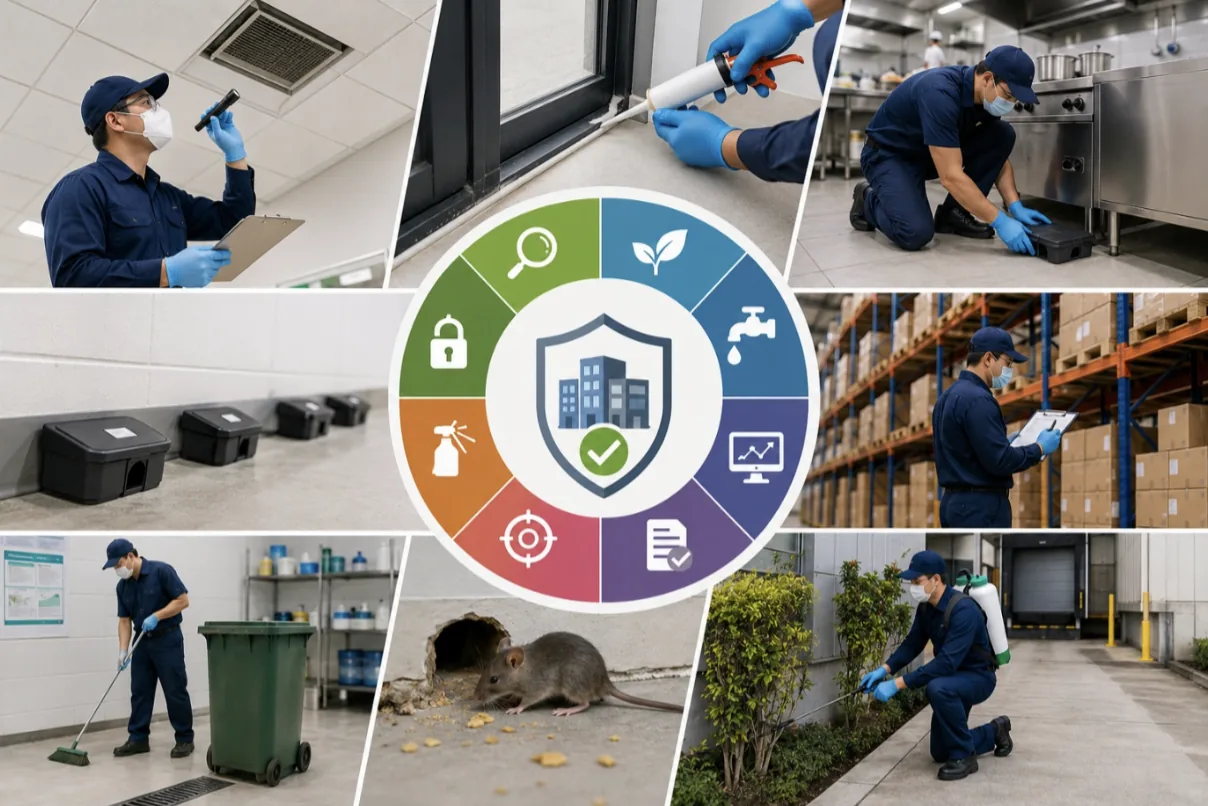
Integrated Pest Management (IPM) combines inspection, prevention, sanitation, structural pest proofing, monitoring, corrective action, and targeted treatment to manage pest risks while reducing unnecessary pesticide use. For offices, restaurants, hotels, hospitals, warehouses, retail stores, factories, educational institutions, and other commercial properties in Bangalore, an IPM program can help protect people, products, property, operations, and business reputation.
What Is Integrated Pest Management?
Integrated Pest Management, commonly called IPM, is a systematic approach to preventing and controlling pests. Instead of asking only "which chemical should we spray?", IPM asks why pests are here, how they are entering, where they are hiding, what food or water sources are supporting them, whether the problem can be prevented without pesticide application, and how to monitor whether the solution is working.
This changes pest control from a reactive treatment into a continuous risk-management program.
The Core IPM Process
A commercial IPM program can generally be structured as a cycle: inspection, identification, prevention, exclusion, sanitation, monitoring, corrective action, targeted treatment, documentation, and review. Each stage contributes to long-term pest prevention.
Why Commercial Properties Need IPM
Commercial properties often provide pests with everything they require: food, water, warmth, shelter, waste, storage, structural openings, and undisturbed areas. Businesses also have continuous movement of employees, customers, suppliers, delivery vehicles, raw materials, cartons, food, and waste.
These activities create numerous opportunities for pests to enter and spread. Professional commercial pest control services should therefore consider the complete property rather than treating individual pest sightings in isolation.
The Business Risks of Pest Infestations
Pest activity can create several types of business risk.
Health and Hygiene Risks
Cockroaches, rodents, flies, and other pests can contaminate environments and create sanitation concerns.
Inventory Damage
Rodents, termites, and stored-product pests can damage goods, packaging, furniture, and building materials.
Electrical Damage
Rodents may gnaw cables and electrical wiring.
Customer Experience
A visible pest can immediately affect how customers perceive a business.
Reputation Damage
Customers can post photographs and videos of pest sightings online within minutes.
Operational Disruption
Severe infestations may require emergency treatment, temporary closure of affected areas, product disposal, or extensive corrective work.
IPM aims to identify and reduce these risks before they become major incidents.
Step 1: Detailed Pest Inspection
Every strong IPM program begins with inspection. The technician should inspect areas such as kitchens, storage rooms, washrooms, drains, basements, false ceilings, electrical rooms, loading areas, waste-storage zones, building perimeter, gardens, and parking areas.
The inspection should identify both pests and the conditions supporting them.
Step 2: Correct Pest Identification
Correct identification is essential because different pests require different control strategies.
Cockroaches
May require sanitation improvement, monitoring, gel bait, exclusion, and targeted treatment.
Rodents
May require structural proofing, traps, monitoring stations, sanitation, and carefully planned control measures.
Mosquitoes
Require breeding-source identification and water management in addition to adult mosquito control.
Ants
Require identification of trails, entry points, and colonies.
Termites
Require specialised termite inspection and treatment methods.
Applying the same treatment to every pest is not IPM.
Step 3: Identify the Root Cause
A pest sighting is often only the symptom. Consider a repeated cockroach problem in a commercial kitchen. The underlying cause could be grease accumulation, drainage problems, hidden food residues, water leakage, or cracks around equipment.
Repeated spraying may temporarily reduce visible activity, but the infestation can return if these conditions remain. IPM asks: what is allowing this pest to survive here?
Step 4: Pest Exclusion
Exclusion means preventing pests from entering the building. This is one of the most important IPM strategies because it can provide long-term protection without relying on pesticides. Inspection should cover door gaps, windows, pipe openings, cable penetrations, drain openings, wall cracks, roof gaps, utility ducts, and loading doors.
Suitable corrective measures may include door sweeps, mesh, drain covers, or durable sealing materials.
Not sure what's causing the problem? Get a professional inspection before you decide on treatment.
Book Free Inspection Call NowStep 5: Sanitation
Sanitation removes the resources pests need. Commercial properties should control food by cleaning spills and protecting stored food, water by repairing leaks and eliminating standing water, waste by using suitable covered bins and removing waste regularly, and harbourage by reducing unnecessary clutter, cardboard, and unused materials.
Even a well-designed pesticide program can struggle if pests have continuous access to food and water. See our guide on Sanitation Best Practices for Commercial Pest Prevention for a fuller breakdown.
Step 6: Pest Monitoring
Monitoring is one of the major differences between IPM and purely reactive pest control. Rather than waiting for someone to see a pest, monitoring devices help detect activity earlier. Depending on the pest and site, these may include rodent monitoring stations, mechanical traps, cockroach monitoring traps, flying-insect monitoring devices, and pest-sighting registers.
Monitoring allows businesses to measure whether pest activity is increasing or decreasing.
Creating a Pest Monitoring Map
Larger commercial properties can number monitoring devices, for example R01 – Main Entrance, R02 – Loading Dock, R03 – Kitchen Exterior, R04 – Waste Area, and R05 – Basement. Each device is shown on a site map, and during every inspection the technician records activity. Over time, this information can reveal pest hotspots.
Step 7: Establish Action Thresholds
Not every pest observation requires the same response. An IPM program can establish action thresholds based on pest species, property type, location, risk level, and monitoring results.
For example, pest tolerance in a hospital ICU or food-processing room may be extremely low compared with some exterior areas. The appropriate response should therefore be based on risk.
Step 8: Corrective Action
When pest activity is detected, the underlying condition should be investigated. For example: an observation of repeated rodent activity near the loading dock, an inspection finding of a gap below the shutter door, a corrective action of repairing the door seal, a pest-management action of increasing monitoring and implementing appropriate rodent-control measures, and a follow-up to confirm activity has stopped.
This is significantly stronger than repeatedly replacing bait without repairing the opening.
Step 9: Targeted Treatment
Chemical treatment still has an important role in IPM when required. However, it should be targeted and justified. Treatment selection should consider pest species, infestation level, location, occupancy, sensitive materials, food handling, product label, and applicable safety requirements.
The objective is to use the appropriate treatment, in the appropriate place, at the appropriate time.
Step 10: Documentation
Commercial IPM programs should be documented. Depending on the business, records may include the pest-control contract, scope of work, service schedule, technician service reports, pest-sighting register, monitoring-device map, monitoring records, treatment records, product information, corrective-action reports, follow-up reports, and trend analysis.
Documentation helps transform pest control into a measurable management process — see our guide on Documentation in Commercial Pest Control for how to structure these records.
Pest Trend Analysis
One monitoring result provides information. Several months of monitoring provide intelligence. Consider this example:
| Monitoring Point | Month 1 | Month 2 | Month 3 |
|---|---|---|---|
| R01 | 0 | 0 | 0 |
| R02 | 1 | 3 | 6 |
| R03 | 0 | 0 | 0 |
| R04 | 1 | 0 | 0 |
The increasing activity around R02 indicates a developing problem. Management can investigate before the infestation spreads. Possible causes include a structural opening, a food source, waste accumulation, a drain connection, or an exterior burrow. This is the strategic value of IPM.
IPM Across Commercial Property Types
Food businesses such as restaurants and commercial kitchens require particularly strong pest prevention because pest activity can affect food safety — IPM there should focus on kitchen sanitation, drain management, cockroach monitoring, rodent monitoring, fly prevention, waste management, and structural proofing.
Hotels require pest management across guest rooms, kitchens, restaurants, banquet halls, laundry areas, basements, gardens, and waste areas, with bed bug detection and guest-room inspection especially important.
Healthcare properties require particularly careful risk-based pest management across sensitive areas such as the ICU, NICU, operation theatres, patient rooms, laboratories, and pharmacies, with prevention, monitoring, and non-chemical controls receiving strong emphasis.
Warehouses benefit significantly from monitoring and exclusion, with particular attention to loading docks, shutter doors, storage racks, incoming goods, false ceilings, and exterior perimeter.
Retail pest management should protect both inventory and customer experience, with monitoring covering sales areas, storage rooms, food sections, loading areas, staff pantries, and waste areas.
Ready to get this sorted? Ask us about a structured, documented treatment plan.
Book Free Inspection WhatsApp UsIPM for Office Buildings
Office buildings can experience cockroaches in pantries, ants around food areas, rodents in false ceilings, mosquitoes around landscaping, and termites affecting wooden structures. An office IPM program should coordinate pest management with housekeeping and facility maintenance — for example, repeated cockroach activity in a pantry may require sanitation and plumbing corrections rather than additional spraying.
IPM for Manufacturing Facilities
Factories and manufacturing facilities often have large and complex pest-risk environments, including raw-material storage, finished-goods storage, production areas, utility rooms, loading bays, staff cafeterias, waste areas, and exterior perimeter. A risk-zone approach can help prioritise inspection and monitoring.
Creating Pest Risk Zones
Large commercial properties can divide the premises into risk categories: critical risk for food production, healthcare-sensitive areas, or other highly controlled environments; high risk for kitchens, food storage, loading areas, and waste zones; medium risk for general storage, offices, corridors, and staff areas; and exterior risk for gardens, drains, parking, garbage areas, and building perimeter.
Inspection and monitoring frequency can then be adjusted according to risk.
The Role of Employees in IPM
Pest control should not be the responsibility of the pest-control technician alone. Employees can help identify problems early. Staff should know how to report cockroach sightings, rodent droppings, gnaw marks, ant trails, flies, water leaks, damaged doors, and structural openings — a simple reporting process can follow the flow of date, location, pest or issue, reported by, action, follow-up, and closure. See our guide on Employee Training for Pest Awareness in the Workplace for how to build this into a pest-smart team.
Pest Control and Facility Management Should Work Together
Some of the strongest pest-control solutions are maintenance actions. For example: a pest-control finding of rodent entry through a pipe opening leads to a facility action of sealing the opening; a finding of cockroach activity near a leaking sink leads to repairing the plumbing; and a finding of mosquito breeding in standing water leads to correcting the drainage. This cooperation is fundamental to successful IPM.
Preventive Pest Control vs Reactive Pest Control
Reactive pest control follows a simple pattern: a pest appears, a complaint is raised, a chemical treatment is applied, and everyone waits for the next complaint. Integrated Pest Management instead follows a cycle of inspecting, preventing, monitoring, detecting, correcting, treating if necessary, and verifying. The second approach is far better suited to businesses that want predictable pest-management performance.
Business Benefits of IPM
Reduced Pest Activity
Preventive actions address the conditions supporting infestations.
Early Detection
Monitoring identifies problems before they become severe.
Reduced Dependence on Pesticides
Exclusion, sanitation, and monitoring can reduce unnecessary treatments.
Better Documentation
Businesses can track pest activity and corrective actions.
Improved Audit Readiness
Organised records support internal and external hygiene-management processes.
Inventory Protection
Rodent, termite, and stored-product pest risks can be identified earlier.
Better Customer Experience
Reducing visible pest activity helps protect customer confidence.
Reputation Protection
Preventive pest management can reduce the likelihood of pest incidents becoming negative online reviews.
Commercial IPM Checklist
- Conduct a detailed site inspection
- Identify pest species correctly
- Map high-risk areas
- Seal pest entry points
- Repair water leaks
- Improve sanitation
- Manage waste properly
- Reduce unnecessary clutter
- Install appropriate monitoring devices
- Number and map monitoring points
- Maintain a pest-sighting register
- Establish action thresholds
- Record corrective actions
- Use targeted treatments where necessary
- Maintain treatment documentation
- Review pest trends regularly
- Verify whether corrective actions worked
Professional IPM Services in Bangalore
Standard Pest Control provides commercial pest-management solutions for businesses in Bangalore using a structured, preventive approach. IPM programs can be customised for restaurants, hotels, hospitals, warehouses, retail stores, shopping malls, offices, factories, commercial kitchens, educational institutions, and industrial facilities. Before signing an AMC, see our guide on Choosing a Commercial Pest Control Provider for what to check.
Our approach focuses on inspection, prevention, exclusion, monitoring, corrective action, targeted treatment, and documentation. Explore our related pest-control services: Cockroach Pest Control Bangalore, Rodent Pest Control Bangalore, Mosquito Pest Control Bangalore, Ant Pest Control Bangalore, Termite Control Bangalore, and Bed Bug Control Bangalore.
Frequently Asked Questions
What does IPM mean in pest control?
IPM stands for Integrated Pest Management. It combines inspection, prevention, sanitation, structural exclusion, monitoring, corrective action, and targeted pest-control treatments.
Is IPM only for food businesses?
No. IPM can be used in restaurants, hospitals, hotels, warehouses, offices, retail stores, factories, schools, residential communities, and many other environments.
Does IPM completely avoid pesticides?
Not necessarily. IPM aims to reduce unnecessary pesticide use. When chemical treatment is required, it is selected and applied in a targeted manner according to the pest and site conditions.
Why is pest monitoring important?
Monitoring helps detect pest activity early and provides data that can be used to identify trends and hotspots.
What is a pest-monitoring map?
It is a site plan showing the location and identification number of pest-monitoring devices such as rodent stations or insect monitors.
Is IPM better than routine spraying?
For long-term commercial pest management, IPM provides a more comprehensive approach because it addresses pest entry, food, water, harbourage, sanitation, and monitoring, not only visible pests.
Can IPM help during audits?
A properly documented IPM program can provide useful evidence of inspections, monitoring, treatments, corrective actions, and ongoing pest-risk management.
Conclusion
IPM for commercial properties is not simply a pest-control technique — it is a business-protection strategy. Instead of repeatedly asking what should we spray, businesses should ask why this pest is here, how it can be prevented, and how the problem can be proven to be under control.
That shift transforms pest control from an emergency expense into a structured risk-management program. By combining inspection, pest proofing, sanitation, monitoring, corrective action, targeted treatment, documentation, and trend analysis, commercial properties can better protect people, products, property, operations, customers, and reputation.
For businesses in Bangalore, a professionally managed IPM program provides a strategic and preventive approach to long-term pest protection.
Related reading: Documentation in Commercial Pest Control: Why Records Matter | Choosing a Commercial Pest Control Provider: What to Look For | Sanitation Best Practices for Commercial Pest Prevention | Employee Training for Pest Awareness in the Workplace: Building a Pest-Smart Team | Pest Control Regulations: What Homeowners and Businesses Need to Know | HACCP and Pest Control: Ensuring Food Safety Compliance | Pest Control for Restaurants: Maintaining Health Code Compliance | Pest Control for Sports Facilities: Stadiums and Arenas | Pest Control for Zoos and Animal Facilities: Specialized Care | Pest Control for Green Buildings: Sustainable Solutions