Professional pest control is important for every commercial property, but technicians cannot be present at a workplace every hour of every day.
Employees are.
Security staff may notice a rat near the loading area. Housekeeping may find cockroach activity below a sink. Kitchen staff may see flies near a drain. Warehouse employees may discover damaged cartons or rodent droppings. Maintenance teams may notice gaps around pipes, leaking taps or damaged doors that can contribute to pest activity.
This makes employee pest-awareness training an important part of a successful commercial Integrated Pest Management (IPM) program.
For restaurants, hotels, hospitals, warehouses, offices, retail stores, factories and other businesses in Bangalore, trained employees can become an effective early-warning system for pest problems.
Why Employees Matter in Pest Management
Pest control should not be considered the responsibility of the pest-control company alone. A successful program involves: Management, Employees, Housekeeping, Maintenance and the Pest Control Provider working together.
Employees work throughout the property every day. They are often the first people to notice changes that may indicate pest activity. Early reporting can allow a small problem to be investigated before it develops into a major infestation.
What Is Pest Awareness Training?
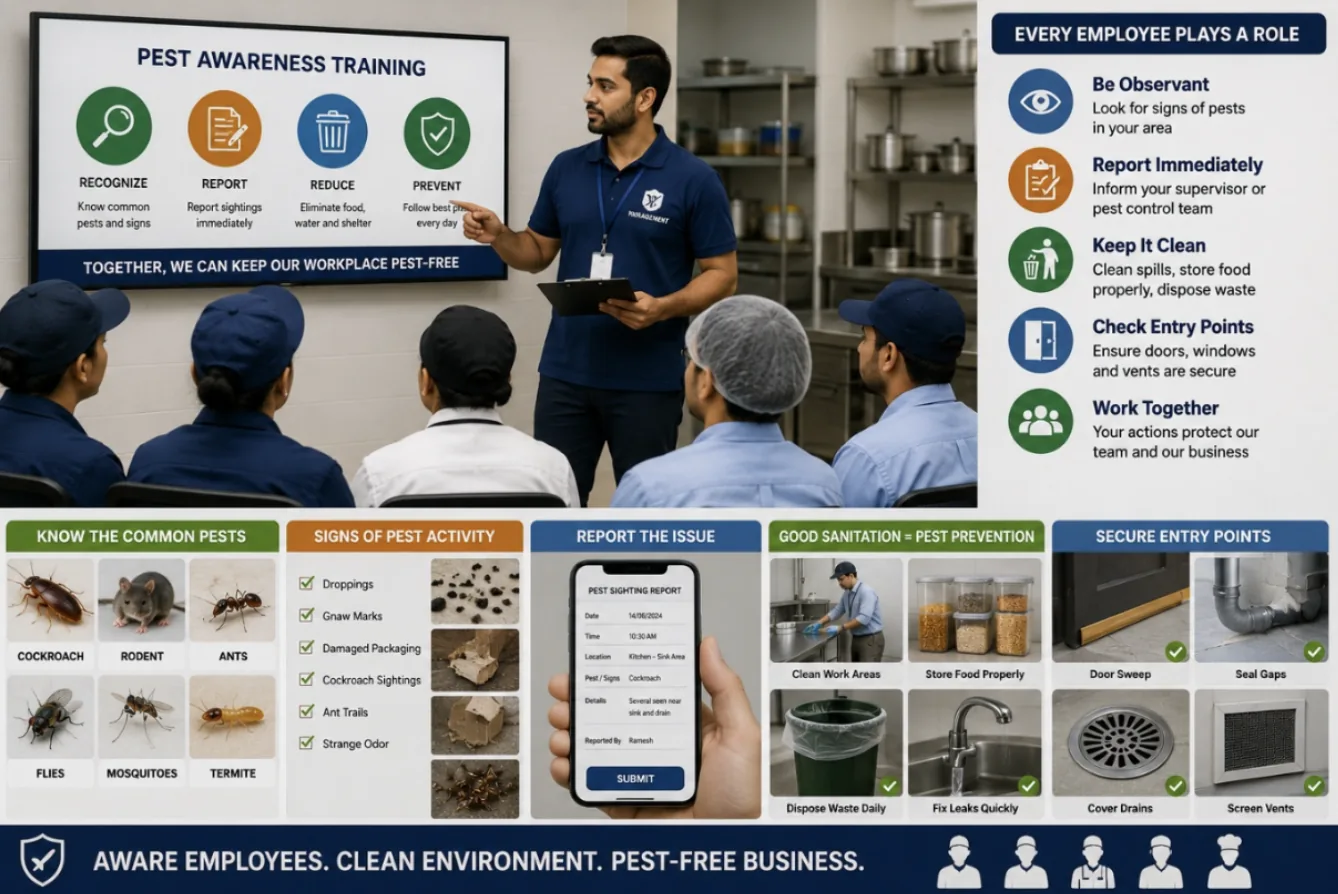
Pest-awareness training teaches employees how to:
- Recognise common workplace pests
- Identify signs of pest activity
- Understand what attracts pests
- Report sightings correctly
- Maintain good sanitation practices
- Reduce food and water sources
- Identify potential entry points
- Avoid unsafe DIY pest-control practices
- Support the company's IPM program
Employees do not need to become pest-control technicians. Their role is primarily: Observe → Report → Prevent. The professional pest-control team can then: Inspect → Identify → Correct → Treat → Monitor → Verify.
Why Pest Awareness Training Is Important
1. Early Pest Detection
A single cockroach sighting may indicate activity in a hidden area. Fresh rodent droppings may indicate a new entry point. A few flies around a drain may indicate an emerging sanitation or drainage problem. When employees understand these warning signs, they are more likely to report them quickly.
2. Faster Corrective Action
Without a reporting system, employees may simply ignore pest sightings. For example: Monday, an employee sees a rodent near the loading dock. Wednesday, another employee sees rodent droppings. Friday, stock packaging is damaged.
If the first sighting had been reported immediately, the pest-control team could have inspected the area earlier.
3. Better Sanitation
Employees play an important role in controlling the food and water sources pests need. Training can reinforce simple practices such as:
- Cleaning food spills promptly
- Keeping food properly stored
- Closing waste containers
- Removing waste regularly
- Reporting leaking taps
- Keeping storage areas organised
- Avoiding unnecessary cardboard accumulation
These everyday actions can significantly support pest prevention.
4. Better Communication
Commercial pest management often fails when information does not reach the right people. For example: a kitchen employee sees a cockroach, does not report it, the pest-control technician visits one week later, and the technician does not know where activity occurred.
A better system is: Employee sees cockroach → Records exact location → Supervisor informed → Pest-control provider notified → Area inspected → Corrective action recorded.
Communication turns individual observations into useful pest-management information.
Common Workplace Pests Employees Should Recognise
Employees should receive basic awareness about the pests most relevant to their workplace.
Cockroaches
Employees should report:
- Live cockroaches
- Dead cockroaches
- Egg cases
- Droppings
- Repeated activity around equipment
- Unusual cockroach activity during daytime
High-risk areas include kitchens, pantries, drains, washrooms, storage rooms and electrical equipment. Learn more: Cockroach Pest Control Bangalore.
Rodents
Employees should learn to recognise signs such as:
- Rat or mouse sightings
- Droppings
- Gnaw marks
- Damaged packaging
- Scratching sounds
- Grease marks
- Burrows
- Damaged wiring
Rodent signs should be reported promptly. Learn more: Rodent Pest Control Bangalore.
Flies
Employees should report unusual fly activity, particularly around food-preparation areas, drains, garbage, waste rooms, loading areas and organic residues. Repeated fly activity may indicate a breeding source that requires investigation.
Ants
Employees should avoid repeatedly wiping away ant trails without reporting them. The trail may help the pest-control technician identify where ants are entering. Report:
- Ant trails
- Concentrated activity
- Ants around food
- Entry through wall or floor gaps
Learn more about Ant Pest Control Bangalore.
Bed Bugs
Hotels, hostels and accommodation facilities should provide specific bed bug awareness training. Employees should recognise signs such as:
- Live bed bugs
- Dark spotting around mattress seams
- Shed skins
- Guest reports of suspected bites or sightings
Housekeeping teams can be particularly valuable for early detection. Learn more: Bed Bug Control Bangalore.
Termites
Employees and maintenance teams should report:
- Mud tubes
- Damaged wood
- Hollow-sounding wood
- Discarded wings
- Unusual damage to wooden fixtures
Early detection can help reduce structural and furniture damage. Learn more: Termite Control Bangalore.
Teach Employees What Attracts Pests
Employees should understand the basic pest-survival triangle:
- Food — Spills, crumbs, uncovered food, damaged packaging and waste.
- Water — Leaks, condensation, standing water and poorly maintained drains.
- Shelter — Clutter, cardboard, false ceilings, structural gaps and unused storage.
Remove these conditions and the property becomes less attractive to pests.
Create a Simple Pest Reporting System
Employees should know exactly what to do when they see pest activity. A simple system can use: Date → Time → Location → Pest/Sign → Employee → Action. For example:
| Date | Location | Observation | Action |
|---|---|---|---|
| 12 Aug | Pantry | Cockroach sighting | Supervisor informed |
| 13 Aug | Loading Bay 2 | Rodent droppings | Pest team notified |
| 14 Aug | Kitchen Drain | High fly activity | Drain inspection requested |
This information can become part of the property's pest-sighting register.
Be Specific About Location
Employees should avoid reports such as "there is a rat somewhere in the warehouse."
A more useful report is "rodent seen at approximately 7:30 PM behind Rack B12 near Loading Bay 3."
Specific information helps technicians investigate entry points, nearby food sources, harbourage, monitoring devices and structural gaps. Better reporting leads to better pest-control decisions.
Encourage Photographic Evidence Where Safe
Where company policy permits and it can be done safely, employees may photograph pest sightings, droppings, damaged packaging, gnaw marks, structural gaps, standing water and damaged drain covers.
Photographs can help pest-control technicians understand the situation even when the pest is no longer visible during the inspection. Employees should never put themselves at risk simply to obtain a photograph.
Want your staff trained to spot pest problems early? Ask us about employee pest-awareness training as part of your commercial pest-management program.
Book Free Inspection Call NowEmployees Should Not Use Unapproved Pest-Control Products
One important training topic is what employees should not do. Staff should generally avoid independently applying:
- Household insect sprays
- Unapproved pesticides
- Rodent poison
- Unknown chemicals
- Unauthorised pest-control products
Uncoordinated pesticide application can create unnecessary safety risks and may interfere with professional pest-management programs. Pest sightings should instead be reported through the approved process.
Never Move Pest Monitoring Devices
Employees should be instructed not to move or interfere with pest-monitoring equipment, including rodent stations, mechanical traps, cockroach monitors and flying-insect monitoring devices.
Devices may be positioned according to a monitoring plan. Moving them can affect both pest-control performance and documentation.
Training Housekeeping Staff
Housekeeping teams are among the most important participants in pest prevention. Training should cover food-spill removal, waste management, drain cleaning, under-equipment cleaning, reporting pest signs, reporting water leaks, reducing clutter and avoiding movement of pest monitors.
Housekeeping employees frequently work in areas where early pest signs may first appear.
Training Kitchen Staff
Restaurant, hotel and commercial-kitchen teams should receive specific pest-awareness training. They should monitor food spills, grease buildup, drains, under-equipment areas, dry storage, waste areas and deliveries.
Employees should immediately report cockroach, rodent or unusual fly activity.
Training Warehouse Employees
Warehouse staff should be trained to inspect for rodent droppings, gnaw marks, damaged cartons, stored-product insects, pest-contaminated incoming goods, shutter gaps, damaged doors and exterior pest activity.
Receiving teams are particularly important because pests may enter with deliveries.
Training Hotel Employees
Different hotel departments encounter different pest risks:
- Housekeeping — Bed bugs and guest-room pest activity.
- Kitchen — Cockroaches, rodents and flies.
- Engineering — Structural gaps, leaks and drains.
- Security — Exterior rodent activity.
- Front Office — Guest pest complaints.
This information should eventually reach one central pest-management reporting system.
Training Healthcare Employees
Healthcare pest-awareness training should focus heavily on rapid reporting and safe procedures. Staff should not independently apply pest-control chemicals in sensitive areas.
Pest sightings should be reported through the facility's established process so that treatment can be properly assessed and coordinated.
Training Retail Employees
Retail staff should look for damaged stock, rodent signs, cockroach activity, ant trails, flies and pest activity in incoming deliveries. Food retailers and supermarkets require particular attention.
Maintenance Teams Are Essential to Pest Prevention
Many pest-control recommendations require maintenance work rather than pesticide treatment. For example:
Finding: rodent gap beneath door. Maintenance action: install appropriate door seal.
Finding: cockroach activity around leaking pipe. Action: repair leak.
Finding: mosquito breeding caused by standing water. Action: correct drainage — see our full guide on eliminating standing water for exactly what to look for.
Finding: pest entry around cable penetration. Action: seal opening.
This connection between pest control and maintenance is a fundamental part of IPM.
Running a restaurant, hotel, warehouse or office? Get a professional inspection and a tailored commercial pest-control plan.
Book Free Inspection WhatsApp UsTrain Security Staff
Security personnel often work when commercial properties are quieter and pest activity may be easier to observe. They can be trained to report rodents around the perimeter, burrows, open doors, damaged shutters, waste problems and night-time pest activity.
Their observations can provide valuable information to the pest-control team.
Pest Awareness During Employee Induction
Basic pest awareness can be included in new-employee induction for high-risk businesses. A short session can cover:
- Why pest prevention matters.
- Common pests at the property.
- Signs employees should recognise.
- How to report pest activity.
- What employees should not do.
- Basic sanitation responsibilities.
This helps establish good habits from the beginning.
Refresher Training
Pest-awareness training should not necessarily be a one-time activity. Periodic refresher training may be useful, especially when pest activity increases, new employees join, processes change, a new facility opens, recurring sanitation problems occur or audit findings identify weaknesses.
Short, focused refresher sessions can often be more effective than lengthy presentations.
Use Real Examples From Your Property
Generic pest photographs can help, but actual site examples can make training more relevant. For example:
Photo: gap beneath warehouse shutter. Lesson: possible rodent entry point.
Photo: food debris beneath kitchen equipment. Lesson: cockroach food source.
Photo: standing water near drain. Lesson: potential mosquito breeding condition.
Employees can then understand exactly what they should look for in their own workplace.
Measure Whether Training Is Working
Training should lead to behavioural improvement. Management can track indicators such as the number of useful pest reports, speed of reporting, repeat sanitation findings, unresolved structural issues, pest activity trends and corrective-action closure rates.
The objective is not simply to say "training completed." The objective is: "did workplace pest prevention improve?"
Employee Pest Awareness and IPM
Employee involvement fits naturally into Integrated Pest Management. A strong IPM cycle becomes: Employee observes → Reports → Technician inspects → Root cause identified → Corrective action completed → Treatment if required → Monitoring → Verification.
Without employee participation, pest activity may remain unnoticed between scheduled service visits.
Workplace Pest Awareness Training Checklist
Employees should understand:
- Common pests found at the property
- Basic signs of pest activity
- Where pests commonly hide
- What attracts pests
- How to report a pest sighting
- Why exact location matters
- Importance of sanitation
- Importance of reporting leaks
- Importance of keeping doors closed
- Why structural gaps should be reported
- Why monitoring devices should not be moved
- Why unauthorised pesticides should not be used
- Who to contact when pest activity is observed
- How corrective actions are followed up
Benefits of Employee Pest Awareness Training
- Earlier Detection — Employees can identify warning signs between professional inspections.
- Faster Response — Accurate reports help technicians investigate problems quickly.
- Better Sanitation — Staff understand how their daily activities affect pest pressure.
- Improved IPM — Employee observations provide additional information for pest monitoring.
- Better Documentation — Pest sightings can be recorded and analysed.
- Reduced Recurrence — Employees can help identify leaks, gaps, waste and other contributing conditions.
- Better Business Protection — Preventing infestations helps protect people, products, property and reputation.
Professional Commercial Pest Management in Bangalore
Standard Pest Control provides commercial pest-management solutions for businesses across Bangalore. Programs can be customised for restaurants, hotels, hospitals, warehouses, retail stores, shopping malls, offices, factories, food-processing facilities, commercial kitchens and educational institutions.
Our commercial approach focuses on: Inspection → Prevention → Employee Awareness → Monitoring → Corrective Action → Targeted Treatment → Documentation → Verification.
Explore related services: Cockroach Pest Control Bangalore, Rodent Pest Control Bangalore, Mosquito Pest Control Bangalore, Ant Pest Control Bangalore, Termite Control Bangalore and Bed Bug Control Bangalore.
Frequently Asked Questions
Why should employees receive pest-awareness training?
Employees are present between scheduled pest-control visits and may be the first people to notice pest activity. Early reporting allows problems to be investigated sooner.
Should employees perform pest-control treatments?
Generally, pest treatment should be handled through the organisation's approved pest-management process by appropriately trained personnel. Employees should focus on recognising, reporting and preventing pest conditions.
What should employees report?
They should report live or dead pests, droppings, gnaw marks, damaged packaging, unusual fly activity, ant trails, structural gaps, leaks and other potential pest-related conditions.
What information should be included in a pest report?
The date, time, exact location, pest or evidence observed and any useful photograph or description should be recorded.
Should employees move rodent stations?
No. Monitoring devices should remain in their designated locations unless authorised personnel need to reposition them.
How often should pest-awareness training be provided?
Frequency should be based on the property's risk, employee turnover and pest-management requirements. Refresher training is particularly useful after recurring problems or operational changes.
Is employee training part of IPM?
Yes. Employee awareness supports IPM by improving early detection, sanitation, reporting and corrective action.
Your Employees Are Your Pest-Control Early-Warning System
Your employees can be one of your most valuable pest-monitoring resources.
A pest-control technician may visit a commercial property weekly, fortnightly or monthly—but employees observe the workplace every day.
Training them to recognise pest warning signs and report them correctly creates a powerful early-warning system: See it → Report it → Record it → Investigate it → Correct it → Verify it.
When employee awareness is combined with professional pest control, sanitation, exclusion, monitoring, documentation and facility maintenance, businesses can move from reactive pest treatment to proactive pest prevention.
For commercial properties in Bangalore, building a pest-aware workforce is a practical step toward protecting employees, customers, inventory, facilities and business reputation. Explore Standard Pest Control for professional commercial pest-management services.
Related reading: Pest Control Regulations: What Homeowners and Businesses Need to Know | Pest Control Careers: What It Takes to Be a Professional Exterminator | Why Choose Standard Pest Control in Bangalore | Why Follow-Up Treatment Is Necessary | The Role of Research in Advancing Pest Control Solutions | IPM for Commercial Properties: A Strategic Approach to Business Protection | Pest Control for Libraries: Protecting Books and Documents | Pest Control for Zoos and Animal Facilities: Specialized Care | Pest Control for Historic Properties: Preservation Challenges | Pest Control for Gyms and Fitness Centres: Hygiene and Health