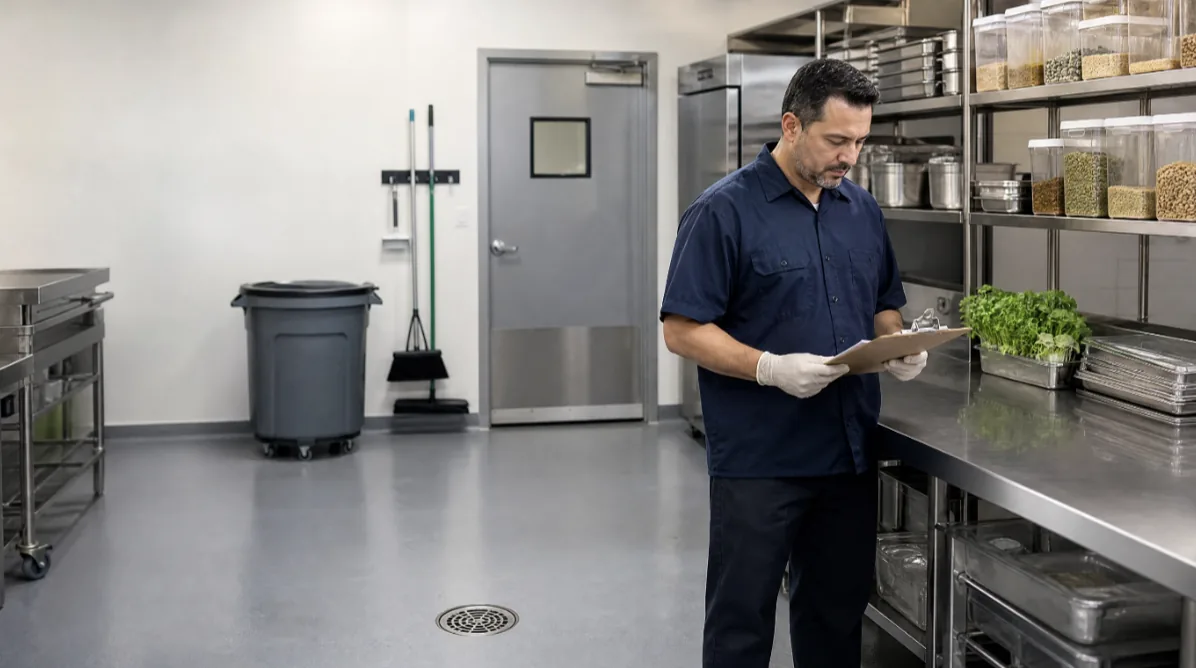
A clean commercial facility is not automatically pest-proof, but effective sanitation makes the environment far less attractive to rodents, cockroaches, flies, stored-product pests, and other unwanted visitors. Food residue, standing water, overflowing waste containers, clutter, and hard-to-clean areas can provide the essentials pests need: food, water, and shelter.
That is why sanitation should be treated as a preventive operating system, not an occasional deep-cleaning project. Integrated pest management (IPM) is a science-based approach that combines prevention, monitoring, identification, thresholds, control measures, and evaluation. Its practical summary is straightforward: do not attract pests, keep them out, and use the safest effective method when they are confirmed.
Prevention comes before control in the IPM sequence. Pesticides may have a role, but they should be selected according to the pest, the situation, and the level of risk rather than used as a substitute for correcting sanitation or building-maintenance problems. Businesses evaluating a commercial pest control provider should look for one that treats sanitation and IPM as central to its program, not an afterthought.
1. Remove Food Sources Quickly and Consistently
Pests are often drawn to small, repeated food opportunities rather than a single dramatic spill. Crumbs beneath equipment, grease along a wall, residue inside drains, open ingredient bags, and food waste left overnight can sustain an infestation even when visible surfaces appear clean.
Commercial facilities should establish cleaning procedures that address both high-traffic surfaces and hidden accumulation points. Clean food-contact and preparation areas according to the facility's applicable sanitation procedures, then pay particular attention to floors, corners, equipment legs, casters, wall-floor junctions, shelving, and the spaces beneath and behind appliances.
Spills should be cleaned as soon as they occur. Dry ingredients should be swept or vacuumed rather than pushed into cracks or under equipment. At closing, employees should confirm that production, dining, receiving, and storage areas are free of exposed food and residue. A simple sign-off routine is often more reliable than relying on memory.
Practical Food-Source Controls
| Risk area | Preventive practice | Verification question |
|---|---|---|
| Food preparation | Remove residue from work surfaces, equipment, and floor edges after each shift | Can employees see or feel grease, crumbs, or sticky residue? |
| Dry goods | Keep ingredients in clean, sealed, pest-resistant containers and rotate stock | Are packages intact, labeled, and stored off the floor? |
| Receiving | Inspect deliveries for damaged packaging, moisture, webbing, droppings, or live insects | Is questionable stock isolated and reported before it enters storage? |
| Break rooms | Empty small waste bins frequently and clean around vending machines and appliances | Are food and drink stored only in designated areas? |
| Storage | Maintain visible inspection space around walls, corners, and shelving | Can staff inspect the entire perimeter without moving clutter? |
2. Control Moisture and Standing Water
Water can be as important as food in sustaining pest activity. Leaking pipes, dripping faucets, condensation, wet mops, clogged floor drains, and damp cardboard can create favorable conditions even when a facility has strong cleaning habits.
Inspect plumbing fixtures, refrigeration equipment, ice machines, dishwashing areas, roof penetrations, and exterior drainage on a regular schedule. Repair leaks promptly and document work orders until they are closed. Keep mop heads and cleaning tools clean, wrung out, and stored so they can dry. Do not leave buckets filled with water after use.
Floor drains deserve special attention. They can collect organic material and moisture, and their surrounding areas may be difficult to clean. Use the facility's approved drain-cleaning process, maintain drain covers and grates, and report slow drainage or recurring odors before they become persistent sanitation issues.
Need help identifying sanitation risks? Get a documented, IPM-based commercial pest prevention plan from Standard Pest Control.
Book Free Inspection Call Now3. Manage Garbage and Recycling Correctly
Waste-handling practices strongly influence pest pressure, and a poorly managed garbage area can quickly attract rodents. Place garbage and recycling in containers that are durable, cleanable, and kept closed when not in use. Use liners where appropriate, avoid overfilling, and remove waste on a schedule based on the facility's volume and risk rather than waiting until containers are full.
Clean the inside and outside of waste containers when residue or odors are present. Keep dumpsters and compactors as far from building entrances and service doors as the site layout permits, and maintain the surrounding pavement or pad so spills can be removed promptly. Cardboard should be flattened and moved out of receiving and storage areas without delay, because it can conceal pests and provide harborage.
A designated employee should inspect the waste area during each operating day. That inspection should look for leaking bags, food residue, pooled water, damaged lids, overflowing containers, and pest evidence around the perimeter.
4. Eliminate Clutter and Hidden Harborage
Pests prefer protected, undisturbed places. Unused boxes, excess packaging, spare parts, abandoned equipment, stacked pallets, and dense storage can create harborage and make inspection difficult.
Use a clear-storage standard: keep products organized, maintain separation from walls where possible, and preserve enough access to inspect floors, corners, and shelving. Remove unnecessary materials instead of allowing them to accumulate "temporarily." In exterior areas, trim vegetation away from the building, reduce debris near walls, and prevent stored materials from creating concealed entry routes.
Good housekeeping also improves response time. When employees can see walls, floors, drains, and equipment bases, they are more likely to notice droppings, gnaw marks, shed skins, live insects, unusual odors, or damaged packaging at an early stage.
5. Keep Pests Outside Through Exclusion
Sanitation reduces the resources that attract pests, while exclusion reduces the opportunities that allow them inside. Inspect doors, windows, vents, utility penetrations, loading docks, roof lines, and foundation-level openings. Repair torn screens, replace damaged door sweeps, seal gaps around pipes and conduits, and keep doors closed except when in active use.
Loading docks and receiving areas require special discipline. Keep dock doors closed when possible, inspect incoming goods, and avoid leaving pallets or deliveries in place longer than necessary. Exterior lighting can also influence flying-insect activity; where appropriate, facilities can review fixture placement and maintenance with a qualified professional.
Exclusion work should be assigned, tracked, and verified. A note that says "seal hole" is less useful than a work order specifying the location, responsible person, completion date, and follow-up inspection.
Ready to build a documented IPM program? Book a free facility assessment with Standard Pest Control today.
Book Free Inspection WhatsApp Us6. Build Sanitation into a Monitoring Program
Cleaning alone cannot tell a facility whether pest risk is declining. A commercial IPM program should pair sanitation with routine inspection and monitoring, using inspection, accurate pest identification, action thresholds, multiple control measures, and evaluation as its core components.
Place monitoring devices in appropriate locations based on pest behavior and facility risk. Check them on a defined schedule, record findings, and use trend information to identify recurring hot spots. Employees should report sightings, droppings, gnawing, damaged packages, insect parts, or unusual odors immediately instead of attempting to handle the issue informally.
Not every sighting calls for the same response. The correct action depends on the pest's identity, location, frequency, and potential impact. A qualified pest-management professional can help establish action thresholds and determine when additional control is justified, supporting the principle of monitoring and identifying pests before choosing a control method.
7. Train Employees and Assign Accountability
Sanitation standards fail when they exist only in a binder. Employees need to know what "clean" means, when a task must be performed, which conditions must be reported, and who is responsible for follow-up.
Training should cover spill response, waste removal, food storage, door discipline, receiving inspections, clutter control, pest-evidence reporting, and the safe handling of monitoring devices. Supervisors should verify high-risk tasks through routine observations rather than relying solely on completed checklists.
A useful accountability model assigns ownership at three levels: the employee completes the task, the supervisor verifies it, and management reviews trends and unresolved findings. This structure turns sanitation from a general expectation into a measurable part of facility operations.
8. Document Findings and Correct Root Causes
A recurring pest sighting is often a symptom of a repeating condition. Instead of recording only "pest observed," document the location, date, time, pest or evidence type, nearby conditions, immediate action, and corrective action owner. Review records for patterns by room, shift, equipment, supplier, season, or weather event.
The goal is not to create paperwork for its own sake. Documentation helps a facility determine whether a problem is being solved or merely treated repeatedly. It also gives internal teams and pest-management providers a common record for evaluating results.
Sanitation is a central part of prevention, but it does not replace professional pest identification, building repairs, or compliance with applicable local health, safety, environmental, and industry requirements.
A Simple Daily Sanitation Checklist
The following checklist can be adapted to a restaurant, warehouse, healthcare facility, office, retail location, or other commercial setting:
| Frequency | Core checks |
|---|---|
| During operations | Clean spills immediately; keep food covered; close waste containers; report leaks, sightings, and damaged packages. |
| At shift change | Remove exposed food and residue; inspect floors and equipment edges; empty waste as required; leave work areas accessible. |
| At closing | Clean preparation and service areas; sweep or vacuum beneath movable equipment; dry wet areas; secure ingredients and waste. |
| Weekly | Inspect storage, receiving, drains, doors, screens, utility penetrations, and exterior perimeters; remove clutter and unused materials. |
| Monthly | Review monitoring records, recurring findings, open work orders, employee reports, and trends with the responsible manager and pest-management provider. |
Frequently Asked Questions
Why is sanitation the foundation of commercial pest prevention?
A clean facility is not automatically pest-proof, but sanitation removes the food, water, and shelter that rodents, cockroaches, flies, and stored-product pests need to survive, making the environment far less attractive to them.
What is the first step in a commercial sanitation program?
Removing food sources quickly and consistently is the starting point — this means addressing both visible spills and hidden accumulation points like equipment edges, floor corners, and the spaces beneath appliances.
How does moisture control help prevent pests?
Water can be as important as food in sustaining pest activity. Repairing leaks promptly, keeping cleaning tools dry, and maintaining floor drains removes conditions that pests depend on.
Why does clutter increase pest risk?
Pests prefer protected, undisturbed places. Unused boxes, excess packaging, and dense storage create harborage and make it harder for staff to spot early warning signs during routine inspection.
How does exclusion work alongside sanitation?
Sanitation removes the resources that attract pests, while exclusion — sealing doors, vents, utility penetrations, and other entry points — removes the opportunities that let them inside in the first place.
Why is documentation important in a sanitation program?
Documenting the location, conditions, and corrective action for each pest finding helps a facility identify recurring patterns and determine whether a problem is actually being solved or just repeatedly treated.
Final Takeaway
The most effective commercial pest-prevention programs do not begin with a spray. They begin with disciplined sanitation, moisture control, waste management, clutter reduction, exclusion, monitoring, and employee accountability. These practices remove the conditions that allow pests to establish themselves and provide early warning when risk begins to rise.
By combining daily housekeeping with a documented IPM process, commercial facilities can respond earlier, reduce reliance on broad chemical treatments, protect products and property, and create a cleaner environment for employees, customers, residents, and visitors.
Related reading: Choosing a Commercial Pest Control Provider: What to Look For | Employee Training for Pest Awareness in the Workplace: Building a Pest-Smart Team | The Benefits of Integrated Pest Management (IPM) for Cockroaches | Sanitation and Rodent Control: Eliminating Food and Water Sources | Rodent Exclusion: Sealing Entry Points to Keep Pests Out | Is Your Apartment's Garbage Area Attracting a Rodent Army? | Documentation in Commercial Pest Control: Why Records Matter | Pest Control for Green Buildings: Sustainable Solutions