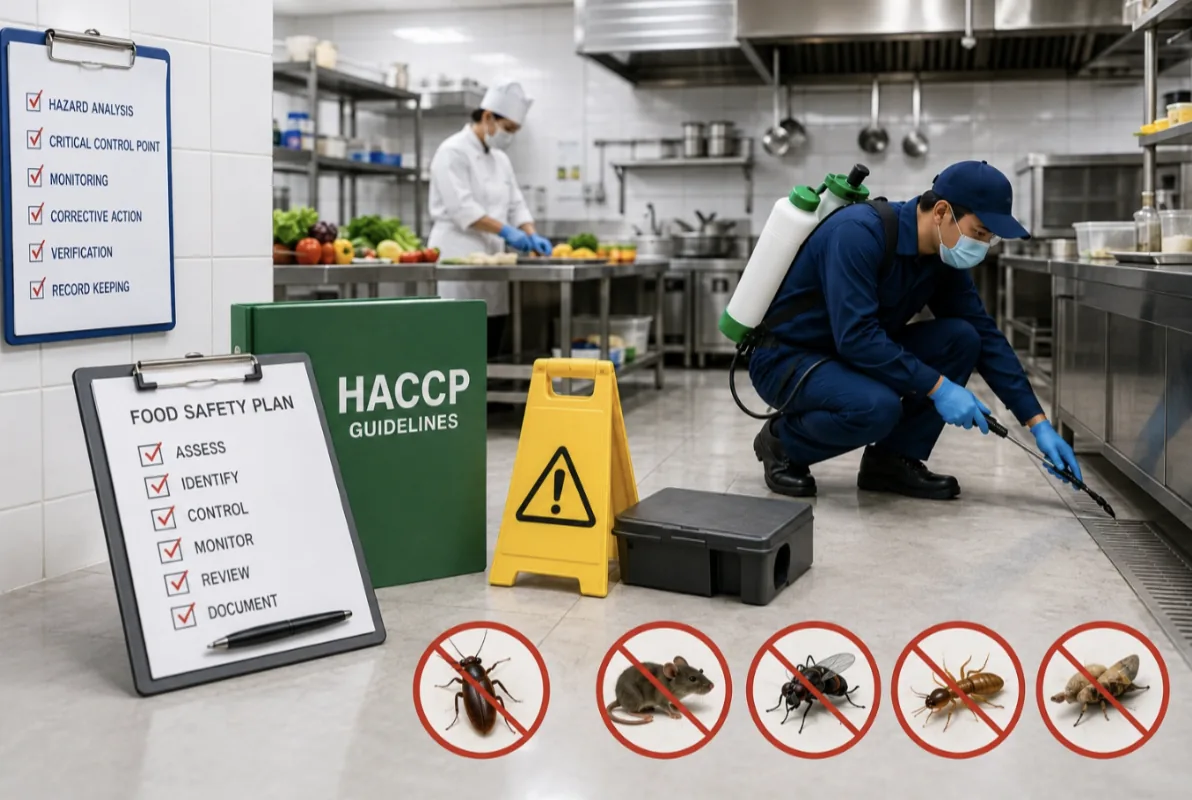
Food safety is one of the most important responsibilities for restaurants, hotels, commercial kitchens, food-processing units, bakeries, warehouses, supermarkets, cloud kitchens, and catering businesses.
Even a well-maintained food facility can face pest risks from cockroaches, rodents, flies, ants, stored-product insects, and other pests. These pests can enter through deliveries, drains, doors, structural gaps, packaging, and waste areas.
This is where HACCP and professional pest control work together. HACCP — Hazard Analysis and Critical Control Point — is a systematic food-safety approach used to identify, evaluate, and control significant food-safety hazards. Pest management supports this system by reducing pest-related contamination risks throughout food handling, preparation, storage, and distribution.
For food businesses in Bangalore, a documented Integrated Pest Management (IPM) program can be an important component of a broader food-safety and hygiene system.
What Is HACCP?
HACCP stands for Hazard Analysis and Critical Control Point. It is a preventive food-safety system rather than a system that waits until contamination has already occurred.
The basic principle is simple: identify potential hazards, determine how they can be controlled, monitor controls, take corrective action, and maintain records.
HACCP can address biological, chemical, and physical food-safety hazards. Pest management supports the overall system by helping prevent pests from contaminating food, food-contact environments, packaging, and storage areas.
Not sure what's causing the problem? Get a professional inspection before you decide on treatment.
Book Free Inspection Call NowWhy Pest Control Matters in Food Safety
Pests are attracted to many of the same things found in food businesses: food, water, warmth, shelter, organic waste, cardboard, drains, and hidden structural spaces.
Once pests enter a food facility, they may move between waste areas, drains, floors, storage areas, and food-handling environments. A pest infestation can therefore indicate weaknesses in sanitation, waste management, structural maintenance, incoming-goods inspection, storage practices, drain maintenance, or pest monitoring.
Professional commercial pest control services should address these underlying conditions rather than relying entirely on pesticide application.
HACCP and Integrated Pest Management
A strong pest-management program for food businesses should follow Integrated Pest Management principles. IPM combines inspection, prevention, exclusion, sanitation, monitoring, corrective action, targeted treatment, and documentation.
This approach fits well with preventive food-safety systems because it focuses on identifying and controlling risks before they develop into serious problems.
Ready to get this sorted? Ask us about a structured, documented treatment plan.
Book Free Inspection WhatsApp UsCommon Pest Risks in Food Facilities
1. Cockroaches
Cockroaches can become established around kitchen equipment, drains, sinks, dishwashing areas, refrigerators, storage rooms, electrical equipment, and cracks and crevices. Their presence in food-handling environments should be investigated promptly.
Treatment may include sanitation improvements, monitoring, gel bait, exclusion, and appropriately targeted applications. Learn more: Cockroach Pest Control Bangalore.
2. Rodents
Rats and mice can damage packaging and contaminate food-storage environments. Signs may include droppings, gnaw marks, damaged packaging, grease marks, burrows, and scratching noises.
Food facilities should maintain systematic rodent monitoring. A professional rodent-control program can combine exclusion, monitoring, trapping, sanitation, and appropriate baiting where suitable. Learn more: Rodent Pest Control Bangalore.
3. Flies
Flies can move between waste, drains, organic matter, and food areas. Common problem locations include garbage rooms, floor drains, food-preparation sections, vegetable areas, loading docks, and waste-storage zones.
Successful fly management should focus heavily on locating and eliminating breeding sources.
4. Ants
Ants may enter through small structural openings and establish trails toward food and moisture. Common attraction points include sugar, syrups, bakery products, food residues, and water sources.
Professional management should identify the colony and entry points rather than repeatedly spraying visible ants. Learn more: Ant Pest Control Bangalore.
5. Stored-Product Pests
Food-processing plants and warehouses storing grains and dry foods may experience pests such as weevils, beetles, moths, and other stored-product insects. These pests may sometimes arrive inside incoming raw materials, which makes incoming-goods inspection and stock management particularly important.
Seven HACCP Principles and Their Connection to Pest Management
The internationally recognised HACCP approach is built around seven principles, each with a direct link to how a pest-management program should be run.
Principle 1: Conduct a Hazard Analysis
Identify which pests and pest-related conditions could pose a food-safety risk at the site.
Principle 2: Determine Critical Control Points
Identify receiving areas, storage zones, and processing points where pest entry or contamination is most likely.
Principle 3: Establish Critical Limits
Define acceptable thresholds for pest activity — for example, zero tolerance for cockroach sightings in food-preparation areas.
Principle 4: Establish Monitoring Procedures
Set inspection frequency and monitoring-device checks to track pest activity over time.
Principle 5: Establish Corrective Actions
Define the response when monitoring shows activity above the threshold, such as increased treatment or facility repairs.
Principle 6: Establish Verification Procedures
Confirm that pest-control measures are working through follow-up inspections and trend review.
Principle 7: Establish Documentation and Record Keeping
Maintain service reports, sighting registers, and monitoring records as evidence that the system is functioning.
Creating a Pest-Control Map
Larger food facilities should consider maintaining a pest-monitoring map. Monitoring devices can be assigned identification numbers, for example R01 – Receiving Area, R02 – Dry Storage, R03 – Kitchen Exterior, R04 – Waste Area, and R05 – Loading Dock.
The map allows technicians and auditors to identify the location of each device, and monitoring results can then be compared over time.
Frequently Asked Questions
What does HACCP stand for?
HACCP stands for Hazard Analysis and Critical Control Point, a preventive food-safety system used to identify, evaluate, and control significant food-safety hazards before contamination occurs.
How does pest control support HACCP?
Pest management reduces pest-related contamination risks throughout food handling, preparation, storage, and distribution, supporting the biological-hazard side of a HACCP system.
Which pests pose the biggest food-safety risk?
Cockroaches, rodents, flies, ants, and stored-product insects such as weevils, beetles, and moths are the most common pest risks in food facilities.
What is a pest-monitoring map?
It is a site plan with numbered monitoring devices — for example around receiving areas, dry storage, kitchen exteriors, waste areas, and loading docks — that lets technicians and auditors track pest activity by location over time.
Why does documentation matter for HACCP compliance?
Service reports, pest-sighting registers, and monitoring records provide the evidence auditors need to confirm that pest-control measures are actually working, in line with HACCP's documentation and verification principles.
Should food businesses use IPM instead of routine spraying?
Yes. Integrated Pest Management addresses the underlying causes of pest activity — sanitation, structural gaps, waste management, and monitoring — rather than relying only on pesticide application, which fits the preventive philosophy of HACCP.
Conclusion
HACCP and pest control share the same fundamental philosophy: prevention is better than reaction. A food business should not wait until a customer, employee, or auditor discovers a pest problem.
A well-designed pest-management program combines inspection, sanitation, exclusion, monitoring, corrective action, targeted treatment, and documentation.
When these measures are integrated into the wider food-safety system, businesses can better protect food, customers, inventory, compliance, and brand reputation.
For restaurants, hotels, food warehouses, supermarkets, commercial kitchens, and food-processing facilities in Bangalore, professional IPM provides a structured approach to pest prevention while supporting HACCP-based food-safety management.
Related reading: IPM for Commercial Properties: A Strategic Approach to Business Protection | Documentation in Commercial Pest Control: Why Records Matter | Choosing a Commercial Pest Control Provider: What to Look For | Sanitation Best Practices for Commercial Pest Prevention | Employee Training for Pest Awareness in the Workplace: Building a Pest-Smart Team | Pest Control for Warehouses and Storage Facilities: Protecting Goods from Damage | Pest Control for Restaurants: Maintaining Health Code Compliance | Safe Ant Control for Kitchens, Restaurants & Food Businesses