Commercial pest control is not complete when the technician finishes the treatment and leaves the premises. For businesses such as restaurants, hotels, hospitals, warehouses, factories, retail stores, commercial kitchens, offices, and food-processing facilities, proper documentation is an important part of a professional pest-management program.
Good records help answer important questions: what pest was found, where it was found, what treatment was performed, which product was used, what corrective action was recommended, and whether the problem is improving or getting worse.
For businesses in Bangalore, maintaining organised pest-control records can support pest prevention, internal audits, food-safety programs, facility management, accountability, and long-term Integrated Pest Management (IPM).
What Is Pest Control Documentation?
Pest-control documentation is the collection of records created during the planning, inspection, monitoring, treatment, and review of a commercial pest-management program. Depending on the type of business, this may include:
- Pest-control contract or AMC
- Scope of work
- Service schedule
- Technician service reports
- Pest-sighting register
- Treatment records
- Products used
- Monitoring-device records
- Rodent station maps
- Corrective-action reports
- Follow-up reports
- Pest trend reports
- Relevant product and safety information
Documentation converts pest control from a series of individual treatments into a traceable management system.
Why Pest Control Records Matter
Imagine a technician visits a commercial kitchen every month. Cockroaches are repeatedly found near the same dishwasher. If every service is performed without proper documentation, each visit may be treated as a new problem. But records could reveal a pattern: cockroach activity near the dishwasher in January, the same location in February, and activity continuing into March.
That pattern tells management that the underlying cause requires investigation. Possible causes could include water leakage, drain problems, food residue, structural gaps, or hidden harbourage.
This is one of the biggest benefits of documentation: records help businesses identify patterns instead of repeatedly treating symptoms.
1. Pest Control Service Reports
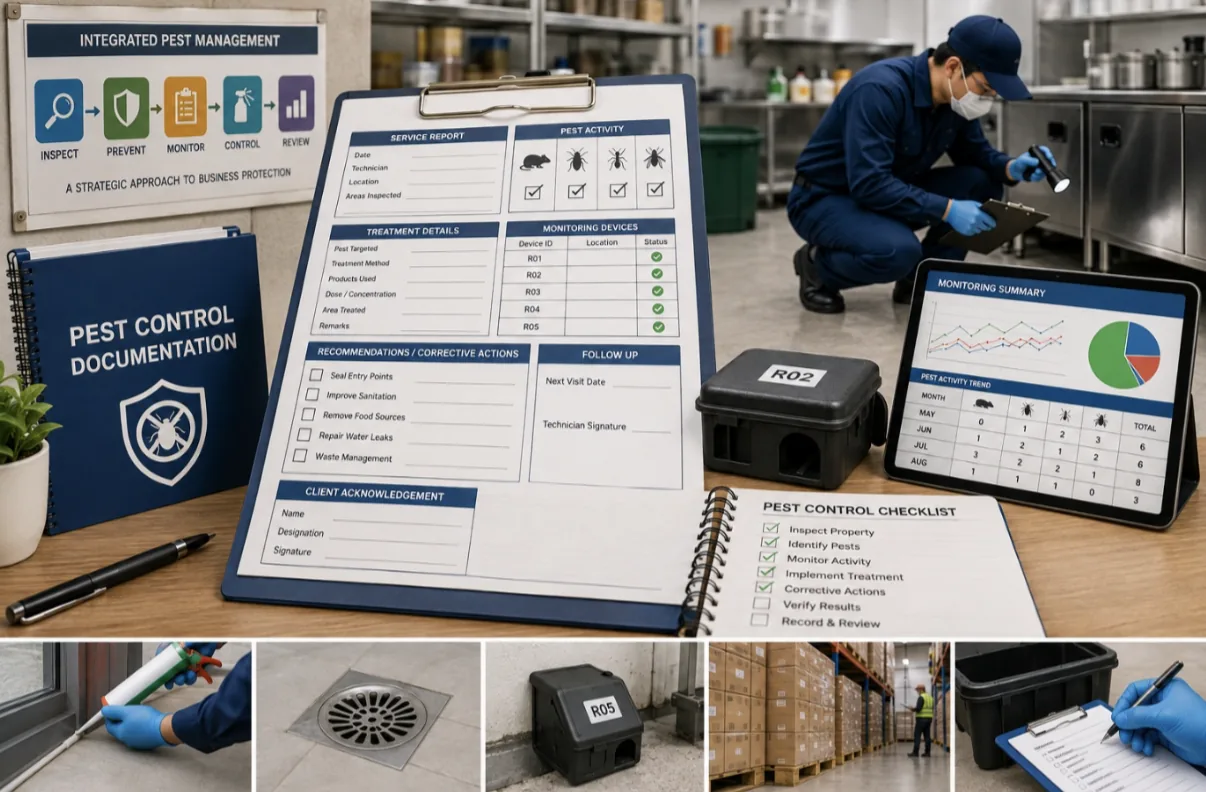
A professional service report is one of the most important pest-control documents. It should clearly record relevant details about each visit, including the service date, property or location, areas inspected, pest activity observed, treatment performed, products used, monitoring devices checked, corrective actions recommended, technician details, and client acknowledgement where applicable.
The service report creates a history of what occurred during each pest-control visit.
2. Pest Sighting Register
Employees often notice pest activity between scheduled pest-control visits. A pest-sighting register provides a simple way to capture this information. For example:
| Date | Location | Pest Observed | Reported By | Action |
|---|---|---|---|---|
| 05 Aug | Kitchen | Cockroach | Kitchen Staff | Technician informed |
| 09 Aug | Loading Dock | Rodent signs | Security | Inspection requested |
| 12 Aug | Pantry | Ant activity | Housekeeping | Area inspected |
This information can help technicians identify areas requiring additional attention.
3. Rodent Monitoring Records
Rodent control is one area where documentation is particularly valuable. Commercial facilities may have multiple monitoring points around the building perimeter, loading docks, kitchens, warehouses, basements, utility areas, and waste zones.
Each monitoring point can be assigned a unique number, for example R01 – Main Gate, R02 – Loading Dock, R03 – Dry Storage, R04 – Kitchen Exterior, and R05 – Garbage Area. During each visit, the technician records the status of each point. Learn more about professional Rodent Pest Control Bangalore.
4. Pest Monitoring Maps
A pest-monitoring map shows exactly where monitoring devices are located. Depending on the property, this may include rodent monitoring stations, mechanical traps, cockroach monitors, and flying-insect monitoring devices. Each device should have a corresponding identification number.
For large commercial properties, this makes monitoring far more systematic. Instead of saying "there was rodent activity somewhere behind the warehouse," records can show "activity detected at monitoring point R07 near Loading Bay 2." That information is much more useful for corrective action.
Not sure what's causing the problem? Get a professional inspection before you decide on treatment.
Book Free Inspection Call Now5. Treatment Records
Treatment records should document relevant details of pest-control applications. Depending on the treatment and business requirements, records may include the date, treatment area, target pest, product used, application method, relevant product details, technician, precautions or restrictions, and follow-up requirements.
Commercial businesses should be able to understand what pest-control work has been performed on their premises.
6. Product Information and Safety Documentation
Businesses may also maintain relevant information about pest-control products used at their premises, including product name, active ingredient information, label information, Safety Data Sheet (SDS) where applicable, and treatment records.
These records can be particularly useful for food businesses, hospitals, pharmaceutical facilities, factories, and large corporate facilities that need to demonstrate responsible pesticide management.
7. Corrective-Action Reports
Professional pest management should identify conditions contributing to pest activity. For example, an observation of rodent droppings near a loading door might trace back to a root cause of a gap beneath the shutter, with a recommendation to install or repair the door seal, a responsible department of facility maintenance, and a status of pending or completed.
This is much more valuable than simply writing "rodent treatment done." Corrective-action records connect the pest-control provider with the client's maintenance, housekeeping, food-safety, and facility-management teams.
8. Follow-Up Records
Corrective action should be verified. For example: a problem of rodent activity near a loading bay, an action of repairing the door gap, a follow-up inspection showing no new droppings detected, monitoring showing no activity at R04 for three consecutive inspections, and a status of closed.
Without follow-up documentation, management may not know whether the problem was actually resolved.
9. Pest Trend Analysis
Trend analysis is one of the most valuable uses of pest-control records. Consider this example:
| Monitoring Point | May | June | July | August |
|---|---|---|---|---|
| R01 | 0 | 0 | 0 | 0 |
| R02 | 1 | 2 | 4 | 6 |
| R03 | 0 | 0 | 1 | 0 |
| R04 | 0 | 0 | 0 | 0 |
The increasing activity at R02 indicates a developing hotspot. Management can investigate the area before the problem spreads. This is an important principle of Integrated Pest Management: collect data, identify trends, investigate causes, take corrective action, and verify results.
Documentation and HACCP
Pest-control documentation is particularly important for food businesses operating within structured food-safety systems. Restaurants, hotels, commercial kitchens, food manufacturers, and food warehouses may need organised records relating to pest monitoring, treatments, corrective actions, pest sightings, products used, and monitoring maps.
A pest-control contract alone does not demonstrate that pest risks are being actively managed — records should show what is actually happening at the facility. Businesses operating in regulated industries may also want to review Pest Control Regulations in India governing licensing and product use.
Documentation for Restaurants, Hotels, Healthcare, Warehouses and Retail
Different commercial environments need slightly different record-keeping emphasis.
Restaurants face continuous pest pressure from food, water, waste, drains, deliveries, and long operating hours, so useful records include cockroach monitoring, rodent monitoring, fly activity, pest sightings, kitchen inspection findings, corrective actions, and treatment reports.
Hotels may require records across guest rooms, kitchens, restaurants, banquet halls, housekeeping areas, laundry rooms, basements, and waste areas — bed bug complaints should be particularly well documented, following the flow of room number, inspection date, evidence found, treatment, adjacent area assessment, follow-up, and closure.
Healthcare environments require careful coordination and record keeping across areas inspected, pest activity, treatment methods, sensitive-area precautions, corrective actions, and follow-up findings, since sensitive locations may require additional internal procedures before treatment.
Warehouses can particularly benefit from rodent maps and monitoring records covering loading docks, storage racks, shutter doors, false ceilings, utility rooms, exterior perimeter, and waste areas — records can help identify recurring activity near specific doors, drains, or structural openings.
Retail businesses should maintain records covering both customer-facing and back-of-house areas, with particular attention around food displays, storage areas, loading docks, refrigeration equipment, staff pantries, and waste areas.
Pest Control Documentation for Audits
Businesses should not begin organising pest-control paperwork the day before an audit — documentation should be maintained continuously. A well-organised commercial pest-control file may include:
- Section 1 – Contract & Scope: current pest-control agreement, service frequency, and scope
- Section 2 – Site Plan: monitoring-device maps and identification numbers
- Section 3 – Service Reports: chronological technician reports
- Section 4 – Pest Sightings: employee-reported pest activity
- Section 5 – Treatment Records: details of pest-control interventions
- Section 6 – Product Information: relevant product and safety information
- Section 7 – Corrective Actions: maintenance and sanitation recommendations and their status
- Section 8 – Trend Analysis: monthly or quarterly review of pest activity
This structure makes records easier to review.
Ready to get this sorted? Ask us about a structured, documented treatment plan.
Book Free Inspection WhatsApp UsDigital Pest Control Records
Commercial pest management is increasingly moving from paper job cards to digital reporting. Digital systems can allow businesses to track the flow from property to service to pest to location to monitoring point to treatment to corrective action to follow-up.
Potential benefits include faster report retrieval, easier trend analysis, reduced paperwork, better photograph storage, easier sharing between departments, and improved historical records. For businesses with multiple branches, digital pest-control documentation can provide centralised visibility across locations.
Using Photographs in Pest Control Reports
Photographs can strengthen pest-control documentation. Useful photographs may include rodent entry points, droppings, damaged packaging, cockroach harbourage, standing water, structural gaps, poor waste conditions, and corrective action before and after repair — for example, a gap beneath a warehouse shutter before, and the gap professionally sealed after. This provides clear evidence that corrective action was completed.
Who Should Review Pest Control Records?
Documentation should not remain unread in a file. Depending on the organisation, records may be reviewed by facility managers, housekeeping managers, food-safety teams, quality teams, maintenance departments, EHS teams, hotel management, warehouse managers, and restaurant managers.
Regular review helps ensure corrective recommendations are actually implemented. Well-trained staff make this easier — see our guide on Employee Training for Pest Awareness in the Workplace for how to build a pest-smart team that reports issues early.
How Long Should Pest Control Records Be Kept?
There is no single retention period suitable for every commercial property. Record-retention requirements may depend on applicable regulations, industry standards, certification schemes, customer requirements, internal company policies, and contractual requirements. Businesses should establish and document an appropriate retention policy for their operations.
Common Pest Control Documentation Mistakes
Commercial properties should avoid:
- Missing service dates
- Unclear treatment locations
- No record of products used
- Unnumbered monitoring devices
- Outdated rodent maps
- No pest-sighting register
- Corrective actions without closure
- Repeated pest activity without investigation
- Reports filed but never reviewed
The purpose of documentation is not simply to create paperwork. It should help improve pest-management performance.
From Documentation to Business Intelligence
The real value of pest-control records appears when businesses use the information to make decisions. For example: data showing rodent activity repeatedly recorded near a loading dock, analysis showing activity increases during evening receiving operations, an inspection finding that the loading shutter remains open for extended periods, a corrective action to improve door management and structural proofing, and a result of declining rodent activity. That is data-driven pest management.
Commercial Pest Control Documentation Checklist
A well-managed commercial property should consider maintaining:
- Current pest-control contract
- Defined scope of work
- Service schedule
- Technician reports
- Pest-sighting register
- Monitoring-device map
- Rodent monitoring records
- Treatment records
- Product information
- Relevant safety documentation
- Corrective-action register
- Follow-up records
- Photographic evidence where useful
- Pest trend analysis
- Periodic management review
Professional Commercial Pest Control in Bangalore
Standard Pest Control provides professional pest-management services for commercial properties in Bangalore. Programs can be customised for restaurants, hotels, hospitals, warehouses, retail stores, shopping malls, offices, factories, food-processing facilities, commercial kitchens, and educational institutions.
When choosing a provider, see our guide on Choosing a Commercial Pest Control Provider for what to check before signing an AMC.
Our approach focuses on inspection, monitoring, treatment, documentation, corrective action, and verification. Explore our related services: Cockroach Pest Control Bangalore, Rodent Pest Control Bangalore, Mosquito Pest Control Bangalore, Ant Pest Control Bangalore, Termite Control Bangalore, and Bed Bug Control Bangalore.
Frequently Asked Questions
Why is documentation important in commercial pest control?
Documentation creates a history of pest activity, treatments, monitoring results, and corrective actions. This helps businesses identify trends and verify whether pest-management measures are working.
What should be included in a pest-control service report?
A report may include the date, areas inspected, pests observed, treatment performed, products used, monitoring findings, recommendations, and follow-up requirements.
What is a pest-sighting register?
It is a record used by employees to document when and where pest activity is observed between scheduled pest-control visits.
Why should rodent stations be numbered?
Numbering allows each station to be mapped and monitored consistently, making it easier to identify rodent hotspots.
Are pest-control records useful for HACCP?
Yes. Pest-management documentation can support food-safety systems by demonstrating monitoring, corrective action, treatment, and verification activities.
Should corrective actions be documented?
Yes. The problem, recommendation, responsible person or department, completion status, and follow-up result should ideally be recorded.
Can pest-control documentation be digital?
Yes. Digital reporting can make it easier to store photographs, retrieve reports, analyse trends, and manage multiple commercial locations.
Conclusion
Documentation is what turns commercial pest control from a treatment service into a measurable pest-management system.
A technician can treat a pest problem today. But without records, the business may not know whether the same problem occurred last month, whether activity is increasing, whether a structural recommendation was completed, or whether the treatment actually worked.
Strong commercial pest management therefore follows a continuous cycle: inspect, record, monitor, analyse, correct, treat, verify, and document.
For commercial properties in Bangalore, maintaining accurate pest-control records can help protect people, inventory, food, property, operational standards, and business reputation.
Related reading: Choosing a Commercial Pest Control Provider: What to Look For | Sanitation Best Practices for Commercial Pest Prevention | Employee Training for Pest Awareness in the Workplace: Building a Pest-Smart Team | Pest Control Regulations: What Homeowners and Businesses Need to Know | IPM for Commercial Properties: A Strategic Approach to Business Protection | HACCP and Pest Control: Ensuring Food Safety Compliance | Pest Control for Libraries: Protecting Books and Documents