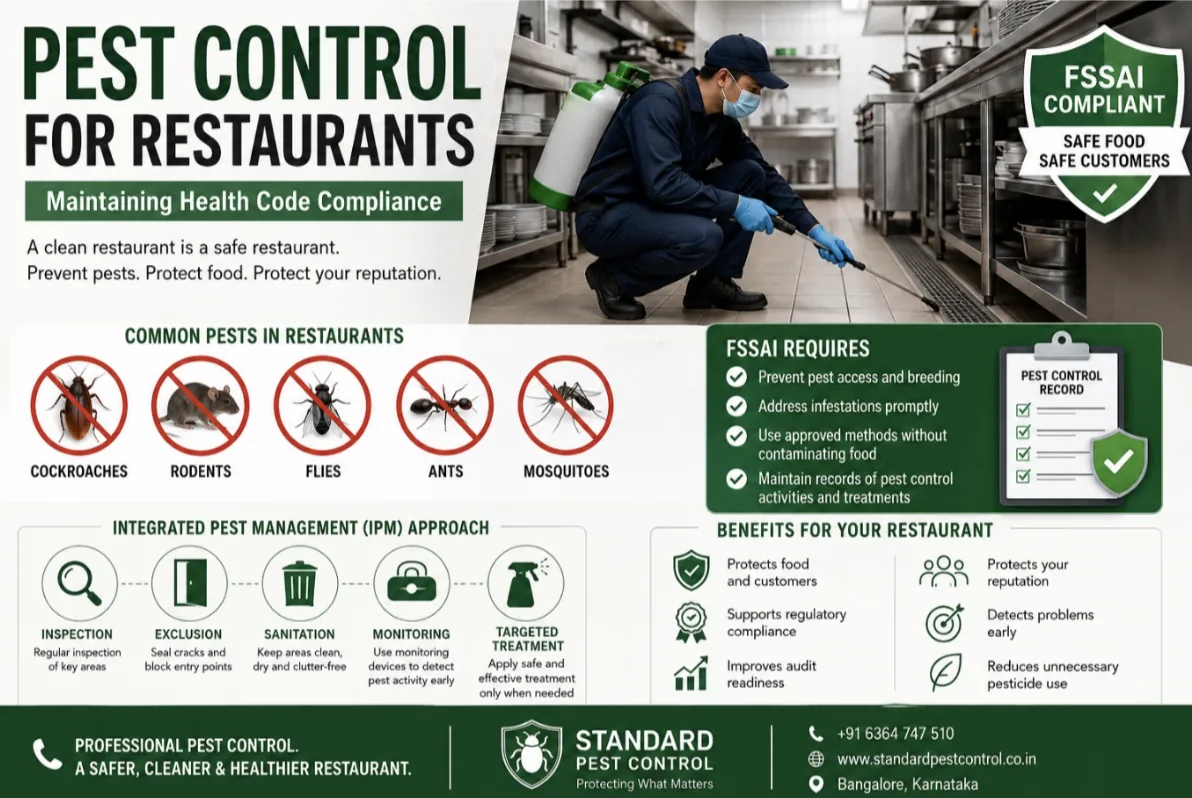
Running a restaurant is not only about serving great food — it is also about maintaining a clean, hygienic, and pest-free environment. Cockroaches, rodents, flies, ants, mosquitoes, and other pests can contaminate food, damage property, affect customer confidence, and create serious food-safety concerns.
For restaurants in Bangalore, a structured commercial pest control program should therefore be part of routine food-safety management rather than something arranged only after pests are noticed.
FSSAI requirements specifically address pest prevention in food establishments. Food premises should be maintained to prevent pest access and breeding, food should be stored appropriately, infestations should be addressed promptly, and records of pesticide/insecticide use, dates, and frequency should be maintained.
Why Pest Control Is Essential for Restaurants
Restaurants provide many of the things pests need to survive: food and food residues, water and moisture, warm kitchens, floor and sink drains, storage areas, waste disposal areas, cardboard boxes and packaging, and cracks, gaps, false ceilings, and utility openings.
Even a restaurant that appears clean can develop a pest problem if these areas are not routinely inspected and monitored. A pest sighting can also quickly become a reputation problem — customers may photograph or record cockroaches, rodents, or flies and share the experience through reviews and social media.
Professional commercial pest control services help restaurants move from reactive pest treatment to a preventive pest-management system.
Restaurant Pest Control and FSSAI Compliance
Pest management is an important component of food hygiene. FSSAI guidance states that food establishments should prevent pest access and eliminate potential breeding sites. Holes, drains, and other possible entry locations should be sealed or appropriately protected, and pest infestations should be dealt with promptly without compromising food safety.
Food businesses should also maintain relevant pest-control documentation. FSSAI materials emphasize trained and authorized personnel, monitoring the effectiveness of pest-control activities, maintaining updated records and contracts, and preventing pest-control chemicals or activities from contaminating food.
This means restaurant pest control should be viewed as an ongoing monitoring, prevention, treatment, and documentation program — see our guide on HACCP and Pest Control for how this fits into a wider food-safety system.
Common Pests Found in Restaurants
1. Cockroaches
Cockroaches are among the most common restaurant pests. Kitchens provide warmth, moisture, food residues, grease, and numerous hiding places. Typical problem areas include under sinks, behind refrigerators, dishwashing areas, drain lines, kitchen cabinets, electrical equipment, cracks and crevices, storage rooms, and garbage areas.
Instead of relying only on aerosol sprays, restaurants should use a targeted management program. Learn more: Cockroach Pest Control Bangalore.
2. Rodents
Rats and mice can enter restaurants through surprisingly small structural openings and may contaminate food-storage and preparation areas. Signs of rodent activity include droppings, gnaw marks, damaged packaging, grease marks, scratching noises, unusual odours, and burrows around the property.
A professional rodent-control program may combine inspection, exclusion, monitoring devices, traps, and appropriately positioned bait stations. FSSAI guidance also discusses the use of traps and baits and indicates that rodent traps, where used, should be adequately provided and mapped. Learn more: Rodent Pest Control Bangalore.
3. Flies
Restaurants frequently experience houseflies, fruit flies, drain flies, and other flying insects. Common breeding or attraction areas include garbage bins, floor drains, wet mops, rotting vegetables, beverage areas, organic waste, and drainage lines.
Fly control requires more than killing adult flies — the breeding source must also be identified and corrected.
4. Ants
Ants can enter through tiny cracks and quickly establish trails toward sugar, food residues, water, and other food sources. Treating only the visible ants may not eliminate the colony. Professional inspection can help locate nesting and entry areas before choosing an appropriate treatment.
5. Mosquitoes
Restaurants with outdoor seating, landscaping, drains, terraces, or nearby standing water can experience mosquito activity. The first priority should be identifying and reducing breeding sources. Depending on the property and infestation, additional mosquito-management measures may be recommended. Learn more: Mosquito Pest Control Bangalore.
Not sure what's causing the problem? Get a professional inspection before you decide on treatment.
Book Free Inspection Call NowIntegrated Pest Management for Restaurants
The most effective restaurant pest-control programs follow an Integrated Pest Management (IPM) approach, focusing on prevention and monitoring rather than depending entirely on pesticide application.
Inspection
Regularly inspect kitchens, storage rooms, dining areas, drains, waste zones, false ceilings, loading areas, and the exterior perimeter.
Exclusion
Seal pest entry points around pipes, doors, windows, drain lines, cable openings, wall penetrations, and utility connections.
Sanitation
Food spills, grease, standing water, and accumulated waste should be cleaned promptly.
Monitoring
Monitoring devices can help identify pest activity before it develops into a larger infestation.
Targeted Treatment
When treatment is necessary, it should be selected according to the pest, infestation level, location, and food-safety requirements.
This reduces unnecessary pesticide application while improving long-term control.
Pest Control Documentation for Restaurant Audits
Documentation is an important but sometimes overlooked part of commercial pest management. Depending on the restaurant and applicable requirements, useful records may include the pest-control service agreement, service schedule, technician service reports or job cards, pest-monitoring records, rodent monitoring or bait-station map, pest-sighting records, corrective-action reports, details of products used, treatment dates and frequencies, and safety or product documentation where applicable.
FSSAI guidance specifically calls for updated pest-control records and contracts and for monitoring pest-control effectiveness. Restaurant managers should keep these documents organised and readily accessible rather than searching for them only when an inspection or audit occurs.
Areas That Should Receive Special Attention
A restaurant pest-control inspection should extend beyond the dining room. Particular attention should be given to the main kitchen, dry-storage room, vegetable-storage area, dishwashing section, drains, refrigerator and freezer surroundings, electrical panels, false ceilings, staff areas, receiving or loading areas, waste-storage area, outdoor dining spaces, and building perimeter.
Each zone presents different pest risks and may require a different control method.
Safe Pest Control Around Food
Pest-control treatments in restaurants require careful planning because food, utensils, preparation surfaces, and equipment must be protected from contamination.
FSSAI training material recommends targeted cockroach treatments such as crack-and-crevice or spot treatment, avoiding contamination of food and preparation surfaces, and carrying out insecticide applications after business hours where appropriate — see our guide on Health and Safety Regulations for Commercial Pest Control for more on safe application practices.
Professional pest control should therefore coordinate treatment timing with restaurant management and provide clear preparation and post-treatment instructions.
Ready to get this sorted? Ask us about a structured, documented treatment plan.
Book Free Inspection WhatsApp UsWhy DIY Pest Control May Not Be Enough
A restaurant employee spraying an insecticide whenever a cockroach appears is not a complete pest-management program. Visible pests can be only one sign of a larger hidden infestation.
Professional pest management helps identify where the pests are coming from, where they are breeding, how they are entering, what conditions are supporting them, and what corrective action can prevent recurrence. The objective should be long-term prevention, not repeatedly killing visible pests.
Preventive Pest Control Is Better Than Emergency Treatment
Waiting until customers notice pests is risky. A scheduled pest-management program allows technicians and restaurant management to identify activity early, monitor trends, address sanitation or structural problems, and take corrective action before the infestation becomes severe.
The appropriate service frequency depends on factors such as restaurant size, pest pressure, operating hours, waste generation, surrounding environment, previous infestation history, and food-storage practices — an ongoing AMC program can provide this kind of ongoing protection.
Restaurant Pest-Control Checklist
Restaurant managers should routinely check that:
- Doors and windows close properly
- Food is stored in sealed containers
- Food stocks are kept appropriately away from floors and walls
- Kitchen spills and grease are cleaned promptly
- Drains are kept clean
- Waste bins are covered and regularly emptied
- Cardboard and unnecessary clutter are removed
- Pipe and cable openings are sealed
- Pest-monitoring devices remain in their designated positions
- Pest sightings are recorded
- Corrective actions are completed
- Pest-control records are updated after every service
Benefits of Professional Pest Control for Restaurants
A professionally managed pest-control program can help restaurants:
- Protect food safety by reducing pest-related contamination risks.
- Support regulatory compliance through systematic monitoring, treatment, and documentation.
- Protect reputation by reducing the likelihood of customers encountering visible pest activity.
- Detect problems early before a minor issue develops into a serious infestation.
- Reduce unnecessary pesticide use through inspection, prevention, exclusion, monitoring, and targeted application.
- Improve audit readiness by keeping service and monitoring documentation organised.
Restaurant Pest Control in Bangalore
Restaurants in Bangalore can face significant pest pressure due to warm weather, food availability, drainage systems, dense commercial development, waste-handling areas, and seasonal conditions.
Standard Pest Control provides professional pest-management solutions for restaurants and other commercial food establishments in Bangalore. Services can include cockroach control, rodent control, ant control, fly management, mosquito control, general pest management, pest monitoring, preventive pest-control programs, and commercial AMC pest-control services.
Explore our other services: Cockroach Pest Control Bangalore, Rodent Pest Control Bangalore, Mosquito Pest Control Bangalore, Ant Pest Control Bangalore, Termite Control Bangalore, and Bed Bug Control Bangalore.
Frequently Asked Questions
How often should a restaurant have pest control?
There is no single frequency suitable for every restaurant. The schedule should be based on pest risk, previous activity, restaurant size, food handling, waste generation, neighbouring conditions, and monitoring results. Higher-risk food premises may require more frequent inspection and monitoring.
Is pest control required for restaurant food-safety compliance?
FSSAI food-safety requirements include measures for preventing pest access, dealing with infestations, using treatments without compromising food safety, and maintaining relevant pesticide/insecticide records.
Can pest control be performed while a restaurant is operating?
Some monitoring and non-chemical activities may be possible during operating hours, but chemical treatments around food areas require careful planning. Certain applications are better scheduled after business hours, with food and preparation surfaces appropriately protected.
What are the most common restaurant pests?
Cockroaches, rodents, flies, ants, and mosquitoes are among the common pests encountered in food-service environments.
What should restaurants keep as proof of pest control?
Service reports, schedules, monitoring records, pest-control contracts, treatment details, corrective actions, and relevant product records should be maintained as appropriate. FSSAI guidance specifically highlights maintaining updated pest-control records and contracts.
Conclusion
Effective pest control for restaurants is about much more than eliminating a cockroach or catching a rat. It requires prevention, sanitation, structural pest-proofing, routine monitoring, targeted treatment, corrective action, and proper documentation.
A proactive pest-management program helps protect food, customers, employees, brand reputation, and regulatory compliance.
For restaurants, cafés, cloud kitchens, bakeries, hotels, canteens, and other food businesses in Bangalore, partnering with a professional pest-control provider can make pest management a routine part of food safety instead of an emergency response.
Related reading: HACCP and Pest Control: Ensuring Food Safety Compliance | IPM for Commercial Properties: A Strategic Approach to Business Protection | Documentation in Commercial Pest Control: Why Records Matter | Understanding Health and Safety Regulations for Commercial Pest Control | Pest Control for Warehouses and Storage Facilities: Protecting Goods from Damage | Pest Control for Retail Stores: Protecting Inventory and Customer Experience | Safe Ant Control for Kitchens, Restaurants & Food Businesses | Commercial Lizard Control for Restaurants, Hotels & Food Processing Units