Commercial pest control is about more than eliminating cockroaches, rodents, termites, mosquitoes, flies, and other pests. In workplaces such as restaurants, hotels, hospitals, warehouses, factories, offices, retail stores, and food-processing facilities, pest management must also be carried out with careful attention to health, safety, pesticide handling, environmental protection, and regulatory compliance.
For businesses in Bangalore, choosing a professional and appropriately licensed pest-control provider is an important part of responsible facility management. A well-designed commercial pest-management program should balance two objectives: effective pest management and safe, responsible treatment.
This guide explains the key health and safety principles businesses should understand when arranging professional pest-control services.
Why Health and Safety Matter in Commercial Pest Control
Pest-control products are designed to control specific organisms. When pesticides are required, they need to be selected, stored, transported, mixed, applied, and disposed of responsibly.
Poor practices can potentially expose employees, customers, contractors, food products, pets and animals, water sources, and the surrounding environment.
Commercial pest control should therefore never be treated as simply "spraying chemicals." Professional pest management begins with inspection and risk assessment and uses chemical intervention only as part of a broader control strategy.
Pest Control Regulations in India
Pesticides in India are regulated under applicable central legislation and rules, including the Insecticides Act, 1968 and the Insecticides Rules, 1971, along with subsequent amendments and regulatory requirements.
The framework covers important areas including registration of insecticides, licensing, sale and distribution, storage, use, packaging, labelling, and safety precautions.
Commercial customers should work with professional pest-control providers that understand and follow applicable pesticide regulations and licence requirements. See our detailed guide on Pest Control Regulations in India for more on the licensing framework.
Why Businesses Should Choose a Licensed Pest Control Company
When selecting a pest-control provider, price should not be the only consideration. Businesses should verify whether the provider holds the licences and registrations applicable to its pest-control operations. A professional company should also be able to provide appropriate documentation relating to its treatments.
Choosing a compliant pest-management provider helps businesses reduce the risks associated with incorrect chemical selection, improper application, excessive pesticide use, incorrect dilution, poor storage practices, untrained application, and missing treatment records.
For commercial establishments, pest-control compliance can also form part of internal audits, vendor assessments, and hygiene programs.
Product Labels Are an Important Safety Requirement
One of the most important principles in professional pesticide application is to follow the approved product label and applicable directions.
The product label provides essential information about matters such as active ingredient, approved uses, application instructions, precautions, protective equipment, storage, first-aid guidance, and disposal requirements.
Technicians should not assume that a pesticide suitable for one environment is automatically appropriate for every location.
Integrated Pest Management Reduces Unnecessary Chemical Use
One of the strongest approaches to commercial pest control is Integrated Pest Management (IPM). IPM focuses on preventing and managing pest problems using multiple control methods rather than depending entirely on routine pesticide spraying.
A typical IPM program includes inspection, identification, exclusion, sanitation, monitoring, targeted treatment, and documentation. This approach can reduce unnecessary pesticide application while improving long-term pest management.
Step 1: Pest Inspection
Before treatment begins, the technician should understand the problem. Inspection may identify pest species, infestation level, entry points, breeding areas, harbourage locations, food sources, moisture sources, and structural deficiencies. Without a proper inspection, treatments may target the symptoms rather than the cause.
Step 2: Correct Pest Identification
Different pests require different treatment strategies. Cockroaches may require gel bait, monitoring, sanitation improvement, and targeted crack-and-crevice treatment. Rodents may require exclusion, traps, monitoring stations, and other control measures. Mosquitoes require attention to breeding sources and standing water. Termites require specialised termite-management procedures. Correct identification helps prevent unnecessary or inappropriate pesticide application.
Step 3: Risk Assessment
Commercial sites contain different levels of risk. Treatment inside an empty warehouse is not the same as treatment around hospital patients, restaurant kitchens, children, food-processing areas, pharmaceutical products, or sensitive equipment.
Before application, the technician and site representative should consider who occupies the area, what products are stored there, whether food is exposed, whether non-chemical methods can solve the problem, whether the area needs to be temporarily restricted, and what preparation is required. Risk-based planning is particularly important for sensitive commercial environments.
Personal Protective Equipment for Pest Control Technicians
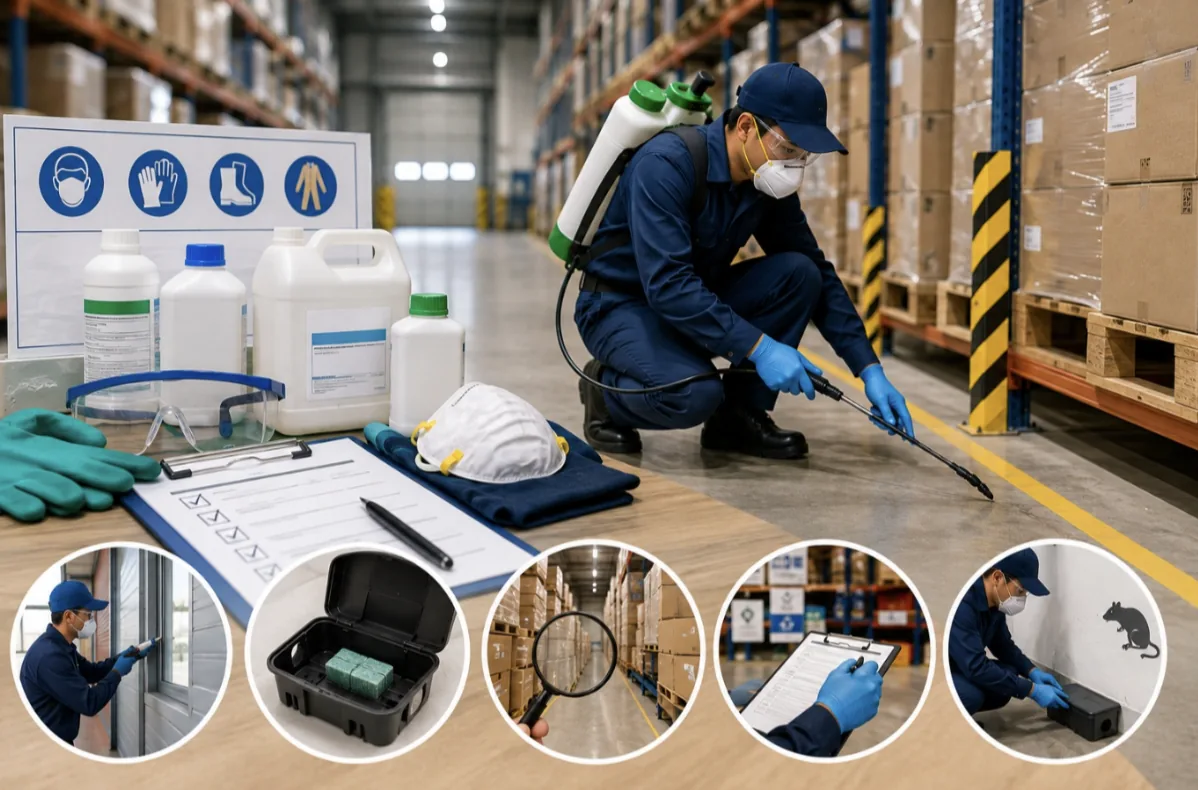
Depending on the product, task, and label instructions, technicians may require suitable Personal Protective Equipment (PPE). This can include protective gloves, suitable work clothing, safety footwear, eye protection, and respiratory protection where required.
PPE requirements should be determined by the pesticide label, Safety Data Sheet where applicable, and the nature of the application. PPE protects technicians, but it does not replace correct pesticide handling procedures.
Safe Pesticide Mixing and Dilution
Using more pesticide does not automatically produce better pest control. Incorrect concentrations can increase unnecessary exposure and may not improve results.
Technicians should follow the applicable product instructions when measuring concentrates, diluting products, preparing application equipment, applying treatments, and cleaning equipment. Commercial clients should avoid encouraging technicians to "make the chemical stronger" than permitted — professional pest management is based on correct application, not maximum chemical concentration.
Not sure what's causing the problem? Get a professional inspection before you decide on treatment.
Book Free Inspection Call NowProtecting Food During Pest Control
Food businesses require additional precautions, including restaurants, hotels, cafeterias, bakeries, food warehouses, supermarkets, commercial kitchens, and food-processing facilities.
Before treatment, exposed food and food-contact items may need to be appropriately protected or removed depending on the treatment. Pesticides should not contaminate food, utensils, preparation surfaces, food containers, or cooking equipment. See our related guide on HACCP and Pest Control for how food-safety systems and pest management work together.
Health and Safety in Healthcare Pest Control
Hospitals, clinics, diagnostic centres, and other healthcare facilities require particularly careful treatment planning. Areas such as the ICU, NICU, operation theatres, patient rooms, laboratories, and pharmacies may require special precautions.
Where possible, pest management in highly sensitive areas should prioritise prevention, exclusion, sanitation, monitoring, and non-chemical measures. Any pesticide intervention should be appropriately assessed and coordinated with the responsible facility personnel.
Safety Considerations for Hotels
Hotels operate around the clock, so pest-control treatments need to be coordinated with housekeeping, engineering, kitchen, and front-office teams. Guest rooms may need temporary access restrictions depending on the treatment.
Special attention should be given to guest rooms, kitchens, restaurants, laundry rooms, food storage, and waste areas.
Safety Considerations for Warehouses
Warehouses may contain food, pharmaceuticals, packaging, consumer goods, raw materials, and industrial products. The pest-control method should consider what is being stored.
Monitoring and pest proofing can be especially important because they allow facilities to reduce reliance on widespread pesticide application.
Safe Rodent Control
Rodent management is more than simply placing rodenticide around a property. A professional program should consider rodent entry points, food sources, harbourage, monitoring, trapping, appropriate bait-station placement, protection of non-target animals, and site-specific risks.
Where rodenticides are used, they should be handled and placed according to applicable product directions and safety requirements. Learn more: Rodent Pest Control Bangalore.
Safe Cockroach Management
Commercial cockroach management should not depend entirely on indiscriminate spraying. An IPM program may include sanitation, monitoring traps, gel bait, crack-and-crevice treatment, exclusion, and moisture reduction. This approach allows treatment to focus on cockroach harbourage areas. Learn more: Cockroach Pest Control Bangalore.
Responsible Mosquito Management
Mosquito management should start with breeding-source reduction. Commercial properties should regularly inspect drains, water containers, terraces, construction areas, plant trays, water-storage areas, and landscaping.
Depending on the site, mosquito management may involve larval control and appropriately targeted adult mosquito treatment. Fogging should not replace source reduction. Learn more: Mosquito Pest Control Bangalore.
Safe Storage of Pest-Control Products
Commercial pest-control companies should maintain appropriate storage procedures for pesticides. Important principles include keeping products in original labelled containers, preventing unauthorised access, separating pesticides from food and animal feed, protecting containers from damage, following applicable storage requirements, and maintaining suitable inventory controls.
Pesticides should never be transferred into beverage bottles or other misleading containers.
Transportation of Pest-Control Chemicals
Pesticides should be transported responsibly. Containers should remain properly closed, appropriately labelled, protected against leakage, and secured during transport. Technicians should also be prepared to respond appropriately to accidental spills.
Ready to get this sorted? Ask us about a structured, documented treatment plan.
Book Free Inspection WhatsApp UsSpill Management
Commercial pest-control operators should have procedures for accidental spills. Depending on the product and circumstances, this may include isolating the affected area, using appropriate PPE, preventing the material from entering drains or water bodies, containing the spill, following product-specific cleanup procedures, managing contaminated materials appropriately, and reporting the incident where required.
The product label and Safety Data Sheet should guide response procedures where applicable.
Safety Data Sheets
A Safety Data Sheet (SDS) provides important information about a chemical product, including hazard identification, handling precautions, storage information, first-aid measures, exposure controls, spill-response information, and disposal considerations.
Commercial clients may request relevant product documentation as part of their vendor-management or safety procedures.
Pest Control Documentation for Commercial Properties
Professional pest-control programs should maintain suitable records. Depending on the business, documentation may include the pest-control agreement, scope of work, service schedule, technician service report, products used, treatment location, pest activity observed, corrective recommendations, monitoring records, rodent monitoring maps, pest-sighting registers, follow-up reports, and relevant safety documentation.
Documentation becomes especially important for businesses undergoing internal or external hygiene and safety audits.
Protecting Employees and Customers
Before treatment, the pest-control company and client should communicate clearly. Employees may need to know which areas will be treated, when treatment will occur, whether access will be restricted, what preparation is necessary, and when normal activities can resume.
Clear communication helps prevent accidental entry into treatment areas, and trained staff are better placed to follow it — see our guide on Employee Training for Pest Awareness in the Workplace.
Environmental Responsibility
Responsible pest management should also consider the surrounding environment. Technicians should take precautions to prevent unnecessary contamination of water bodies, drains, soil, plants, and non-target animals.
Integrated Pest Management can help by reducing unnecessary pesticide applications.
Why Routine Spraying Is Not Always the Best Solution
A common misconception is that more spraying means better pest control. This is not necessarily true. If cockroaches are entering through a drain or rodents are entering through an open pipe penetration, repeated chemical treatment may not correct the actual cause.
A better strategy is to find the cause, correct the condition, monitor activity, and treat only where necessary. This is the foundation of professional IPM.
Choosing a Commercial Pest-Control Company
Before appointing a pest-management provider, businesses can ask:
- Is the company appropriately licensed? Verify applicable licences and registrations.
- Are technicians trained? Technicians should understand pesticide handling and application procedures.
- Do they use an IPM approach? The provider should offer more than routine spraying.
- Will they provide service documentation? Commercial clients should receive appropriate treatment records.
- Can they provide product information? Businesses should know what products are being used on their premises.
- Do they provide corrective recommendations? A professional provider should identify structural and sanitation problems contributing to pest activity.
For a fuller breakdown, see our guide on Choosing a Commercial Pest Control Provider.
Commercial Pest-Control Safety Checklist
Facility managers can use this basic checklist:
- Verify the pest-control provider's applicable licence
- Maintain a pest-control agreement
- Keep scheduled service records
- Record products used
- Maintain relevant product information
- Ensure treatments follow label directions
- Protect food and sensitive materials
- Restrict access where required
- Maintain pest-monitoring records
- Record pest sightings
- Complete structural corrective actions
- Repair water leaks
- Improve sanitation where required
- Review recurring pest trends
- Maintain appropriate safety documentation
Professional Commercial Pest Control in Bangalore
Standard Pest Control provides pest-management services for commercial and institutional properties in Bangalore. Commercial pest-management programs can be customised for restaurants, hotels, hospitals, retail stores, shopping malls, warehouses, offices, factories, educational institutions, commercial kitchens, and industrial facilities.
Our approach focuses on inspection, risk assessment, prevention, monitoring, targeted treatment, and documentation. Explore related services: Cockroach Pest Control Bangalore, Rodent Pest Control Bangalore, Mosquito Pest Control Bangalore, Ant Pest Control Bangalore, and Termite Control Bangalore.
Frequently Asked Questions
Is a licence required for commercial pest-control services in India?
Pesticide sale and commercial pest-control operations are subject to applicable requirements under India's pesticide regulatory framework. Businesses should verify that their service provider holds the licences required for the activities being performed.
What is the safest approach to commercial pest control?
Integrated Pest Management is generally a strong approach because it prioritises prevention, exclusion, sanitation and monitoring before targeted pesticide intervention.
Should businesses know which chemicals are being used?
Yes. Commercial clients should maintain appropriate treatment records and may request relevant product information and safety documentation.
Is stronger pesticide concentration better?
No. Pest-control products should be prepared and applied according to approved label directions. Increasing the concentration beyond those directions can increase risk without improving pest-control performance.
Can pest control be performed during business hours?
It depends on the treatment, product, location and occupancy. Inspections and some monitoring activities may be possible during normal operations, while other treatments may require restricted access or scheduling outside operating hours.
What is PPE in pest control?
PPE means Personal Protective Equipment. Depending on the treatment, this may include gloves, protective clothing, safety footwear, eye protection and respiratory protection.
Why is documentation important?
Documentation helps businesses track pest activity, treatments, products, monitoring results and corrective actions. It can also support internal safety, hygiene and vendor-management programs.
Conclusion
Understanding health and safety regulations for commercial pest control helps businesses make better decisions about how pest-management services are selected and performed.
Effective pest control is not about applying the largest possible quantity of pesticide. Professional pest management combines correct pest identification, risk assessment, prevention, monitoring, appropriate treatment, safe application, and documentation.
For commercial properties in Bangalore, choosing a properly managed pest-control program can help protect employees, customers, inventory, food, property and the surrounding environment while delivering effective long-term pest management.
Related reading: Pest Control Regulations: What Homeowners and Businesses Need to Know | IPM for Commercial Properties: A Strategic Approach to Business Protection | Choosing a Commercial Pest Control Provider: What to Look For | Documentation in Commercial Pest Control: Why Records Matter | HACCP and Pest Control: Ensuring Food Safety Compliance | Employee Training for Pest Awareness in the Workplace: Building a Pest-Smart Team