Retail stores depend heavily on cleanliness, product quality and customer experience. Whether you operate a supermarket, grocery store, clothing outlet, electronics showroom, pharmacy, department store, shopping mall, warehouse-connected outlet or neighbourhood shop, pest activity can quickly become a serious business problem.
A cockroach near a billing counter, rodent-damaged packaging, ants around food products or flies near a supermarket food section can immediately affect how customers perceive the business.
Pests can also damage inventory, contaminate products, chew electrical wiring and packaging, and create additional operational costs. For retailers in Bangalore, professional pest control for retail stores should therefore be a preventive management program rather than an emergency service used only after customers notice pests.
Why Pest Control Is Important for Retail Stores
Retail environments constantly receive people, products, cartons and deliveries. Every movement creates a potential opportunity for pests to enter the premises. Common pest entry routes include delivery cartons, loading areas, open doors, drain lines, utility openings, false ceilings, storage areas, shared walls, food deliveries, and cracks and structural gaps.
Once inside, pests can find food, water and undisturbed hiding locations. Professional commercial pest control services can help identify these risks before they develop into significant infestations.
How Pests Can Affect Retail Businesses
Pest problems can affect retailers in several ways.
Inventory Damage
Rodents, cockroaches and other pests may damage food packaging, cardboard cartons, paper products, clothing, stored goods, electrical wiring and display materials. Damaged products may have to be discarded even when the contents themselves have not been consumed.
Product Contamination
Pest activity around food products, storage areas or preparation zones can create contamination concerns — particularly for supermarkets, grocery stores, bakeries, food retailers, convenience stores, pharmacies and stores selling packaged food.
Customer Experience
Customers expect retail stores to be clean. Seeing a rat running between shelves or a cockroach near the checkout counter can immediately change their perception of the business.
Reputation
A customer can photograph or record pest activity and post it online within minutes. A single pest sighting can therefore escalate quickly: a pest sighting becomes a customer complaint, then a photo or video, then an online review, then reputation damage. Preventive pest management helps reduce this risk.
Common Pests Found in Retail Stores
1. Rodents
Rats and mice are among the most damaging retail pests. They may enter through loading docks, door gaps, drainage systems, pipe openings, cable openings, false ceilings and warehouse connections, and can damage cartons, packaging, electrical cables and stored products.
Common signs include droppings, gnaw marks, damaged packaging, grease marks, scratching noises, burrows and unusual odours. Rodent management should focus on inspection, exclusion and monitoring, rather than relying only on rodenticide. Learn more: Rodent Pest Control Bangalore.
2. Cockroaches
Cockroaches can enter retail premises through cartons, drains, service ducts and neighbouring properties. They are particularly common around staff pantries, food sections, washrooms, drains, electrical areas, storage rooms, garbage areas and refrigeration equipment.
Supermarkets and stores with food sections require particularly careful cockroach monitoring. Professional treatment should target harbourage areas rather than simply spraying visible cockroaches. Learn more: Cockroach Pest Control Bangalore.
3. Ants
Ants can become a problem around packaged food, sugar products, bakeries, staff pantries, cafeterias, checkout areas and waste bins. Repeatedly treating visible ants may not solve the underlying colony — a professional inspection should identify trails, entry points and nesting locations. Learn more: Ant Pest Control Bangalore.
4. Flies
Flies can create an immediate hygiene concern in supermarkets and other food-retail environments. Potential sources include garbage areas, drain lines, food waste, wet organic matter, fruit and vegetable sections, meat or food-preparation areas and loading zones. Effective fly management requires identifying and eliminating breeding sources rather than treating adult flies alone.
5. Stored-Product Pests
Retailers selling grains, flour, cereals, spices, dry foods, pet food and similar products may encounter stored-product insects. These pests can sometimes arrive inside already-infested products, so retailers should inspect incoming goods and maintain proper stock rotation. The FIFO principle — First In, First Out — can help reduce long-term product storage.
6. Termites
Furniture stores, clothing outlets, bookstores, warehouses and other businesses containing wooden fixtures, paper products or structural wood may face termite risks, which can damage wooden shelving, display units, furniture, doors, wooden partitions and stored paper materials. Learn more: Termite Control Bangalore.
High-Risk Areas in Retail Stores
Not every part of a retail property has the same pest risk. Particular attention should be given to several zones.
Receiving and Loading Areas
Deliveries can introduce pests or pest-contaminated packaging. Incoming cartons should be checked for damage, droppings, insects and other suspicious signs.
Storage Rooms
Dark and undisturbed storage areas can provide excellent pest harbourage. Avoid excessive clutter and unnecessary cardboard accumulation.
False Ceilings
Rodents can sometimes use false ceilings as concealed movement routes. Scratching noises, droppings or damaged wiring should be investigated.
Food Sections
Supermarkets and grocery stores require additional monitoring around food shelves, refrigeration units and preparation areas.
Staff Pantry
Food residues and water can attract cockroaches and ants.
Garbage Areas
Poorly maintained waste areas can encourage flies, rodents and cockroaches.
Building Perimeter
Exterior pest pressure should not be ignored. Vegetation, drains, waste, structural openings and loading areas can all contribute to pest entry.
Not sure what's causing the problem? Get a professional inspection before you decide on treatment.
Book Free Inspection Call NowIntegrated Pest Management for Retail Stores
The most effective retail pest-control programs follow an Integrated Pest Management (IPM) approach, combining prevention, monitoring and targeted intervention.
Step 1: Inspection
A professional inspection identifies existing pest activity, entry points, harbourage areas, food sources, water sources, sanitation problems and structural deficiencies.
Step 2: Exclusion
Prevent pests from entering by sealing door gaps, pipe openings, cable openings, wall cracks, drain openings and utility penetrations. Door sweeps and suitable screening can provide additional protection where appropriate.
Step 3: Sanitation
Good housekeeping is essential. Retailers should remove food spills promptly, keep waste bins covered, clean drains, repair leaks, remove unnecessary cardboard, maintain organised storage, and avoid excessive clutter.
Step 4: Monitoring
Monitoring helps detect activity before customers see pests. Depending on the environment, a monitoring program may include rodent monitoring stations, mechanical traps, cockroach monitoring traps, flying-insect monitoring devices, and pest-sighting registers.
Step 5: Targeted Treatment
When treatment is necessary, it should be based on pest species, infestation level, location, products stored, customer activity and operational conditions. The objective is to use the appropriate treatment where it is actually needed.
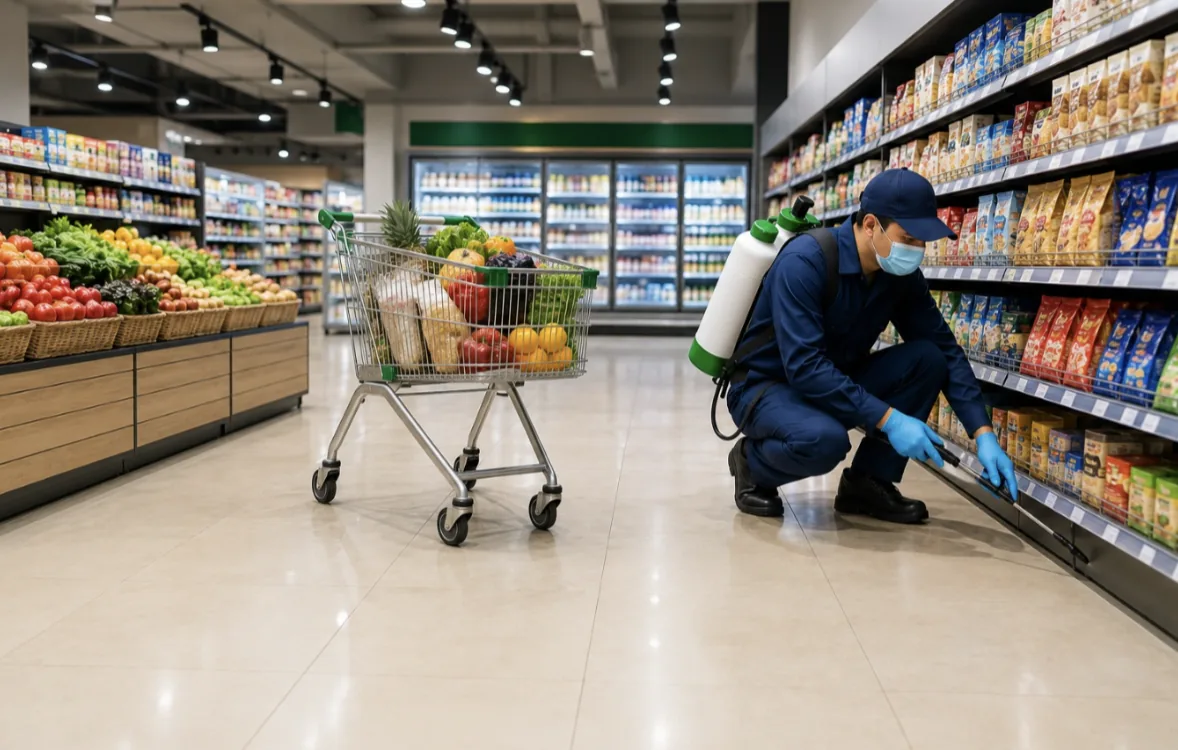
Pest Control for Supermarkets
Supermarkets require particularly comprehensive pest management because multiple risk environments exist under one roof, including fruit and vegetable sections, grocery aisles, bakery areas, meat sections, refrigeration areas, storage rooms, loading docks, staff pantries and waste areas — back-of-house zones that carry many of the same risks as a warehouse's storage areas.
Pest monitoring should cover both customer-facing and back-of-house areas. Food retailers may also find our guide to Pest Control for Restaurants: Maintaining Health Code Compliance useful for food-handling sections.
Protecting Retail Inventory from Rodents
Rodent prevention deserves special attention because one animal can damage multiple products without consuming them. Retail stores should avoid placing stock directly against walls wherever operationally practical — this makes inspection easier and reduces concealed harbourage.
Other preventive measures include inspecting incoming deliveries, removing damaged cartons, sealing structural openings, maintaining organised storage, monitoring false ceilings, keeping loading doors closed when not in use, and investigating rodent signs immediately.
Pest Control and Customer Experience
Customers rarely know about the pest-control work happening behind the scenes. That is exactly how successful preventive pest management should work — the best pest-control result for a retail business is often that the customer never sees the pest.
Clean aisles, hygienic food sections and pest-free shopping environments contribute to a positive customer experience. Pest management should therefore be considered part of overall store hygiene and customer-service standards.
Protecting Your Online Reputation
Retail businesses increasingly depend on Google reviews, social media, local search, customer recommendations and online marketplaces. A pest-related complaint can affect these channels.
Preventive pest management helps retailers address pest risks before they become customer complaints. For larger retail brands with multiple branches, maintaining consistent pest-management standards across locations is especially important.
Pest Control Documentation for Retail Businesses
Commercial retail properties can benefit from maintaining organised pest-control records, including the pest-control agreement, scope of work, service schedule, service reports, pest-sighting register, rodent monitoring map, monitoring records, treatment details, product information, corrective-action reports and follow-up reports.
Documentation allows management to identify recurring patterns. For example, repeated rodent activity near one loading door may indicate a structural gap that requires repair rather than additional treatment.
Ready to get this sorted? Ask us about a structured, documented treatment plan.
Book Free Inspection WhatsApp UsPest Trend Analysis
Instead of viewing every pest sighting as a separate incident, businesses should analyse patterns by asking where pest activity is repeatedly occurring, what time it is being observed, which pest is involved, what environmental condition is supporting it, and whether the recommended corrective action has been completed.
This approach turns pest control from an emergency service into a preventive management system.
Retail Pest Control AMC
An Annual Maintenance Contract (AMC) can be particularly useful for supermarkets, malls and retail chains. A customised AMC may include scheduled inspections, cockroach management, rodent monitoring, ant control, fly management, general pest control, monitoring devices, corrective recommendations, service documentation and emergency response where included.
The appropriate service frequency should depend on the property's risk level, size, stock type, operating hours and previous pest activity. When comparing providers, see our guide on Choosing a Commercial Pest Control Provider.
Pest Control for Shopping Malls
Shopping malls present additional challenges because multiple businesses operate within the same property. A pest problem in one food outlet can potentially affect neighbouring premises.
Mall pest management should therefore consider food courts, restaurants, retail shops, basements, parking areas, loading docks, common washrooms, garbage rooms, drainage systems, landscaped areas and utility corridors. Coordinated pest management between property management and individual tenants can provide stronger results than isolated treatment.
Retail Store Pest Prevention Checklist
Store managers should regularly check that:
- Incoming goods are inspected
- Damaged cartons are removed
- Stock is organised
- Unnecessary cardboard is discarded
- Food spills are cleaned promptly
- Waste bins remain covered
- Garbage is removed regularly
- Water leaks are repaired
- Door gaps are sealed
- Pipe and cable openings are closed
- Loading doors remain closed when possible
- Monitoring devices remain correctly positioned
- Pest sightings are recorded
- Corrective actions are completed
- Pest-control service records are maintained
Benefits of Professional Pest Control for Retail Stores
Professional pest management helps businesses:
- Protect Inventory. Reducing pest activity helps minimise damage to products, packaging, wiring and storage materials.
- Protect Customers. A clean, pest-managed environment contributes to a better shopping experience.
- Protect Reputation. Preventive pest management reduces the risk of visible pest activity becoming an online complaint.
- Detect Problems Early. Monitoring allows pest activity to be identified before it becomes widespread.
- Reduce Product Loss. Preventing infestations can help reduce stock damage and unnecessary disposal.
- Improve Store Hygiene. Pest management works alongside housekeeping, waste management and facility maintenance.
- Improve Management Visibility. Service reports and monitoring records help managers understand pest trends and corrective actions.
Professional Retail Pest Control in Bangalore
Standard Pest Control provides professional pest-management solutions for retail and commercial properties across Bangalore. Programs can be customised for supermarkets, grocery stores, shopping malls, clothing stores, electronics showrooms, pharmacies, department stores, furniture stores, retail chains, convenience stores, and warehouses attached to retail outlets.
Our approach focuses on inspection, prevention, exclusion, monitoring, targeted treatment and documentation. Explore our related services: Cockroach Pest Control Bangalore, Rodent Pest Control Bangalore, Ant Pest Control Bangalore, Mosquito Pest Control Bangalore, Termite Control Bangalore, and Bed Bug Control Bangalore.
Frequently Asked Questions
How often should retail stores have pest control?
The frequency depends on the type of store, products sold, pest history, operating hours, food handling, waste generation and surrounding environment. Supermarkets and food retailers may require more frequent monitoring than lower-risk stores.
What are the most common pests in retail stores?
Rodents, cockroaches, ants and flies are common concerns. Stores selling food products may also encounter stored-product insects.
How can retailers prevent rodents?
Seal structural openings, maintain organised storage, inspect incoming deliveries, manage waste properly and use a systematic rodent-monitoring program.
Can pest control be performed while a store is open?
Some inspections and monitoring activities may be possible during operating hours. Chemical treatments should be planned according to the product label, treatment area and customer or employee exposure considerations.
Should supermarkets have a pest-control AMC?
A preventive AMC can be valuable because supermarkets experience continuous movement of food, deliveries, customers and waste. Scheduled inspection and monitoring can help identify pest activity early.
Why is IPM better for retail stores?
Integrated Pest Management addresses the conditions that allow pests to survive — such as entry points, food, water and harbourage — rather than depending entirely on pesticide application.
Conclusion
Pest control for retail stores is about protecting more than the premises — it protects inventory, customers and business reputation.
Waiting until a customer sees a cockroach or rodent can turn a manageable pest issue into a public complaint. A preventive Integrated Pest Management program provides a stronger approach through inspection, sanitation, exclusion, monitoring, targeted treatment and documentation.
For supermarkets, malls, pharmacies, showrooms, grocery stores and other retail businesses in Bangalore, professional pest management can help maintain a cleaner environment while protecting valuable stock and delivering the shopping experience customers expect.
Related reading: Pest Control for Restaurants: Maintaining Health Code Compliance | Pest Control for Warehouses and Storage Facilities: Protecting Goods from Damage | IPM for Commercial Properties: A Strategic Approach to Business Protection | Documentation in Commercial Pest Control: Why Records Matter | Choosing a Commercial Pest Control Provider: What to Look For | Pest Control for Salons and Spas: Cleanliness and Client Comfort