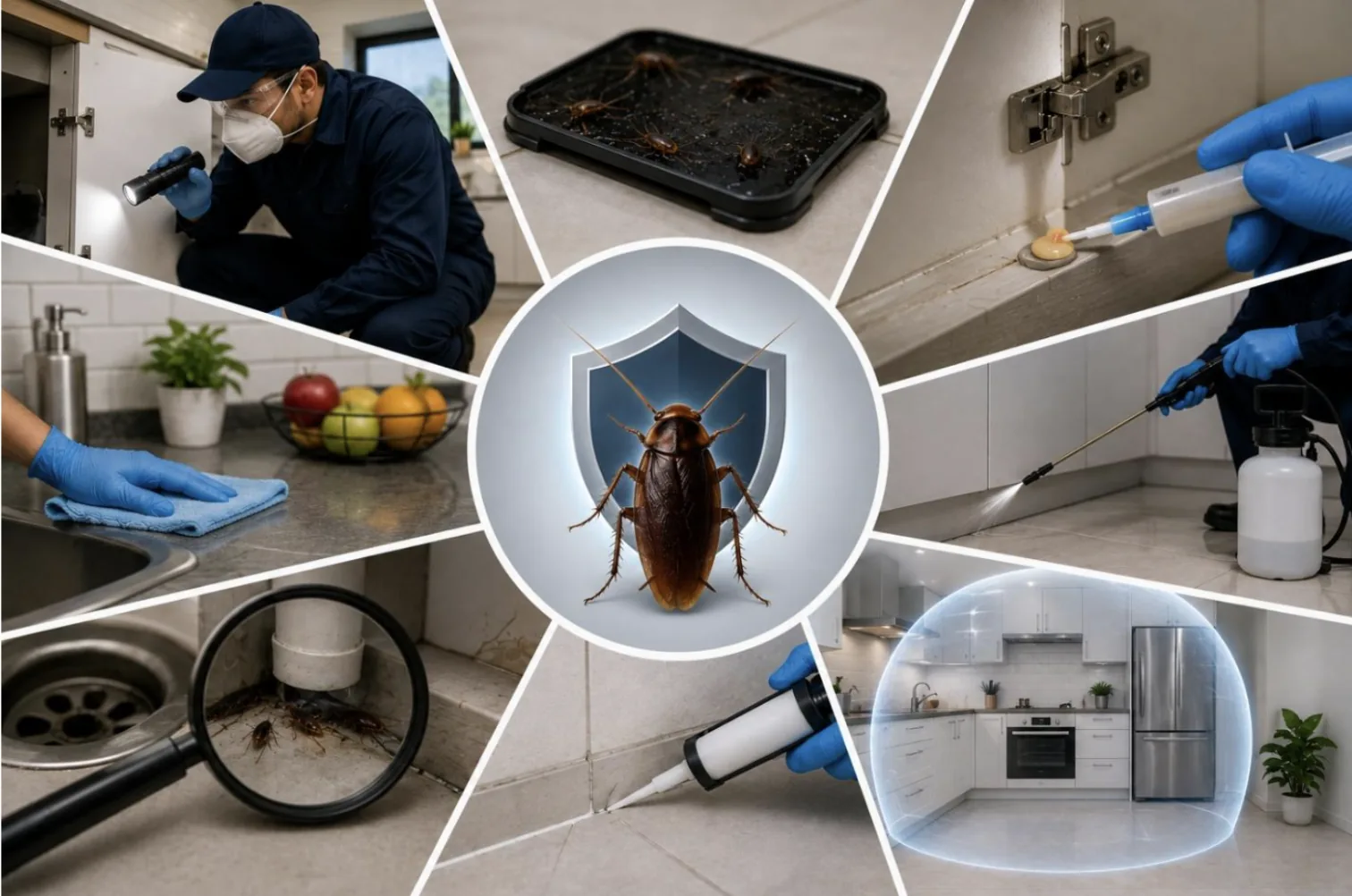
Cockroach control is not simply about spraying insecticide whenever you see a cockroach. A successful long-term program requires understanding why cockroaches are present, where they are hiding, what is supporting their population, and how they are entering the property.
This is where Integrated Pest Management (IPM) becomes valuable.
Integrated Pest Management combines inspection, sanitation, exclusion, monitoring, targeted treatment, and prevention to manage cockroach populations while reducing unnecessary pesticide use.
For homes, apartments, restaurants, hotels, hospitals, offices, and other commercial properties, an IPM-based approach can provide a more systematic and sustainable solution to recurring cockroach problems.
What Is Integrated Pest Management (IPM)?
Integrated Pest Management is a pest-control strategy that uses multiple compatible methods rather than relying exclusively on pesticide application. For cockroaches, a typical IPM program may include:
Each step addresses a different part of the cockroach problem. Instead of asking "Which chemical should we spray?", IPM asks "Why are cockroaches surviving here, and what needs to change to control them?" That difference is important.
Why Is IPM Effective for Cockroach Control?
Cockroaches require three basic resources:
They also need a way to enter or move through the property. If a treatment kills some cockroaches but food, moisture, hiding places, and entry routes remain unchanged, the conditions that created the infestation are still present.
IPM attempts to address both:
This can make pest management more effective over the long term.
1. IPM Starts With a Detailed Inspection
Inspection is the foundation of professional cockroach management. Before treatment begins, technicians should identify areas of activity and potential harbourages — common inspection locations include kitchen cabinets, cabinet hinges, under sinks, behind refrigerators, cooking appliances, plumbing areas, drains, cracks and crevices, utility shafts, storage rooms, and garbage areas.
Technicians may also look for live cockroaches, nymphs, egg cases, droppings, shed skins, moisture, and food residue. This information helps determine the severity and location of the infestation.
2. Correct Cockroach Identification Improves Treatment
Not all cockroaches behave in exactly the same way. German cockroaches, for example, are strongly associated with indoor kitchens and food-handling environments. Larger cockroach species may be associated with drains, basements, utility spaces, outdoor areas, or other damp environments.
Correct identification helps professionals determine:
Without identification, pest control can become little more than random pesticide application.
Want an evidence-based approach instead of guesswork? Get a free inspection and IPM-based treatment plan.
Book Free Inspection Call Now3. IPM Reduces Unnecessary Pesticide Use
One of the biggest benefits of IPM is that pesticide use is based on actual pest activity and need. Instead of routinely spraying every accessible surface, professional technicians can focus treatment on identified cockroach harbourages and movement areas.
Depending on the infestation, targeted treatment may include gel bait, bait stations, crack-and-crevice applications, appropriate targeted sprays, Insect Growth Regulators (IGRs), and monitoring traps. The objective is maximum pest-control effectiveness with minimum unnecessary pesticide application.
This is especially valuable in kitchens, homes, hospitals, schools, restaurants, and other sensitive environments.
4. Sanitation Removes Cockroach Food Sources
Even an excellent treatment program can struggle when cockroaches have unlimited food. Cockroaches can survive on surprisingly small amounts of organic material — potential food sources include food crumbs, cooking grease, spilled liquids, uncovered food, garbage, pet food, and food residue underneath appliances.
An IPM program therefore includes sanitation recommendations. Homeowners and businesses may be advised to clean food spills promptly, remove grease deposits, keep food in sealed containers, empty garbage regularly, clean underneath appliances, and avoid leaving dirty dishes overnight — see our guide on cockroaches and food contamination for more on protecting your kitchen.
Sanitation does not replace treatment when an infestation already exists. It makes the environment less supportive of cockroach survival and helps other control methods work more effectively.
5. Moisture Management Reduces Cockroach Survival
Cockroaches also need water. Common moisture sources include leaking taps, damaged plumbing, water underneath sinks, condensation, wet cleaning areas, refrigerator drainage, and standing water.
IPM addresses these conditions. Repairing leaks and reducing unnecessary moisture can make harbourage areas less attractive to cockroaches — particularly important in kitchens, bathrooms, restaurants, and commercial food environments.
6. Exclusion Helps Stop Cockroaches From Returning
Controlling the current population is only part of the job. You should also ask: how are cockroaches entering the property?
Potential entry points include gaps around plumbing, cracks in walls, spaces underneath doors, drainage openings, utility conduits, gaps behind cabinets, damaged window screens, and service shafts. Appropriate openings can be sealed or otherwise managed — this process is known as exclusion.
Treatment controls the current infestation. Exclusion helps reduce reinfestation.
Recurring infestation despite regular spraying? Ask about our species-specific gel bait and exclusion plans.
Book Free Inspection WhatsApp Us7. Monitoring Shows Whether Treatment Is Working
A major advantage of IPM is that treatment decisions can be based on evidence. Sticky monitoring traps and visual inspections can help determine where cockroaches are most active, whether activity is increasing or decreasing, which areas require additional attention, and whether treatment has been successful. For example:
This provides much more useful information than simply asking whether someone happened to see a cockroach that day.
8. IPM Targets Hidden Cockroach Harbourages
Cockroaches spend much of their time hidden. Common harbourages include:
A professional IPM program focuses treatment near these areas instead of simply spraying the centre of a room. This is especially important for German cockroach infestations.
9. IPM Can Include Professional Gel Bait
Gel bait is frequently used as part of integrated cockroach management. Small amounts can be strategically placed close to cockroach harbourages — suitable placement locations may include cabinet hinges, drawer tracks, cracks and crevices, under sinks, behind appliances, and kitchen cabinet corners.
Correct bait placement helps cockroaches encounter the treatment during their normal movement and feeding activity. Sanitation also becomes important because other available food can compete with the bait.
10. IPM Can Incorporate Insect Growth Regulators
For some infestations, pest-management professionals may include Insect Growth Regulators (IGRs) as part of the program. IGRs interfere with aspects of insect development or reproduction. They are not necessarily designed to provide immediate visible knockdown — instead, their role can be to help manage the cockroach population over time.
This illustrates another important principle of IPM: different tools perform different jobs.
11. IPM Helps Reduce Repeated Broad Spraying
Without an integrated strategy, some properties enter a cycle:
This cycle can continue because the underlying causes remain unchanged. IPM changes the approach:
Instead of repeatedly reacting to visible cockroaches, the goal is to manage the entire infestation.
12. IPM Is Valuable for Bangalore Apartments
Apartment cockroach problems can be particularly challenging. Several units may share plumbing shafts, drainage systems, electrical conduits, utility ducts, garbage areas, and common service spaces.
Treating one apartment may reduce activity temporarily, but cockroaches can potentially move from other parts of the building. An IPM approach can identify these movement routes and recommend building-level preventive measures. For persistent apartment infestations, coordinated pest management may provide better results than repeatedly treating individual flats.
13. IPM Is Particularly Important for Restaurants
Restaurants provide many of the resources cockroaches need:
An IPM program for a restaurant may include kitchen inspection, monitoring traps, gel baiting, targeted treatment, drain management, grease removal, waste-management recommendations, structural sealing, and regular follow-up.
Rather than waiting until customers or employees see cockroaches, routine monitoring can identify activity earlier. This helps protect hygiene and business reputation.
14. IPM Supports Commercial Pest Management
Integrated pest management is also valuable for hotels, hospitals, offices, schools, retail stores, warehouses, food-processing facilities, commercial kitchens, and apartment complexes.
Commercial environments often benefit from documented inspection, monitoring, corrective actions, and preventive recommendations. This creates a structured pest-management program rather than a simple reactive spray service.
IPM vs Traditional Spray-Only Pest Control
| Spray-Only Approach | Integrated Pest Management |
|---|---|
| Cockroach appears, pesticide is sprayed | Property is inspected first |
| Visible insects die | Cockroach species is identified |
| Hidden harbourages may remain | Harbourages are located |
| Food and water remain | Food and moisture sources are reduced |
| Entry points remain | Entry points are addressed |
| Cockroaches may return | Activity is monitored and treatment adjusted |
The difference is simple: spray-only treatment reacts to the cockroach. IPM manages the infestation and the conditions supporting it.
Key Benefits of IPM for Cockroach Control
An effective IPM program can provide several advantages:
- Better targeting — treatment is concentrated where cockroaches are actually active
- Reduced unnecessary pesticide use — chemical treatment is used strategically rather than automatically across large areas
- Longer-term prevention — sanitation, exclusion, and moisture management help reduce conditions that support reinfestation
- Early detection — monitoring can identify activity before an infestation becomes severe
- Better decision-making — treatment decisions are based on inspection and monitoring rather than guesswork
- Suitable for sensitive environments — targeted pest management is particularly useful in homes, kitchens, hospitals, schools, hotels, and food-handling facilities
Can IPM Eliminate Cockroaches Permanently?
No responsible pest-control provider should promise that cockroaches can never return. Cockroaches may enter through deliveries, packaging, neighbouring apartments, drains, utility lines, or other pathways.
IPM instead aims to:
Long-term success depends on cooperation between pest-control professionals and property occupants.
What Can Homeowners Do?
You play an important role in IPM. Follow these simple practices:
- Keep kitchens clean
- Store food properly
- Empty garbage regularly
- Fix leaking taps
- Reduce standing water
- Seal suitable cracks and gaps
- Keep drains covered where appropriate
- Avoid unnecessary DIY spraying
- Follow technician recommendations
- Report recurring activity promptly
Professional treatment works best when the environment does not continuously provide cockroaches with food, water, and shelter.
Professional IPM Cockroach Control in Bangalore
Standard Pest Control provides professional cockroach pest control in Bangalore for residential and commercial properties. Our approach can combine:
Depending on the infestation and property, treatment may include professional gel bait, targeted insecticide applications, monitoring devices, and other appropriate methods. Services are available for apartments, independent houses, villas, restaurants, hotels, hospitals, offices, schools, shops, commercial kitchens, and industrial and commercial premises.
The objective is not simply to kill the cockroaches you can see. It is to understand why they are there and how to reduce the conditions allowing them to survive and return.
Frequently Asked Questions
What does IPM mean in cockroach control?
IPM stands for Integrated Pest Management. It combines inspection, monitoring, sanitation, exclusion, targeted treatment, and prevention to manage cockroach populations.
Is IPM better than simply spraying for cockroaches?
For long-term management, IPM provides a more comprehensive approach because it addresses both the cockroaches and environmental conditions such as food, moisture, harbourages, and entry points.
Does IPM use pesticides?
Yes, pesticides can be part of an IPM program when appropriate. The goal is to use suitable products strategically and only where necessary rather than relying entirely on broad pesticide application.
Can cockroach gel be part of IPM?
Yes. Professional gel bait is commonly incorporated into IPM programs for suitable indoor cockroach infestations.
How does monitoring help cockroach control?
Monitoring helps identify activity hotspots and determine whether cockroach populations are increasing or decreasing after treatment.
Is IPM suitable for restaurants?
Yes. Restaurants can particularly benefit from IPM because sanitation, monitoring, waste management, moisture control, targeted treatment, and documentation are all important for managing cockroach risks.
Is IPM useful for apartments?
Yes. IPM can be especially valuable in apartments because cockroaches may travel through shared plumbing, drainage, utility shafts, and structural openings.
How long does IPM take to work?
The timeline depends on the cockroach species, infestation level, property conditions, treatment selected, and cooperation with sanitation and exclusion recommendations. Established infestations may require treatment plus follow-up monitoring.
Final Takeaway
The biggest benefit of Integrated Pest Management is that it changes the question from "What should we spray?" to "Why are cockroaches surviving here, and how do we stop them?"
Effective IPM combines:
This approach can reduce unnecessary pesticide use, improve treatment targeting, identify infestations earlier, and provide better long-term cockroach prevention.
For homes and businesses dealing with recurring cockroach problems, Integrated Pest Management provides a structured approach to controlling both the pest and the conditions supporting it.
Related reading: What to Expect During a Professional Cockroach Extermination Service | Cockroaches and Food Contamination: Protecting Your Kitchen | Are Cockroaches a Health Risk? Allergies, Asthma and Disease Transmission | Cockroaches and Electrical Damage: A Hidden Danger | The Role of Research in Advancing Pest Control Solutions