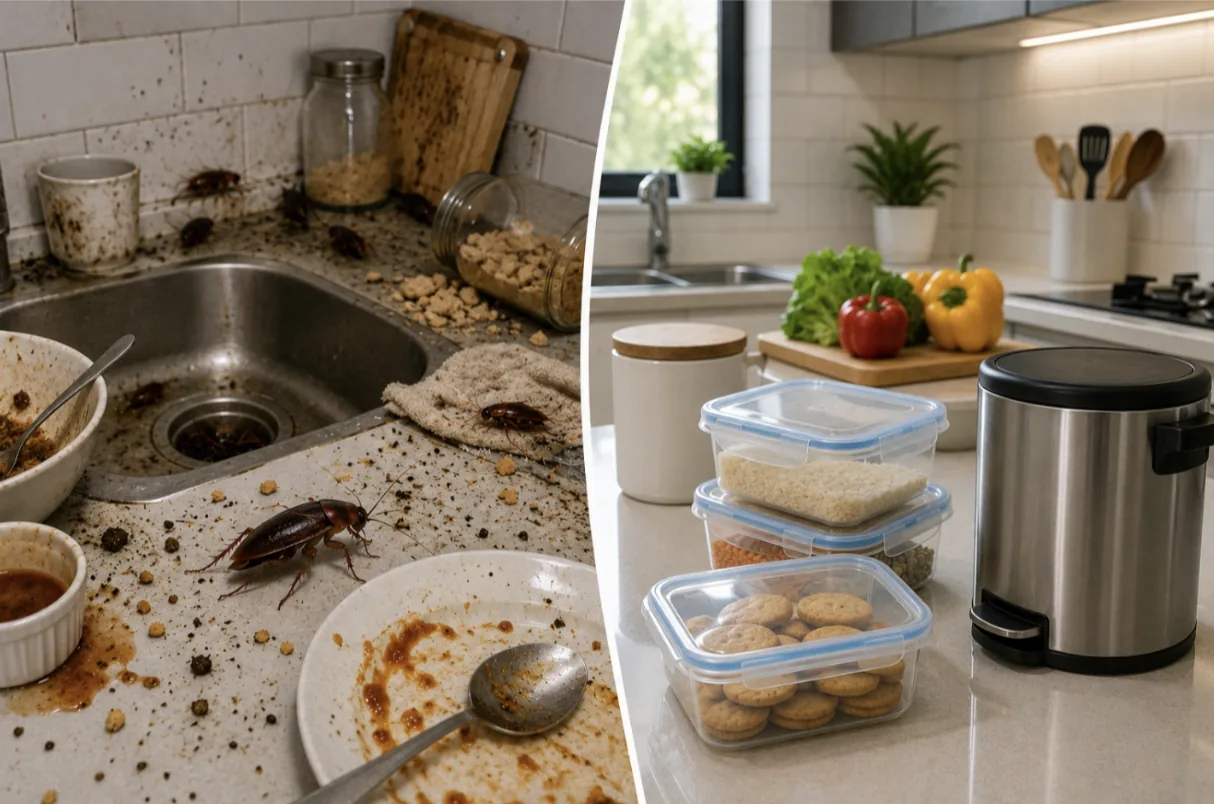
Your kitchen should be one of the cleanest and safest areas of your home. Unfortunately, it is also one of the most attractive places for cockroaches.
Food crumbs, cooking grease, water, warmth, garbage, appliances, cabinets, and numerous hiding places can create ideal conditions for cockroach activity.
The concern is not simply that cockroaches look unpleasant. Cockroaches may travel through drains, garbage areas, dirty surfaces, and other contaminated environments before moving across kitchen counters, utensils, food-storage areas, and exposed food. This creates an important question: can cockroaches contaminate your food?
Yes. Cockroaches can contribute to food contamination by mechanically transferring microorganisms and leaving behind droppings, body fragments, and other biological material.
Understanding how contamination occurs — and how to prevent it — is an important part of maintaining a hygienic kitchen and controlling a cockroach infestation before it spreads.
Why Are Cockroaches Attracted to Kitchens?
Cockroaches require three basic resources:
A kitchen can provide all three.
Food — cockroaches can feed on crumbs, grease, food spills, uncovered food, garbage, pet food, and residue underneath appliances.
Water — moisture can come from kitchen sinks, leaking taps, plumbing leaks, wet sponges, standing water, and refrigerator drainage.
Shelter — cockroaches prefer protected locations such as cabinet hinges, drawer tracks, behind refrigerators, under sinks, appliances, cracks and crevices, and plumbing openings.
This combination makes kitchens particularly vulnerable to infestation.
How Do Cockroaches Contaminate Food?
Cockroaches are scavenging insects. Depending on their environment, they may move through:
During this movement, microorganisms and contaminated material can potentially be carried on their bodies. Cockroaches may then walk across food, plates, cutting boards, countertops, utensils, storage shelves, and cooking equipment.
This is known as mechanical transmission. The cockroach acts as a physical carrier between contaminated and clean environments.
What Can Cockroaches Leave Behind?
Food contamination isn't limited to the cockroach physically touching food. Cockroach infestations can also leave behind droppings, shed skins, egg cases, body fragments, secretions, and dead cockroaches.
These materials can contaminate storage and food-preparation environments. Some cockroach debris can also contribute to indoor allergens — see our guide on whether cockroaches are a health risk for more on allergies and asthma triggers.
What Microorganisms Are Associated With Cockroaches?
Studies of cockroaches collected from contaminated environments have detected different microorganisms, including certain bacteria and fungi. Bacteria reported in association with cockroaches in various studies include organisms from groups such as Salmonella, E. coli, Staphylococcus, Klebsiella, and Pseudomonas.
This does not mean every cockroach carries all these organisms or that seeing one cockroach means someone will become sick. The important point is that cockroaches can move between contaminated environments and food-handling areas. That is enough to make established infestations a hygiene concern.
Cockroaches active around your kitchen? Get a free inspection and treatment plan.
Book Free Inspection Call NowShould You Eat Food That a Cockroach Has Touched?
If you know that a cockroach has directly crawled over exposed, ready-to-eat food, the safer choice is generally to discard it. This is particularly important for cooked food, children's food, bakery products, cut fruits, snacks, and uncovered leftovers.
Do not simply remove the visible portion and assume the remaining food is uncontaminated. Prevention is better — keep food covered so cockroaches cannot access it in the first place.
What About Packaged Food?
Inspect food packaging carefully. Cockroaches may hide around cardboard cartons, paper packaging, food-storage boxes, and grocery bags. Check for droppings, egg cases, live cockroaches, and damaged packaging.
Sealed, intact packaging provides better protection than open or loosely closed food packets. For long-term storage, transfer appropriate dry foods into tightly closed containers.
Can Cockroaches Contaminate Kitchen Utensils?
Yes, cockroaches may crawl across stored utensils — plates, spoons, cups, glasses, cooking vessels, and cutting boards. If you discover cockroach activity or droppings in a utensil-storage cabinet, clean and appropriately wash the affected utensils before use.
Then address the infestation. Repeatedly washing utensils without eliminating the cockroaches will not solve the underlying problem.
Pay Special Attention to Cutting Boards
Cutting boards come into direct contact with food. Keep them clean, dry, properly stored, and protected from pest activity. If cockroach contamination is suspected, clean and sanitize the board appropriately according to the material and manufacturer's instructions. Replace heavily damaged cutting boards that cannot be cleaned effectively.
Keep Countertops Clean
Cockroaches may walk across kitchen counters at night while searching for food. Before preparing food, inspect the surface, clean visible contamination, and use appropriate kitchen-cleaning procedures.
At night, remove food crumbs, oil, spilled drinks, and uncovered food. A clean countertop provides cockroaches with fewer feeding opportunities.
Don't Forget the Area Behind the Refrigerator
The refrigerator is a common cockroach hotspot. Why? It can provide:
Food crumbs and grease can accumulate underneath or behind the refrigerator. Periodically clean accessible areas around appliances. If cockroaches repeatedly emerge from behind the refrigerator, professional inspection may be necessary.
Clean Under Cooking Appliances
Cooking areas can accumulate grease, oil, food particles, and crumbs. These residues may remain unnoticed underneath appliances. Regular cleaning helps remove food sources — however, do not dismantle electrical or gas appliances unless qualified to do so.
Recurring cockroach activity despite cleaning regularly? Ask about our species-specific gel bait and monitoring plans.
Book Free Inspection WhatsApp UsControl Kitchen Garbage
Garbage is a major cockroach food source. Use a waste bin with a properly fitting lid. Good practices include removing food waste regularly, cleaning spills around the bin, washing dirty bins, and avoiding overnight accumulation of food waste where practical.
Commercial kitchens may require more frequent waste-management procedures.
Keep Your Sink Dry at Night
Cockroaches need water. After finishing kitchen work, remove food residue, clean the sink, repair dripping taps, and avoid unnecessary standing water.
A dry kitchen does not guarantee that cockroaches will disappear, but reducing moisture makes the environment less favourable.
Fix Plumbing Leaks
Check underneath your sink regularly. Look for dripping pipes, loose fittings, damp cabinet material, and standing water. Plumbing leaks provide cockroaches with both moisture and protected harbourage. Repair leaks promptly.
Store Food in Closed Containers
Proper food storage is one of the easiest cockroach-prevention measures. Store items such as rice, flour, cereals, sugar, snacks, and pet food in appropriately sealed containers. This prevents cockroaches from accessing food and also helps protect stored products from other pests.
Don't Leave Pet Food Overnight
Pet food is still food to a cockroach. Where practical, remove leftover pet food, clean feeding areas, and store pet food securely. Water bowls should be managed according to your pet's needs, but spills around the feeding area should be cleaned.
Check Grocery and Delivery Packaging
Cockroaches can sometimes be transported into properties through packaging. Inspect grocery cartons, delivery boxes, used appliances, and storage boxes. Avoid keeping unnecessary cardboard in the kitchen for long periods — cardboard can provide hiding places for cockroaches.
Look for Cockroach Droppings
Droppings are an important sign of infestation. They may appear around cabinet corners, drawer tracks, under sinks, appliances, shelves, and food-storage areas. If you clean the droppings and they quickly reappear, active cockroach harbourages are likely nearby. Professional inspection may be necessary.
Baby Cockroaches Are an Important Warning Sign
Seeing small cockroaches, or nymphs, in your kitchen can indicate that cockroaches are reproducing nearby. Common breeding and harbourage areas include:
At this point, simply spraying the visible cockroaches may not be enough. The breeding population needs to be addressed.
Why Random Household Spraying Can Be a Problem
It may be tempting to spray insecticide whenever a cockroach appears. But indiscriminate spraying in a kitchen can create unnecessary pesticide exposure and may fail to reach hidden harbourages.
Never spray pesticides directly onto food, food-preparation surfaces, cooking utensils, or dishes unless a product is specifically labelled and instructed for that use. Always follow pesticide labels.
For established infestations, targeted professional treatment is generally a better approach than repeated random spraying.
How Professional Cockroach Treatment Protects Kitchens
Professional cockroach management begins with inspection. Technicians may examine:
Treatment can then be directed toward the areas where cockroaches are actually hiding. Depending on the infestation, this may include gel bait, targeted crack-and-crevice treatment, monitoring, sanitation recommendations, and entry-point management.
The objective is to control the infestation while minimizing unnecessary pesticide application to exposed kitchen surfaces.
The Role of Integrated Pest Management
Integrated Pest Management (IPM) is particularly suitable for kitchens. Instead of relying exclusively on pesticides, IPM combines:
This addresses both the cockroach population and the environment supporting it. For long-term kitchen protection, this is often more effective than simply spraying whenever cockroaches appear.
Food Safety in Restaurants and Commercial Kitchens
Cockroach prevention is even more important in commercial food environments. Restaurants, hotels, bakeries, cafés, canteens, and food-processing areas should maintain a structured pest-management program, including scheduled inspections, monitoring traps, kitchen sanitation, drain management, waste management, structural maintenance, targeted treatment, and pest-control documentation.
Waiting until customers see cockroaches is not a good pest-management strategy. Prevention and early detection are critical.
A Simple Night-Time Kitchen Routine
Before going to bed:
- Store food — cover or refrigerate exposed food
- Clean counters — remove crumbs and grease
- Wash dishes — avoid leaving dirty dishes overnight where practical
- Remove food waste — empty or properly secure garbage
- Check the sink — remove food residue and unnecessary standing water
- Store pet food — remove leftovers
This simple routine can significantly reduce resources available to cockroaches.
Kitchen Cockroach Prevention Checklist
Food & Storage
- Food stored in closed containers
- No exposed leftovers overnight
- Food waste removed regularly
- Pet food properly stored
- Cardboard clutter reduced
Cleaning & Monitoring
- Countertops clean, grease removed
- Sink clean, leaking taps repaired
- Under-sink area dry
- Garbage covered
- Refrigerator area cleaned
- Cracks and gaps inspected
- Cockroach activity monitored
When Should You Call Professional Pest Control?
Consider professional cockroach pest control if you notice frequent cockroach sightings, baby cockroaches, egg cases, droppings, daytime activity, cockroaches around food, cockroaches inside cabinets, activity around appliances, infestation spreading to multiple rooms, or cockroaches returning after DIY treatment.
Food-handling businesses should respond promptly to any evidence of cockroach activity.
Professional Cockroach Control in Bangalore
Standard Pest Control provides professional cockroach pest control in Bangalore for residential and commercial kitchens. Services are suitable for apartments, independent houses, villas, restaurants, hotels, cafés, bakeries, hospitals, offices, commercial kitchens, and other food-handling premises.
Our approach focuses on:
Depending on the infestation, professional treatment may include gel baiting, targeted applications, monitoring, sanitation recommendations, and exclusion advice. The objective isn't simply to kill visible cockroaches. It is to protect the areas where your food is stored, prepared, and served.
Frequently Asked Questions
Can cockroaches contaminate food?
Yes. Cockroaches can mechanically carry microorganisms and contaminated material from unsanitary environments onto food and food-contact surfaces.
Should I throw away food if a cockroach crawled on it?
For exposed ready-to-eat food that has clearly been contacted by a cockroach, discarding it is generally the safer option.
Can cockroaches contaminate plates and utensils?
Yes. If cockroach activity occurs inside utensil-storage areas, wash affected utensils appropriately before use and address the infestation.
Do cockroaches carry Salmonella?
Studies have detected Salmonella and other microorganisms in association with cockroaches from certain environments. This does not mean every cockroach carries Salmonella, but it demonstrates why infestations are considered a hygiene concern.
Why are cockroaches always in my kitchen?
Kitchens can provide food, moisture, warmth, and numerous hiding places, making them attractive cockroach environments.
How can I keep cockroaches away from food?
Keep food covered, use sealed containers, clean spills and grease, manage garbage, reduce moisture, remove cardboard clutter, seal appropriate entry points, and control existing infestations.
Is cockroach gel suitable for kitchens?
Professional gel bait can be used in appropriate protected locations according to its product label. It should not be applied directly to food or food-contact surfaces.
When should I call professional cockroach control?
Professional treatment should be considered when cockroaches repeatedly appear, nymphs or egg cases are present, droppings accumulate, or cockroaches are active around food-storage and preparation areas.
Final Takeaway: Protect the Place Where Your Food Is Prepared
Cockroaches and kitchens are a dangerous combination from a hygiene perspective. The problem isn't simply seeing an unpleasant insect. It is the possibility of cockroaches moving:
Protecting your kitchen requires more than killing individual cockroaches. The most effective approach combines:
If cockroaches are already breeding inside cabinets, appliances, or other hidden kitchen areas, professional inspection and targeted treatment may be necessary. A cockroach-free kitchen isn't only more comfortable — it is an important part of maintaining a clean and hygienic food environment.
Related reading: What to Expect During a Professional Cockroach Extermination Service | Are Cockroaches a Health Risk? Allergies, Asthma and Disease Transmission | The Psychological Impact of Cockroaches: Fear, Disgust and Stress | Can Cockroaches Bite Humans? Understanding Their Behavior