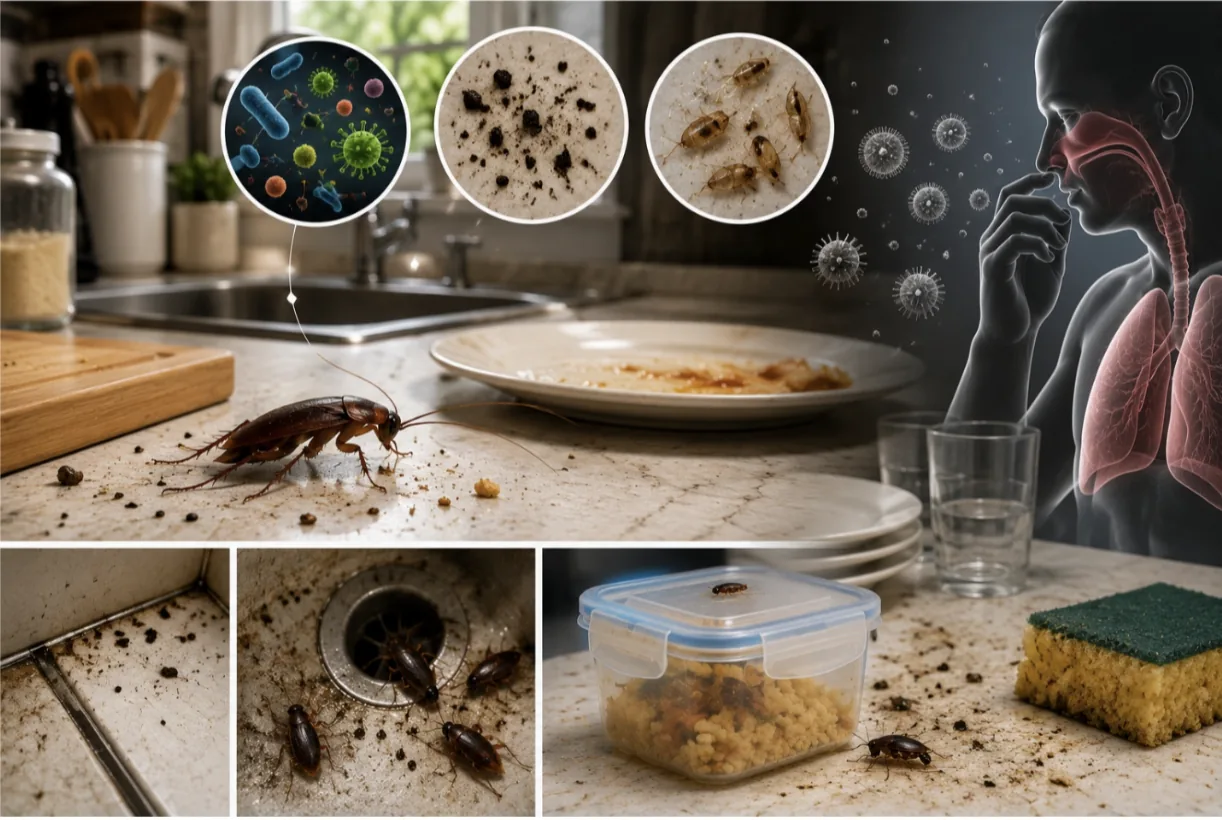
Cockroaches are more than an unpleasant sight in the kitchen. Their presence can create genuine hygiene and health concerns, particularly when infestations occur in homes, restaurants, hospitals, schools, food-handling areas, and other sensitive environments.
Cockroaches can pick up microorganisms as they move through garbage, drains, sewage-associated environments, and contaminated surfaces. Their droppings, shed body parts, and other debris can also contribute to indoor allergens.
For families, one of the most important questions is: are cockroaches actually dangerous to human health?
The answer is that cockroaches can contribute to allergen exposure, asthma problems in susceptible individuals, food contamination, and mechanical transmission of microorganisms. However, it is important to distinguish these risks from the idea that every cockroach directly infects a person.
Understanding the real risks can help you respond appropriately without unnecessary fear — and know when a cockroach infestation needs professional attention.
Why Cockroaches Are a Hygiene Concern
Cockroaches are scavengers. Depending on the environment, they may travel through garbage areas, drains, sewage-associated locations, food waste, dirty storage spaces, bathrooms, and kitchens. They can later move across food-storage and food-preparation areas.
This movement is one reason cockroach infestations should not be ignored. The issue isn't simply "There is an insect in my kitchen." The concern is "Where has that insect travelled before reaching my kitchen?"
Cockroaches and Disease Transmission
Cockroaches are generally discussed as mechanical carriers of microorganisms. This means bacteria and other microbes may be picked up on their bodies or through contaminated material and transported to another location.
Cockroaches are different from biological disease vectors such as mosquitoes, where a pathogen develops or multiplies within the insect as part of its transmission cycle. With cockroaches, the concern is largely contamination. For example:
This is why controlling cockroaches is particularly important in food-handling environments.
What Types of Microorganisms Can Cockroaches Carry?
Research has detected various microorganisms associated with cockroaches collected from contaminated environments. These can include certain bacteria, fungi, parasites, and other microbes. Bacterial organisms associated with cockroaches in different studies have included species or groups such as Salmonella, E. coli, Staphylococcus, Klebsiella, and Pseudomonas.
However, finding a microorganism on a cockroach does not automatically mean that every cockroach carries it or that seeing a cockroach means someone will become ill. The practical message is simpler: cockroaches can move between contaminated environments and food or living spaces, creating an avoidable hygiene risk.
Worried about cockroach contamination in your kitchen? Get a free inspection and treatment plan.
Book Free Inspection Call NowCockroaches and Food Contamination
Food contamination is one of the most important reasons cockroaches should be controlled in kitchens. Cockroaches may contaminate exposed food, cooking surfaces, kitchen cabinets, utensil-storage areas, food containers, and preparation equipment.
Contamination can occur through contact with their bodies, droppings, regurgitated material, or other debris. Food that has clearly been contaminated by cockroaches should be discarded.
Can Cockroaches Cause Food Poisoning?
Cockroaches do not cause every case of food poisoning. However, because they can mechanically carry microorganisms from unsanitary environments to food and food-contact surfaces, infestations can contribute to contamination risk.
In homes, good sanitation and cockroach control help reduce this risk. In restaurants and commercial kitchens, prevention is even more important because a single hygiene failure can affect many customers.
Cockroaches and Allergies
Disease transmission isn't the only health concern associated with cockroaches. Cockroach allergens are an important indoor environmental issue. Allergenic material can come from droppings, saliva, shed body parts, and other cockroach debris. These particles can accumulate in dust.
Sensitive individuals may develop or experience symptoms such as sneezing, nasal congestion, itchy or watery eyes, skin irritation, and coughing. Symptoms vary significantly between individuals — not everyone exposed to cockroaches will develop an allergy.
Cockroaches and Asthma
Cockroach allergen exposure is particularly important for people who are already sensitized. Research has associated cockroach allergen exposure with asthma symptoms and asthma morbidity, particularly in some children living in environments with significant infestation.
Cockroach allergens can become part of household dust and may be present around kitchens, bedrooms, cabinets, floors, furniture, and cracks and crevices.
For an individual with asthma or suspected allergies, medical advice should come from a qualified healthcare professional. Pest management can help address the environmental cockroach source, but it is not a substitute for medical care.
Why Children May Require Extra Attention
Children spend significant amounts of time close to floors and household surfaces. They may also be more likely to come into contact with dust containing environmental allergens.
In homes with recurring cockroach infestations, reducing cockroach populations and cleaning contaminated dust and debris can therefore be particularly important. A comprehensive approach may include:
Cockroach Droppings Are an Important Warning Sign
Cockroach droppings indicate active or recent cockroach activity. Depending on the species, they may appear as tiny dark specks, pepper-like marks, or larger dark droppings. They are commonly found around kitchen cabinets, drawer corners, under sinks, behind appliances, storage areas, and harbourages.
Avoid handling cockroach debris with bare hands. Clean contaminated areas using appropriate hygiene precautions. If droppings repeatedly return after cleaning, the underlying infestation needs to be addressed.
Cockroach Body Parts Can Contribute to Allergens
Even dead cockroaches can remain relevant from an allergen perspective. Shed skins and body fragments can break down and become part of household dust. This means successful pest management should involve more than simply killing cockroaches.
After the infestation has been controlled, appropriate cleaning can help remove:
This can reduce the amount of cockroach material remaining in the indoor environment.
Recurring droppings or allergy symptoms at home? Ask about our species-specific treatment and monitoring plans.
Book Free Inspection WhatsApp UsAre Cockroaches Dangerous if They Walk Across Food?
Food that has been directly exposed to cockroach activity should generally not be consumed. The safest approach is to discard food that has clearly been contaminated. Food should be stored in properly closed containers to reduce future access — this is especially important for ready-to-eat foods, children's food, bakery products, snacks, open food packets, and pet food.
Can Cockroaches Contaminate Utensils?
Cockroaches may move across utensils and food-storage areas. If you find cockroach activity or droppings around stored utensils, clean the affected utensils appropriately before using them. The underlying infestation should also be controlled — repeatedly washing utensils without eliminating cockroach harbourages only addresses the result, not the source.
Why Cockroaches Are a Serious Concern in Restaurants
Cockroach infestations are particularly problematic in food businesses. Restaurants can provide ideal conditions:
Potential cockroach harbourages include cooking equipment, refrigerators, storage areas, drains, cabinets, food-preparation stations, and waste areas. Cockroach activity can affect food hygiene, customer confidence, business reputation, and pest-management compliance.
Restaurants should therefore emphasize preventive pest management rather than waiting for visible infestation.
Cockroaches in Hospitals and Healthcare Facilities
Healthcare environments require particularly careful pest management. Cockroach activity in hospitals can create concerns because these environments contain vulnerable patients and areas where high hygiene standards are essential.
Pest-management programs should emphasize inspection, monitoring, sanitation, structural maintenance, exclusion, and carefully targeted treatment. Pesticide selection and application in sensitive healthcare environments require appropriate professional judgment.
Cockroaches in Schools
Schools and childcare environments can also benefit from Integrated Pest Management. Instead of relying on routine broad pesticide application, an IPM approach may focus on:
This helps address the cockroach problem while reducing unnecessary pesticide use.
Signs That Cockroaches May Be Affecting Your Indoor Environment
Look for repeated cockroach sightings, nymphs, droppings, egg cases, shed skins, cockroaches around food, activity inside cabinets, and persistent infestation.
These signs do not mean that someone will become sick. They do mean that the infestation should be addressed from a hygiene and pest-management perspective.
Why Simply Spraying Visible Cockroaches Is Not Enough
Cockroaches spend much of their time hidden. Common harbourages include:
Spraying one visible cockroach does not necessarily control the population living in these areas. Professional cockroach management therefore focuses on locating and treating the infestation rather than only killing insects that happen to appear.
The Role of Integrated Pest Management
Integrated Pest Management (IPM) is particularly useful when cockroach control is being undertaken for health and hygiene reasons. An IPM program can include:
- Inspection — locate cockroach harbourages and activity
- Monitoring — use evidence to determine where activity is highest
- Sanitation — remove food residue, grease, and garbage
- Moisture management — repair leaks and reduce standing water
- Exclusion — seal suitable entry points
- Targeted treatment — use appropriate professional products only where needed
- Follow-up — confirm that activity is decreasing
This approach addresses both the cockroaches and the conditions that allow them to survive.
How to Reduce Cockroach-Related Health Risks at Home
- Keep food covered — store food in sealed containers
- Clean kitchen surfaces — remove crumbs, grease, and food spills
- Empty garbage regularly — keep bins closed and clean
- Repair water leaks — reduce moisture available to cockroaches
- Clean under appliances — food residue often accumulates underneath refrigerators and cooking equipment
- Seal entry points — close appropriate gaps around plumbing, cabinets, doors, and walls
- Remove cockroach debris — after controlling the infestation, clean droppings, shed skins, and dead cockroaches appropriately
- Arrange professional treatment when needed — recurring infestations require more than repeated DIY spraying
When Should You Call Professional Cockroach Control?
Consider professional pest control if you notice frequent cockroach sightings, cockroaches during daytime, nymphs, egg cases, large amounts of droppings, activity around food, cockroaches in multiple rooms, or recurring infestation after DIY treatment.
Businesses handling food should respond particularly quickly to evidence of cockroach activity.
Professional Cockroach Control in Bangalore
Standard Pest Control provides professional cockroach pest control in Bangalore for residential and commercial properties. Our approach focuses on:
Depending on the infestation and property, professional treatment may include gel baiting, targeted applications, monitoring, and other suitable pest-management methods. Services are available for apartments, independent houses, villas, restaurants, hotels, hospitals, schools, offices, shops, commercial kitchens, and other commercial premises.
Cockroach control isn't only about making your property look cleaner. It is also an important part of maintaining a hygienic indoor environment.
Frequently Asked Questions
Are cockroaches dangerous to humans?
Cockroaches can contribute to health and hygiene risks by mechanically carrying microorganisms and through allergenic material in their droppings, shed skins, saliva, and debris.
Can cockroaches spread disease?
Cockroaches can mechanically transport microorganisms from contaminated areas to food and surfaces. This differs from biological vectors such as mosquitoes.
Can cockroaches cause asthma?
Cockroach allergens can trigger or worsen asthma symptoms in people who are sensitized, and exposure has been associated with asthma morbidity, particularly in some children.
Can cockroach droppings cause allergies?
Cockroach droppings contain allergenic material that can become part of household dust and may trigger symptoms in sensitized individuals.
Can cockroaches contaminate food?
Yes. Cockroaches can move across food and food-contact surfaces after travelling through contaminated environments. Food clearly contaminated by cockroaches should be discarded.
Should I throw away food if a cockroach touched it?
If food has clearly been exposed to cockroach contamination, particularly ready-to-eat food, discarding it is the safer option.
Does killing cockroaches remove allergens?
Not completely. Dead cockroaches, droppings, and shed skins can remain sources of allergenic material. Cleaning after successful pest control is also important.
When should I call professional cockroach pest control?
Professional treatment should be considered when cockroaches appear repeatedly, nymphs or egg cases are present, droppings accumulate, DIY treatments fail, or cockroaches are present in food-handling environments.
Final Takeaway: Cockroaches Are More Than a Nuisance
Cockroaches should not be treated as merely an unpleasant household insect. Their presence can create three important concerns:
This does not mean every cockroach will cause illness. It means that established infestations create an unnecessary hygiene problem that should be addressed. The best strategy combines:
For people with asthma or allergy symptoms, pest management can reduce an environmental source of cockroach allergens, while medical concerns should always be discussed with a qualified healthcare professional.
Keeping cockroaches under control helps create a cleaner, safer, and more hygienic environment for families, employees, customers, and visitors.
Related reading: Cockroaches and Food Contamination: Protecting Your Kitchen | The Psychological Impact of Cockroaches: Fear, Disgust and Stress | Can Cockroaches Bite Humans? Understanding Their Behavior | Cockroaches and Electrical Damage: A Hidden Danger