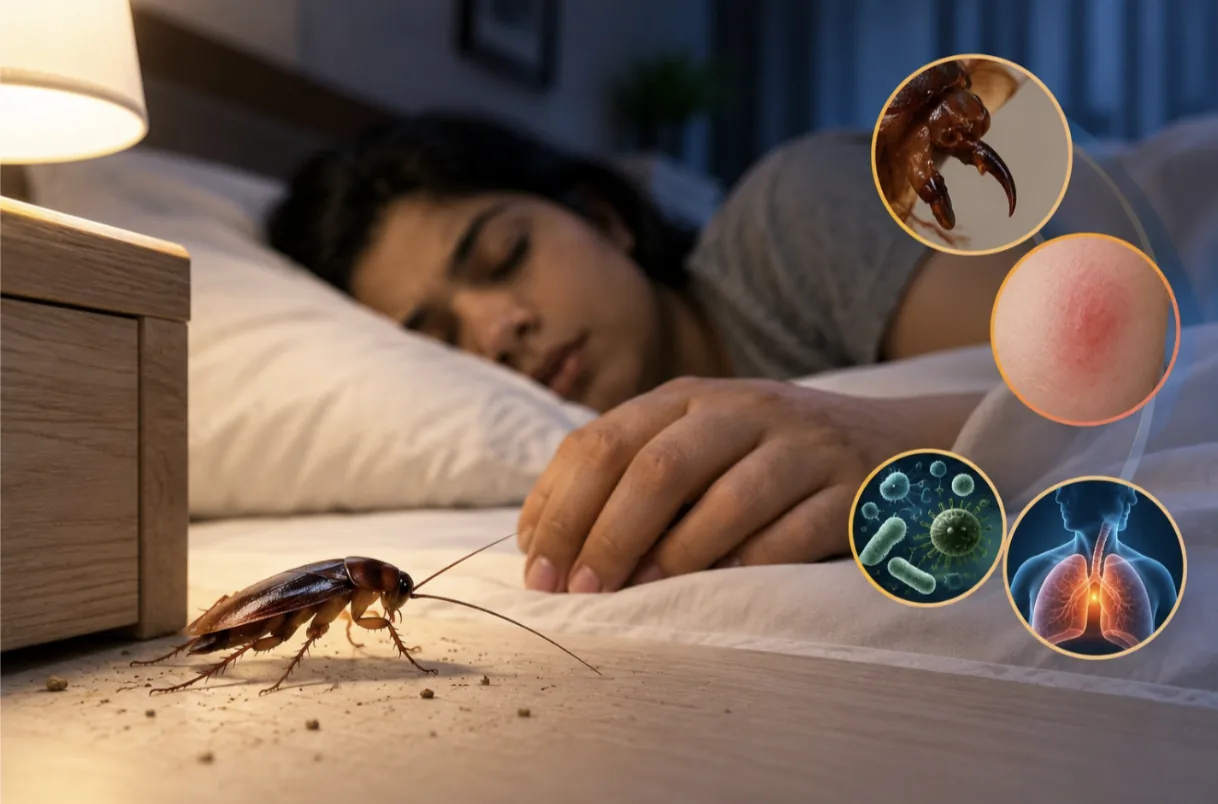
Cockroaches are commonly associated with kitchens, drains, garbage areas, and food contamination. But there is another question that often worries homeowners: can cockroaches bite humans?
The short answer is yes, cockroaches are physically capable of biting humans — but it is uncommon.
Cockroaches are scavengers, not blood-feeding insects. Unlike mosquitoes, fleas, or bed bugs, they do not normally seek humans as a food source. In most household infestations, cockroaches are far more interested in food crumbs, grease, garbage, organic waste, and other accessible materials.
Understanding normal cockroach behaviour can help separate genuine risks from common myths — and clarify when a cockroach infestation actually needs professional attention.
Do Cockroaches Really Bite People?
Cockroaches have chewing mouthparts that allow them to consume a wide range of materials. Because of this, they are physically capable of nibbling or biting human skin under unusual circumstances.
However, human biting is not normal cockroach feeding behaviour. Cockroaches generally prefer easily accessible food sources such as food crumbs, grease, leftover food, garbage, pet food, decaying organic material, and food residue.
If these resources are available, a cockroach has little reason to approach a person for food.
Why Are Cockroach Bites Rare?
Cockroaches generally avoid humans. They are highly sensitive to movement, vibration, light, and disturbance. This is why cockroaches often run into cracks or underneath appliances when you switch on the kitchen light.
Humans represent a threat rather than a normal food source. For a cockroach to attempt to feed on human skin, unusual conditions would generally have to exist, such as an extremely high population combined with severe competition for food.
Even then, biting should not be considered a typical feature of cockroach infestation.
Are Cockroaches Like Bed Bugs?
No. This is an important distinction.
Bed bugs are specialized blood-feeding insects. They actively seek hosts and feed on blood.
Cockroaches are scavengers and opportunistic feeders. They consume a wide variety of organic materials and do not require human blood.
So if someone wakes up repeatedly with unexplained bites, cockroaches should not automatically be assumed to be responsible. Other insects or non-pest causes may need to be investigated.
What Do Cockroaches Normally Eat?
Cockroaches are highly adaptable feeders. In homes, they may consume food crumbs, sugar, starches, grease, leftovers, pet food, garbage, and organic debris. Some species can survive on surprisingly limited food resources.
This adaptability is one reason cockroaches can survive in kitchens, restaurants, storage areas, and other indoor environments.
Can Cockroaches Eat Non-Food Materials?
Cockroaches can sometimes feed on materials people would not normally consider food. Depending on the species and conditions, this may include materials containing organic components such as paper, cardboard, book bindings, certain adhesives, soap residue, hair, and other organic debris.
However, these materials are usually secondary resources compared with accessible food waste and kitchen residue.
Concerned about cockroach activity in your home? Get a free inspection and treatment plan.
Book Free Inspection Call NowWhat Would a Cockroach Bite Look Like?
There is no reliable visual appearance that allows a skin mark to be identified as a cockroach bite simply by looking at it. Many skin conditions and insect bites can look similar.
Possible symptoms after an insect bite can include redness, mild swelling, itching, and irritation. But these symptoms are not specific to cockroaches.
If you develop persistent, severe, painful, infected, or unexplained skin lesions, consult a qualified healthcare professional rather than trying to diagnose the cause from appearance alone.
Do Cockroaches Bite While You Sleep?
This is one of the most common questions about cockroaches. Cockroaches are often more active at night, so they may move through rooms while people are sleeping.
However, night-time activity does not mean cockroaches normally feed on sleeping humans. Their typical behaviour is to search for food, water, and shelter.
If cockroaches are repeatedly appearing in bedrooms or around beds, this can indicate that the infestation has spread beyond the kitchen or that food, moisture, or harbourage opportunities are present nearby. Professional inspection may be appropriate.
Can Cockroaches Crawl on People While They Sleep?
It is physically possible for a cockroach to crawl onto a sleeping person, particularly in a heavily infested environment. But this should not be confused with biting. Cockroaches generally try to avoid contact with humans.
If cockroaches are frequently seen on beds, furniture, or people, the infestation should be considered significant enough to warrant investigation.
Can Cockroaches Enter Your Ears?
Although uncommon, insects — including cockroaches — can occasionally enter the ear canal.
Do not insert sharp objects, cotton swabs, tweezers, or other instruments deep into the ear in an attempt to remove an insect.
If an insect is trapped in the ear or causes pain, hearing problems, bleeding, or persistent discomfort, seek appropriate medical assistance.
Are Cockroach Bites Dangerous?
Because confirmed cockroach bites are uncommon, the larger health concerns associated with cockroach infestations are generally not bites. More important concerns include:
Cockroaches may travel through contaminated environments before moving across kitchen and food-storage areas. Their droppings, shed skins, and body fragments can also contribute to indoor allergens.
Therefore, the reason to control cockroaches is not primarily fear of being bitten. It is about maintaining a hygienic indoor environment.
Can Cockroach Bites Cause Disease?
Cockroaches are not known as biological disease vectors through biting in the way mosquitoes can transmit certain pathogens through feeding. The more relevant concern is mechanical contamination. A cockroach may move:
This can potentially transfer contaminated material. That is why kitchen sanitation and professional pest management are more important than worrying specifically about cockroach bites.
Can Cockroaches Bite Pets?
Cockroaches do not normally seek dogs, cats, or other household pets as food sources. Their primary interest is often the pet's food rather than the animal itself. Pet-food bowls can provide an excellent feeding opportunity for cockroaches.
To reduce activity, store pet food in sealed containers, clean spilled food, remove leftovers where appropriate, and keep feeding areas clean.
If a pet has unexplained skin irritation or wounds, consult a veterinarian rather than assuming cockroaches caused them.
Cockroaches spreading into your bedroom or common areas? Ask about our species-specific gel bait and monitoring plans.
Book Free Inspection WhatsApp UsWhy Are Cockroaches Coming Into the Bedroom?
If cockroaches are appearing in bedrooms, investigate why. Possible reasons include:
- Food — snacks, food wrappers, crumbs, or drinks may attract cockroaches
- Water — moisture can come from attached bathrooms, leaking plumbing, or other sources
- Harbourage — furniture gaps, wall cracks, wardrobes, and structural openings may provide shelter
- Heavy infestation — as populations increase, cockroaches may spread beyond their original harbourages
- Movement through the building — in apartments, cockroaches can sometimes move through plumbing, utility shafts, electrical conduits, and structural gaps
Does Seeing Cockroaches in the Bedroom Mean the Infestation Is Serious?
Not always, but repeated bedroom activity deserves attention. If cockroaches are also present in kitchens, bathrooms, utility areas, and bedrooms, the infestation may be widespread.
Other warning signs include daytime cockroach sightings, baby cockroaches, egg cases, droppings, multiple harbourages, and activity in several rooms. These are good reasons to arrange professional inspection.
What Should You Do if You Think a Cockroach Bit You?
First, avoid assuming the cause based only on the appearance of the skin. Wash the affected area gently with soap and water. Avoid excessive scratching.
If symptoms are severe, spreading, painful, show signs of infection, or are accompanied by an allergic reaction, seek medical advice.
If unexplained bites repeatedly occur at night, consider having the property inspected for other biting pests such as bed bugs rather than assuming cockroaches are responsible.
How to Keep Cockroaches Away From Bedrooms
- Don't eat in bed — food crumbs can attract pests
- Remove food packaging — avoid leaving snack wrappers, cups, or food containers overnight
- Keep the room clean — vacuum or clean crumbs and organic debris
- Seal suitable gaps — inspect cracks, door gaps, plumbing openings, and utility penetrations
- Investigate attached bathrooms — check for moisture and cockroach activity around drains and plumbing
- Control the main infestation — if cockroaches are spreading from the kitchen, treating only the bedroom will not solve the source of the problem
Why Killing Individual Cockroaches Isn't Enough
If cockroaches are established inside your home, killing the insects you see does not necessarily eliminate the infestation. The hidden population may remain inside:
Professional cockroach management therefore focuses on identifying harbourages and controlling the population at its source. Appliances and electronics deserve particular attention too — see our guide on cockroaches and electrical damage for harbourages that are easy to overlook.
How Professional Cockroach Treatment Works
A professional service typically begins with inspection. The technician may examine kitchen cabinets, appliances, under-sink areas, plumbing, bathrooms, drains, utility areas, and bedrooms where activity has been reported.
Treatment can then be selected according to the cockroach species, infestation level, and property conditions. Depending on the situation, this may include professional gel bait, targeted crack-and-crevice treatment, monitoring, sanitation recommendations, exclusion advice, and follow-up treatment.
Integrated Pest Management for Cockroaches
Integrated Pest Management (IPM) combines multiple methods rather than relying only on spraying. A typical approach is:
This can provide more effective long-term control while reducing unnecessary pesticide use.
When Should You Call a Professional?
Consider professional cockroach pest control when cockroaches appear frequently, you see baby cockroaches, egg cases are present, droppings repeatedly appear, cockroaches are visible during daytime, activity spreads into bedrooms, cockroaches are found in several rooms, or DIY treatment repeatedly fails.
You do not need to wait until cockroaches begin crawling near sleeping areas before seeking professional help.
Professional Cockroach Control in Bangalore
Standard Pest Control provides professional cockroach pest control in Bangalore for residential and commercial properties. Services are available for apartments, independent houses, villas, restaurants, hotels, hospitals, offices, schools, shops, commercial kitchens, and other commercial premises.
Our approach focuses on:
Depending on the infestation, professional treatment may include gel bait, targeted applications, sanitation recommendations, exclusion, and follow-up monitoring. The goal is to control the infestation where cockroaches are hiding and breeding — not simply kill the insects that happen to appear.
Frequently Asked Questions
Can cockroaches bite humans?
Yes, cockroaches are physically capable of biting or nibbling human skin, but this behaviour is uncommon. Humans are not their normal food source.
Do cockroaches drink human blood?
No. Cockroaches are not blood-feeding insects. Unlike bed bugs or mosquitoes, they do not depend on human blood for survival.
Can cockroaches bite you while sleeping?
It is possible but uncommon. Cockroaches are active at night, but their normal behaviour is to search for food, water, and shelter rather than feed on humans.
What does a cockroach bite look like?
There is no distinctive appearance that reliably identifies a cockroach bite. Redness, itching, or swelling can have many possible causes.
Are cockroach bites dangerous?
The main health concerns associated with cockroaches are generally allergens, food contamination, and mechanical transfer of microorganisms rather than biting.
Why are cockroaches coming into my bedroom?
They may be searching for food, water, or shelter, or they may be spreading from another part of the property.
Can cockroaches crawl on you while sleeping?
It is possible, especially during a heavy infestation, but cockroaches generally avoid human contact.
Should I call pest control if cockroaches are in my bedroom?
Repeated bedroom activity — particularly when combined with nymphs, droppings, egg cases, daytime sightings, or activity in multiple rooms — is a good reason to arrange professional inspection.
Final Takeaway
So, can cockroaches bite humans? Technically, yes. But cockroach bites are uncommon and are not the primary health concern associated with an infestation.
Cockroaches would much rather find:
than feed on a person. The more important reasons to control an infestation are the risks associated with food contamination, allergens, poor hygiene, and the ability of cockroaches to multiply and spread through a property.
If cockroaches are appearing regularly — or spreading from the kitchen into bedrooms — the best response is not to worry primarily about bites. Instead:
Understanding cockroach behaviour helps replace myths and fear with effective pest management.
Related reading: The Psychological Impact of Cockroaches: Fear, Disgust and Stress | Cockroaches and Electrical Damage: A Hidden Danger | Summer Cockroach Activity: Why They Thrive in Warm Weather | Cockroaches in Winter: Do They Hibernate or Seek Shelter Indoors?