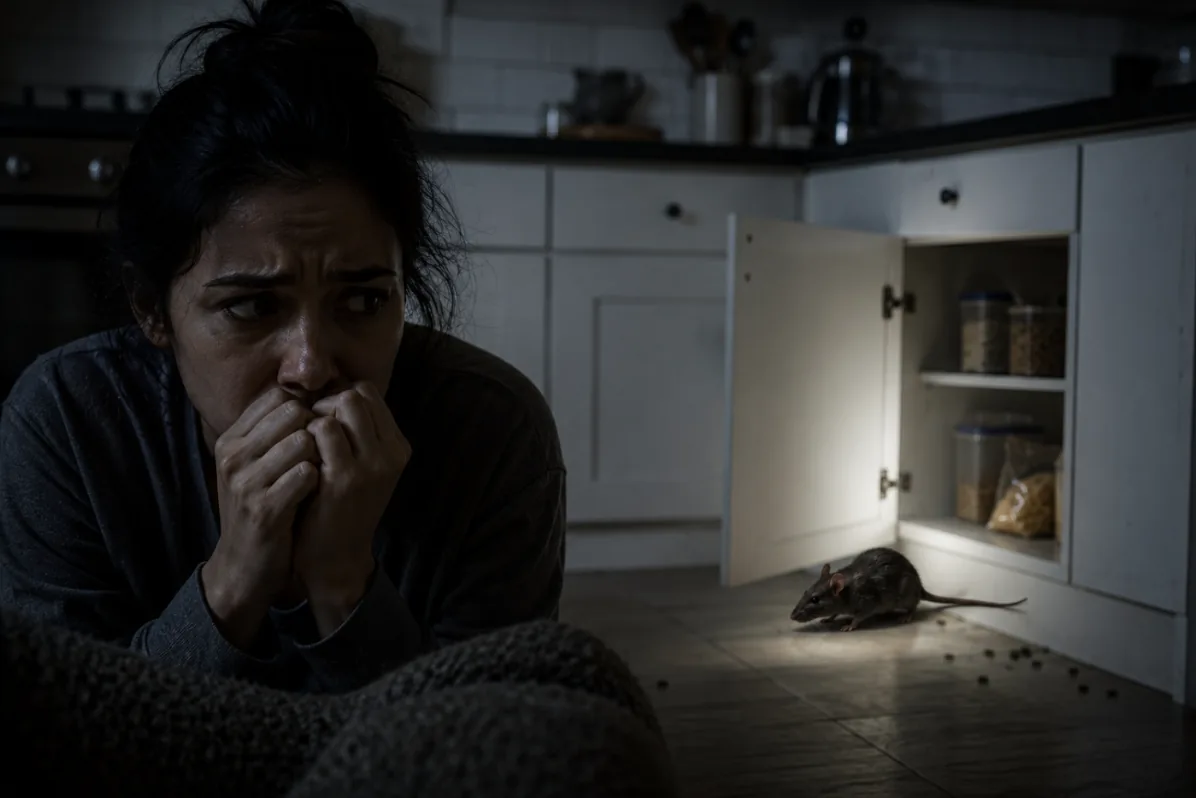
A scratching sound comes from the false ceiling in the middle of the night. You switch on the kitchen light and suddenly see a rat disappear behind the refrigerator. The next morning, you find droppings inside a cabinet.
Even after the rodent disappears, one question may remain: "Is it still somewhere inside my house?"
Rodent infestations are usually discussed in terms of food contamination, disease, property damage and chewed electrical wires. But rats and mice can also affect something less visible: our sense of comfort and security.
For some people, discovering rodents inside the home can lead to fear, disgust, increased alertness, sleep disturbance and ongoing stress until the infestation is resolved. Understanding these reactions — and addressing the rodent problem systematically — can help restore confidence in your living environment.
Why Are People So Afraid Of Rats And Mice?
Fear of rodents can develop for several reasons. Rats and mice move quickly, appear unexpectedly, hide in inaccessible places, are often active at night, can contaminate food, may carry disease-causing organisms, and can gnaw household materials.
Their unpredictable movement can be particularly startling. A rat suddenly running across a kitchen floor gives you very little time to understand what is happening — the body's immediate response may occur before rational thinking catches up.
Fear, Disgust And Stress Are Different
These reactions are related, but they aren't exactly the same.
Fear
Fear is associated with perceived danger. A person may worry: "Will the rat come near me?" or "Could it bite?"
Disgust
Disgust is closely connected with contamination. After finding droppings in a kitchen cabinet, someone may wonder: "What food has it touched?"
Stress
Stress can develop when the problem continues. Night after night of scratching sounds and repeated sightings can create uncertainty, a loss of control, and constant vigilance. Together, these reactions can make a rodent infestation feel overwhelming.
Why Rodents Feel Different Inside Your Home
Seeing a rat outdoors and seeing one beside your kitchen sink can create completely different reactions. Why? Because your home represents safety, privacy, cleanliness and control. A rodent entering that environment violates those expectations.
The emotional response isn't simply "I saw a rat." It may become "something unwanted is living inside my personal space." This feeling of invasion can be one of the most stressful parts of an infestation.
The Fear Of Not Knowing Where The Rodent Is
A visible rat may be frightening. But sometimes the rodent you cannot see creates even more anxiety. You hear scratch, scratch, scratch from inside the ceiling, then silence. Where did it go? Is it above the bedroom? Inside the kitchen? Behind the wall?
The uncertainty can cause people to become highly alert to every sound.
Not sure where the sound is coming from? A proper inspection replaces guesswork with an actual location and plan.
Book Free Inspection Call NowNight-Time Rodent Activity And Sleep
Rats and mice are often active during periods when buildings are quieter. For homeowners, this can mean hearing activity at night. Repeated sounds from false ceilings, walls, storage areas and kitchens may interfere with relaxation or sleep.
Some people may begin waiting for the sound to return — a normal building noise can suddenly trigger the thought "is that the rat again?" When the infestation is properly controlled, this increased vigilance often decreases as confidence returns.
Why Kitchens Create Strong Disgust Reactions
The kitchen is one of the most emotionally sensitive places to discover rodents. It is where we prepare food, store groceries, keep utensils and feed our families. Finding droppings beside food can create immediate concerns about contamination.
People may begin questioning everything: "Did the rat walk across this shelf? Did it touch these utensils? Is this food still safe?" The disgust response encourages us to avoid potentially contaminated materials.
Rodent Droppings Can Increase Anxiety
Droppings are physical evidence that a rodent has been somewhere even if nobody saw it. One dropping may lead to searching. Then another appears behind the refrigerator. Another inside a cabinet. Suddenly the homeowner may begin inspecting every corner — evidence transforms an unseen possibility into something real.
This is why professional inspection can be valuable: it helps determine the extent and location of activity rather than leaving homeowners to imagine the worst. See our guide on signs of rodent infestation for how to read the evidence objectively.
Food Contamination And Loss Of Confidence
After discovering rodent activity in a pantry, some people become uncomfortable using food stored nearby. That reaction is understandable — rodents can potentially contaminate food and surfaces through droppings, urine, saliva, hair and physical contact.
Affected food should be assessed and handled according to appropriate food-safety guidance. Once contaminated items are removed and the area is properly cleaned, sanitized and monitored, confidence can gradually return — see our guides on rodents and food contamination and how to safely clean up rodent droppings and urine.
Fear Of Rodent-Related Diseases
Rodents are associated with several health concerns. Depending on species, geography and exposure, rodents can be associated with illnesses such as leptospirosis, salmonellosis, rat-bite fever and certain hantavirus infections.
However, an important distinction is necessary: seeing a rat does not mean you have contracted a disease. Fear can sometimes cause people to assume the worst. A better response is to evaluate the actual exposure, clean contaminated areas appropriately, and seek medical advice when there has been a relevant exposure or symptoms.
Worried about children, pets or food safety? Talk to our technicians about a plan that keeps everyone safe.
Book Free Inspection WhatsApp UsThe Stress Of Rodents Around Children
Parents may experience additional anxiety when rodents are present. Concerns may include children touching droppings, food contamination, rodent bites, unsafe DIY poison, or rodents entering bedrooms.
This can create pressure to solve the problem immediately. Urgency is appropriate, but panic can lead to unsafe decisions — for example, scattering rodenticide around a home with children can introduce an additional hazard. Professional control should consider both rodent removal and household safety — see our guide on the dangers of secondary rodenticide poisoning.
Rodents And Pet Owners
Pet owners may also worry about pets encountering rodents, pets accessing rodenticide, parasites, contaminated food, or dead rodents. Always tell the pest-control technician about pets before treatment — control methods and device placement should take non-target animals into consideration.
Embarrassment About Having Rats
Some homeowners feel embarrassed when they discover rodents. They may think "people will think my house is dirty." But rodent activity does not automatically mean a property is poorly maintained.
Rodents may enter through pipe openings, utility shafts, door gaps, roof openings, drainage systems, or neighbouring properties. Sanitation matters because accessible food can support an infestation, but structural access is equally important — a clean apartment can still have rats if the building provides an entry route.
Why Embarrassment Can Make Rodent Problems Worse
Embarrassment may cause people to delay seeking help. They may hide the problem, avoid telling neighbours, repeatedly use DIY methods, or wait for the rat to disappear. Meanwhile, the underlying entry point remains open. Early action is usually more effective than waiting for activity to become established.
Fear Can Lead To Excessive Rodenticide Use
When people panic, they sometimes assume "more poison equals faster results." This is not a safe or effective principle. Random rodenticide placement can create risks for children, pets and non-target animals. Rodents may also die in inaccessible spaces, potentially creating odour problems.
Professional rodent management selects control methods according to the site and infestation.
Why DIY Traps Can Become Stressful
Some homeowners repeatedly set traps without knowing where rodents are travelling. Every morning begins with "did we catch it?" If the trap remains empty while scratching continues, frustration increases.
Trap placement should be based on rodent behaviour and evidence — professional inspection may identify travel routes that were not obvious to the homeowner.
Rodents And The Feeling Of Losing Control
A major psychological element of infestation is loss of control. You may control cleaning, food storage, garbage and household routines. But you cannot easily control an animal moving inside a wall.
Professional pest management helps restore control by converting uncertainty into a plan: inspect, identify, control, exclude, monitor. Once the problem becomes measurable, it often feels more manageable.
Professional Inspection Can Reduce Uncertainty
Imagine two situations. In the first, you hear scratching every night and have no idea what is happening. In the second, an inspection identifies rodent activity around one utility opening and a specific ceiling route.
The rodent still needs to be controlled. But the second situation provides something psychologically important: information. Instead of imagining rodents everywhere, you have evidence and a treatment plan.
Monitoring Replaces Guesswork With Evidence
After treatment, homeowners may still worry "what if they're still here?" Monitoring helps answer that question. Professionals can look for fresh droppings, trap activity, bait activity, new gnawing, new sightings and new noises. No fresh activity over an appropriate monitoring period can help rebuild confidence.
Rodent Proofing Can Restore Peace Of Mind
Catching a rat solves one immediate problem, but homeowners often ask "what stops another one coming tomorrow?" This is where rodent exclusion becomes psychologically important as well as practically important.
Proofing potential entry points — plumbing gaps, door gaps, utility openings, vents, roof gaps and structural openings — can provide greater confidence that the problem has been addressed at its source. See our detailed guide on rodent exclusion. The goal is simple: remove current rodents and reduce future entry.
Rodent Stress In Apartment Buildings
Apartment infestations can be particularly frustrating. A resident may keep their own flat extremely clean but continue seeing rodents because activity originates elsewhere. Rodents may travel through shared utility shafts, false ceilings, plumbing systems, basements, garbage areas and service ducts.
This can create a sense that the problem is outside the resident's control. Building-wide inspection and coordinated management may be necessary — see our guide on rodent control for apartment garbage areas.
Psychological Impact On Restaurant Owners
For restaurants, rodent fear is not limited to personal discomfort. Owners may worry "what if a customer sees it?" A single rodent sighting can potentially affect customer confidence, online reviews, reputation, food-safety concerns and staff morale.
This is why commercial rodent programs should focus on prevention and early detection rather than waiting for visible activity.
Rodent Stress In Hotels
Hotels face similar concerns. A rodent sighting in a guest area can quickly become a sighting, then a photo, then a review, then social media. Even a limited incident may create disproportionate reputational consequences. Preventive monitoring, sanitation and exclusion are therefore particularly important.
Employees Can Also Be Affected
Rodent infestations in workplaces can make employees uncomfortable. Staff may avoid pantry areas, storage rooms, certain desks, or night shifts in affected areas. Repeated rodent sightings can reduce confidence in workplace hygiene — management should take reports seriously and communicate clearly about corrective actions.
Children Can Learn Fear From Adults
Children often observe how adults react. If an adult screams, panics or repeatedly talks about rats as terrifying creatures, a child may begin developing similar reactions.
A calmer approach is: keep away, tell an adult, don't touch, let professionals handle it. Children should understand that rodents require caution without being taught unnecessary panic.
When Fear Becomes More Than Ordinary Concern
Some fear during an active infestation is understandable. However, in some people the reaction can become intense. Signs may include avoiding parts of the home, persistent sleep difficulty, repeated checking, panic, or severe distress even after control.
Pest-control professionals can address the environmental infestation — they do not treat anxiety disorders or phobias. If severe fear continues after the rodent problem has been resolved and significantly affects everyday life, speaking with an appropriate healthcare or mental-health professional may be useful.
How To Stay Calm During A Rodent Infestation
A structured response can reduce uncertainty.
- Record the evidence — note sightings, sounds and droppings.
- Protect food — store food securely.
- Keep children and pets away — restrict access to contaminated or treatment areas.
- Avoid random poison use — use appropriate control methods.
- Arrange an inspection — identify the infestation and entry routes.
- Follow the treatment plan — don't repeatedly change methods.
- Complete rodent proofing — address appropriate entry points.
- Monitor — confirm that activity is declining.
The goal is to replace fear, guessing and panic with evidence, action and verification.
How Professional Rodent Control Helps Restore Confidence
A good professional rodent-control program does more than catch animals. It should help answer: what rodent is present, where is it entering, where is it travelling, what is attracting it, how will we control it, and how will we prevent recurrence? When those questions are answered, homeowners regain a sense of control.
Professional Rodent Control In Bangalore
Standard Pest Control provides professional rodent control services in Bangalore for residential and commercial properties, with rodent management available for apartments, independent houses, villas, restaurants, hotels, hospitals, offices, schools, warehouses, factories and commercial kitchens.
Our approach focuses on inspection, identification, control, sanitation, rodent proofing and monitoring. The objective isn't only to remove the rodent — it is to help make the property feel safe, hygienic and comfortable again.
Frequently Asked Questions
Can a rodent infestation cause stress?
Yes. Repeated sightings, scratching noises, contamination concerns and uncertainty about where rodents are hiding can cause stress for some people.
Why am I so afraid of rats?
Rodents move rapidly and unpredictably and are associated with contamination and disease. Personal experiences and learned responses can also influence the intensity of fear.
Why do rats make people feel disgusted?
Disgust is strongly connected with contamination avoidance. Rodent droppings, urine and activity around food can therefore trigger particularly strong reactions.
Can rats affect sleep?
Yes. Night-time scratching or worry about rodents may make it difficult for some people to relax or sleep normally during an active infestation.
Does having rats mean my house is dirty?
No. Poor sanitation can support rodent populations, but rodents can also enter clean properties through structural gaps, pipes, utility systems, doors and neighbouring areas.
Why do I keep checking for rats after treatment?
After an infestation, people may remain alert to possible signs for some time. Objective monitoring can help determine whether rodent activity is actually continuing.
Should I use more poison if I'm frightened by the infestation?
No. Do not respond to fear by increasing or randomly placing rodenticides. Incorrect use can create risks for people, pets and other animals.
Can professional rodent control reduce stress?
Removing the infestation, identifying entry points and monitoring for continued activity can reduce uncertainty and help restore confidence in the property.
What if I am still extremely afraid after the rats are gone?
If intense fear continues after the infestation has been resolved and significantly interferes with daily life, consider discussing it with an appropriate healthcare or mental-health professional.
Final Takeaway: Rodent Control Is Also About Restoring Peace Of Mind
Rodents can contaminate food. They can damage property. They can gnaw electrical wiring. But an infestation can also affect something less visible: how comfortable you feel inside your own home.
Fear says "what if the rat comes near me?" Disgust says "what has it contaminated?" Stress says "what if it never goes away?" The answer to all three begins with replacing uncertainty with action: inspect, identify, control, clean, exclude, monitor.
Don't allow fear to lead to unsafe pesticide use or endless DIY experimentation. Find the source. Control the infestation. Correct the entry points. Monitor the results. Because successful rodent management isn't only about reaching the day when you stop seeing rats — it's about reaching the day when you can walk into your kitchen, turn off the lights and go to sleep without wondering what is moving behind the walls. For persistent rodent activity, Standard Pest Control provides pest-management services for homes and businesses across Bangalore.
Related reading: Signs of Rodent Infestation You Should Never Ignore | Rodents and Food Contamination: Protecting Your Pantry | How to Safely Clean Up Rodent Droppings and Urine | The Dangers of Using Poison for Rodents | Rodent Exclusion: Sealing Entry Points to Keep Pests Out