Finding rat or mouse droppings in your kitchen, pantry, storage room, false ceiling, garage, or warehouse isn't simply unpleasant. Rodent droppings, urine, nesting materials, and contaminated surfaces can create potential health and hygiene risks.
Your first reaction may be to grab a broom or vacuum cleaner and clean everything immediately. But that's not always the safest approach.
Dry sweeping or vacuuming rodent droppings can disturb contaminated material and send particles into the air. Instead, rodent-contaminated areas should be approached carefully, using appropriate protective measures and wet-cleaning/disinfection procedures.
This guide explains practical steps for cleaning rodent droppings and urine safely, what you should avoid, when professional cleaning may be appropriate, and how to prevent rodents from returning.
Why Should Rodent Droppings Be Handled Carefully?
Rats and mice can be associated with disease-causing microorganisms. Depending on the rodent species, location, and type of exposure, health concerns associated with rodents can include illnesses such as leptospirosis, salmonellosis, rat-bite fever, and certain hantavirus infections.
Not every rodent carries these organisms, and finding droppings does not automatically mean you have been exposed to a disease. However, rodent waste should still be treated as potentially contaminated material.
Why Dry Sweeping Rodent Droppings Is A Bad Idea
Imagine dry rodent droppings lying behind a kitchen cabinet. If you aggressively sweep them with a broom, dust and contaminated particles may become airborne. The same concern applies to vacuuming dry contaminated material.
That's why a safer general principle is: don't create dust — wet contaminated material before removal. Public-health recommendations may vary depending on the circumstances, so follow applicable local guidance, particularly for extensive infestations.
Before Cleaning: Deal With The Rodent Problem
Cleaning droppings without controlling active rodents may lead to the same problem again the next morning. If you continue finding fresh droppings, first determine where the rodents are entering, where they are hiding, what food or water is supporting them, and whether the infestation is still active.
Rodent management should generally combine control, cleaning, exclusion and monitoring together — see our guide on rodent exclusion for how to seal the entry points once cleanup is complete.
Step 1: Keep Children And Pets Away
Before beginning cleanup, restrict access to the contaminated area. Keep children, dogs, cats and other pets away from rodent droppings, urine, dead rodents, and nesting materials. Do not allow children to touch or play near contaminated surfaces.
Step 2: Ventilate Enclosed Areas Where Appropriate
If rodent contamination has occurred in an enclosed room or storage area, ventilation may be appropriate before cleanup when it can be done safely. Open doors or windows where suitable and allow fresh air into the area, avoiding actions that unnecessarily disturb dust during this process.
For heavily contaminated or poorly ventilated spaces, professional assessment may be preferable.
Step 3: Wear Appropriate Protective Equipment
Avoid touching rodent waste with bare hands. For routine small-scale cleanup, appropriate disposable or washable gloves are important. Depending on the level of contamination and environment, additional protective equipment may be appropriate — examples include protective clothing and suitable respiratory protection for higher-risk situations.
Extensive infestations require more precautions than a few isolated droppings.
Large amount of droppings or an active infestation? Get a free inspection before you start cleaning.
Book Free Inspection Call NowStep 4: Prepare An Appropriate Disinfectant
Use an appropriate household disinfectant according to the manufacturer's instructions and applicable public-health guidance. If official guidance recommends a diluted bleach solution for the particular situation, prepare it exactly as directed.
Never mix bleach with ammonia, acids, toilet cleaners, or other household chemicals. Mixing cleaning products can create dangerous gases. Always read and follow the product label.
Step 5: Wet The Droppings
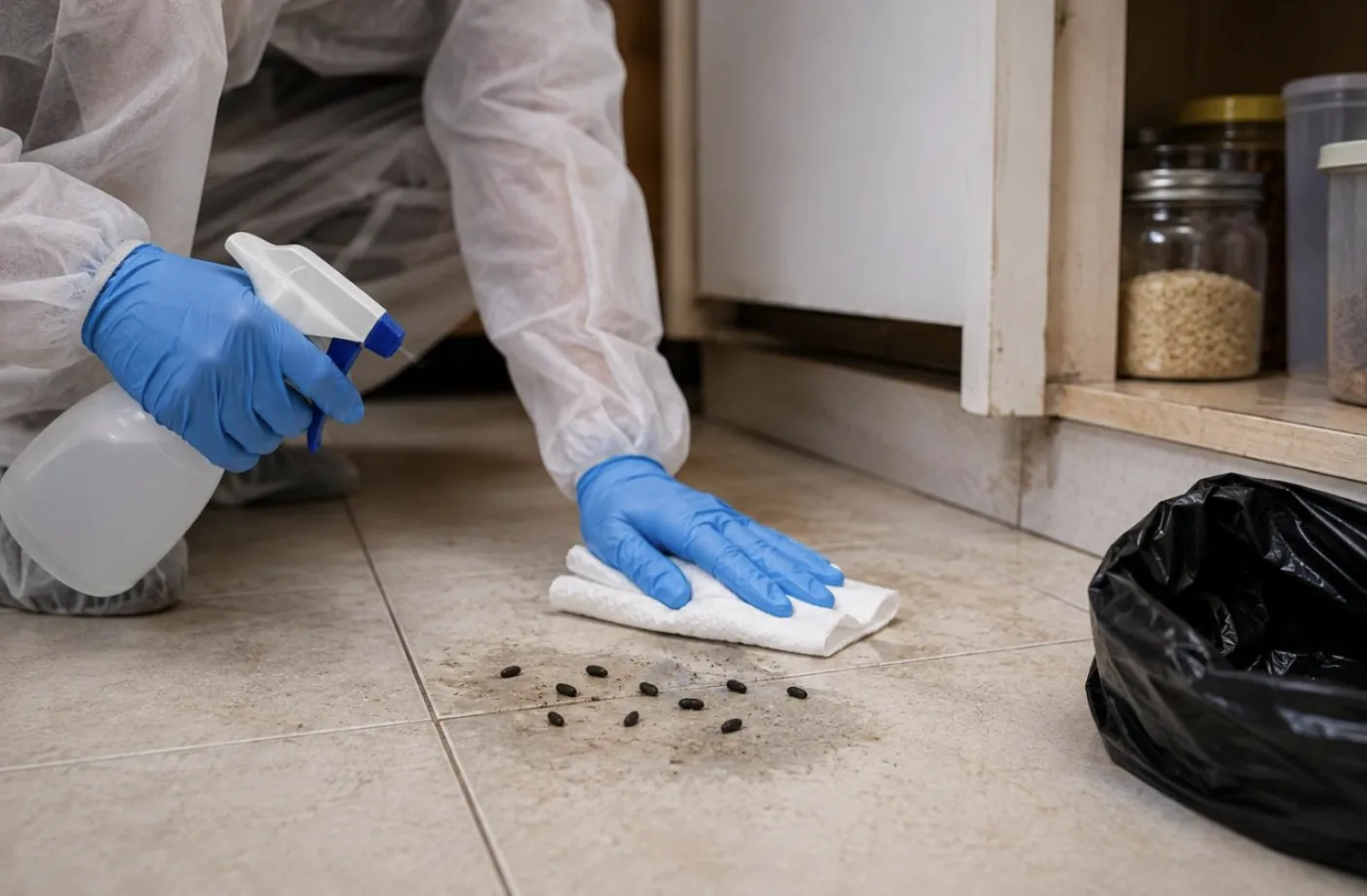
This is one of the most important steps. Instead of immediately sweeping, thoroughly wet the droppings and surrounding contaminated area with the appropriate disinfectant. Allow the product the required contact time specified by its label or applicable public-health guidance. The objective is to avoid disturbing dry contaminated material.
Think: spray, wait, wipe — rather than sweep, dust, vacuum.
Step 6: Remove The Droppings Carefully
After the material has been appropriately wetted and disinfected, use disposable material such as paper towels to pick it up. Place the waste into an appropriate disposal bag.
Avoid crushing droppings, shaking contaminated materials, creating dust, or touching your face during cleanup. Continue treating nearby visibly contaminated surfaces as necessary.
Step 7: Clean Rodent Urine
Rodent urine may not always be easy to see. If droppings are present, assume nearby surfaces may also require cleaning. Pay attention to floors, shelves, cabinets, pantry surfaces, storage racks, walls near activity, and container exteriors. Apply the appropriate disinfectant and follow its required contact time before wiping.
Step 8: Disinfect The Surrounding Area
Don't focus only on the exact spot where you found the dropping — rodents move around. A mouse may travel along a wall, behind a cabinet, across a shelf and behind a refrigerator in one circuit. Clean and disinfect relevant surfaces along known activity areas, but avoid unnecessarily spreading contamination from one area to another with the same dirty cleaning material.
Step 9: Dispose Of Waste Safely
Place contaminated disposable materials in a suitable bag and seal it appropriately. Depending on local public-health guidance and the extent of contamination, double-bagging may be recommended for certain rodent waste or carcasses. Dispose of the material according to applicable local waste requirements.
Step 10: Remove Gloves Correctly
After cleaning, remove gloves without touching contaminated outer surfaces with bare skin where possible. Disposable gloves should be discarded appropriately, and reusable gloves should be cleaned and disinfected according to their instructions.
Step 11: Wash Your Hands Thoroughly
After removing gloves, wash your hands thoroughly with soap and water, even if your hands appear clean. Hand hygiene is one of the simplest and most important parts of the cleanup process.
Cleaned up but still seeing droppings return? The infestation likely needs professional attention, not just more cleaning.
Book Free Inspection WhatsApp UsHow To Clean Rodent Droppings In The Kitchen
A kitchen requires additional care because food and food-contact surfaces are involved. If droppings are found inside a kitchen cabinet: keep people and pets away, inspect nearby food packages, discard food that has been directly contaminated or gnawed open, wet and disinfect the droppings appropriately, remove the waste carefully, clean and disinfect affected surfaces, clean suitable container exteriors, wash hands thoroughly, and investigate the rodent entry point.
Do not simply remove the droppings and place food back onto an uncleaned shelf — see our guide on rodent control in the kitchen for a fuller inspection routine.
What Food Should Be Discarded?
Food safety should be treated seriously when rodents have entered a pantry. Food should generally be discarded if the packaging has been gnawed open, rodent waste has directly contaminated it, the packaging is damaged, or its safety cannot reasonably be established. Do not simply cut off the damaged section of a food packet and use the rest. Follow applicable food-safety guidance when uncertain.
What About Sealed Containers?
Food inside genuinely intact, rodent-resistant containers may remain protected. However, the outside of the container may still be contaminated — clean and disinfect the exterior appropriately before opening or moving it into a clean food-storage area. If the container has been penetrated or its seal compromised, discard the food.
Cleaning Droppings Behind The Refrigerator
Behind refrigerators is a common rodent activity area because it may provide warmth, food residue, darkness and shelter. If droppings are found, do not immediately vacuum them — use the appropriate wet-disinfection and removal process.
Once cleaning is complete, inspect the area for food debris, gnaw marks, damaged cables, pipe gaps and structural openings. If electrical cables appear damaged, arrange assessment by a qualified electrician.
Cleaning Rodent Droppings In A Pantry
Pantries require both cleaning and food inspection. Check rice bags, flour, pulses, cereals, snacks, pet food and cardboard packaging. Discard compromised food and transfer suitable uncontaminated dry goods into secure containers. After cleaning, organize the pantry so future rodent activity is easier to detect — see our guide on sanitation and rodent control for more.
Cleaning Rodent Urine From Hard Surfaces
For non-porous hard surfaces, an appropriate disinfectant can generally be used according to its label instructions. The exact procedure depends on the surface type, the disinfectant and the level of contamination. Avoid using chemicals that could damage the surface or create unsafe residues; food-contact surfaces may require additional steps specified by the product label.
What About Carpets And Upholstery?
Soft materials can be more complicated because contamination may penetrate below the surface. Depending on the material and contamination level, cleaning may require appropriate shampooing, steam cleaning where suitable, professional cleaning, or disposal in severe cases. Follow material-care and public-health guidance, and do not saturate electrical equipment or surfaces that can be damaged by moisture.
Cleaning Rodent-Contaminated Clothing Or Bedding
If washable clothing, bedding, or similar fabrics have been exposed to rodent contamination, handle them carefully to avoid shaking contaminated material into the air. Launder using suitable detergent and the appropriate water temperature for the fabric, following applicable health guidance, and dry thoroughly. Heavily contaminated items may require disposal.
How To Clean Rodent Nesting Material
Rodent nests can contain shredded paper, fabric, insulation, droppings, urine, hair and food debris. Do not grab dry nesting material and shake it into a garbage bag — treat it as contaminated material and wet/disinfect as appropriate before careful removal. Large nests or contamination in difficult spaces may require professional cleaning.
Rodent Droppings In False Ceilings
False ceilings present additional challenges. They can contain electrical wiring, insulation, dust, difficult-to-access contamination and rodent nests. Do not climb into unsafe ceiling spaces or spray liquids near electrical systems without understanding the risks. Professional rodent control and specialized cleanup may be safer when contamination is extensive or inaccessible.
Rodent Droppings In Air-Handling Areas
If rodent contamination is found around ventilation or air-handling equipment, avoid casually disturbing it. Contamination associated with ducts or complex HVAC equipment may require specialized professional assessment. Do not simply run equipment and assume the problem will disappear.
Cleaning A Dead Rodent
A dead rat or mouse should not be handled with bare hands. General precautions include keeping children and pets away, wearing appropriate gloves, applying appropriate disinfectant as recommended, handling the carcass carefully, bagging and disposing of it according to local guidance, cleaning and disinfecting the affected area, and washing hands thoroughly afterwards. Local disposal requirements may differ.
What NOT To Do When Cleaning Rodent Waste
Avoid these common mistakes:
- Don't dry sweep — it can disturb contaminated particles.
- Don't immediately vacuum — avoid vacuuming dry droppings or nesting materials unless specific professional procedures and equipment are being used.
- Don't touch droppings bare-handed — use appropriate protective equipment.
- Don't shake contaminated materials — this can release dust.
- Don't mix cleaning chemicals — especially never mix bleach with ammonia or acidic cleaners.
- Don't ignore food contamination — inspect nearby food carefully.
- Don't clean without addressing the infestation — fresh contamination will simply return.
When Should You Call A Professional?
Professional help may be appropriate when there are large quantities of droppings, multiple rooms are contaminated, rodent nests are present, contamination is inside false ceilings, HVAC systems may be affected, rodents are still active, the area is difficult to access safely, a commercial food area is contaminated, or you are unsure how extensive the infestation is.
A pest-control professional can address active rodents and entry points. Extensive contamination may require a specialist cleaning service.
How To Tell Old Droppings From New Activity
After cleanup, monitoring becomes easier. If new droppings appear in a previously cleaned area, this is strong evidence that rodent activity is continuing. This is why proper cleaning can support pest monitoring — instead of wondering whether droppings were already there, you can identify fresh evidence more confidently. See our guide on signs of rodent infestation for more on reading the evidence.
Preventing Rodent Contamination From Returning
Cleanup solves the contamination. It does not automatically solve the rodent infestation. Long-term prevention requires:
- Food management — store food securely.
- Garbage management — use covered bins and remove waste regularly.
- Clutter reduction — reduce cardboard and unnecessary storage.
- Water management — repair leaks and eliminate unnecessary water sources.
- Rodent proofing — seal appropriate structural entry points using suitable rodent-resistant materials.
- Monitoring — watch for fresh droppings, gnawing and sightings.
Why Rodent Proofing Is Essential
Imagine cleaning your pantry perfectly today. But the same pipe opening remains behind the cabinet. Tomorrow night, a rodent enters, contaminates the pantry, leaves droppings, and cleanup starts again. This cycle continues until the entry point is addressed.
Professional rodent management should therefore combine controlling existing rodents, cleaning contamination, sealing entry points and ongoing monitoring together.
Rodent Cleanup In Apartments
Apartment rodent activity may involve shared utility shafts, plumbing, false ceilings, basements, garbage areas and service ducts. Cleaning one flat is important, but recurring activity may require building-level investigation — see our guide on rodent control for apartment garbage areas for common-area checkpoints.
Rodent Cleanup In Restaurants And Commercial Kitchens
Rodent contamination in food businesses should be treated seriously. Affected areas may include dry stores, kitchen shelves, food-preparation areas, equipment areas, garbage rooms and storage rooms. Commercial sites should follow applicable food-safety, occupational-safety, sanitation, and pest-management requirements, and professional documentation and monitoring may also be necessary.
Professional Rodent Control In Bangalore
Standard Pest Control provides professional rodent control services in Bangalore for residential and commercial properties, suitable for apartments, independent houses, villas, restaurants, hotels, hospitals, offices, schools, warehouses, factories and commercial kitchens.
Our approach focuses on inspection, identification, control, sanitation recommendations, rodent proofing and monitoring. Cleaning rodent waste is important, but if fresh droppings keep appearing, the underlying infestation must also be addressed.
Frequently Asked Questions
What is the safest way to clean rodent droppings?
Avoid dry sweeping or vacuuming. Use appropriate protective equipment, wet the droppings with a suitable disinfectant, allow the required contact time, carefully wipe them up, dispose of contaminated material appropriately, clean the surrounding area, and wash your hands thoroughly.
Can I vacuum rat or mouse droppings?
Avoid vacuuming dry rodent droppings because this may disturb contaminated material and release particles into the air. Follow applicable public-health guidance for safe wet cleanup.
Should I spray rodent droppings before cleaning?
Yes, applicable public-health guidance generally recommends wetting/disinfecting rodent waste before careful removal rather than handling it dry. Follow the disinfectant label and local health recommendations.
Can I use bleach to clean rat urine?
Some public-health guidance may recommend appropriately diluted bleach solutions for certain situations. Follow official instructions carefully and never mix bleach with ammonia, acids, or other cleaning products.
Do I need gloves when cleaning mouse droppings?
Yes. Avoid direct skin contact with rodent waste and use appropriate gloves.
Should food near rodent droppings be discarded?
Food that has been directly contaminated, gnawed open, or stored in compromised packaging should generally be discarded. Follow applicable food-safety guidance when uncertain.
Can rodent urine make you sick?
Rodent urine can potentially contain disease-causing organisms depending on the species and circumstances. Leptospirosis, for example, can be associated with exposure to urine from infected animals.
How do I know if rats are still active after cleaning?
Monitor the cleaned area for fresh droppings, new gnaw marks, food damage, noises, or sightings.
When is rodent cleanup too large to do myself?
Extensive contamination, large nesting areas, contamination in ventilation systems or inaccessible spaces, or situations requiring specialized protective equipment may warrant professional assessment.
Final Takeaway: Don't Sweep First — Clean Safely
Finding rodent droppings naturally creates an urge to clean them immediately. But the method matters. Avoid turning dry contamination into airborne dust.
Remember the basic approach: keep people away, protect yourself, wet/disinfect, wait, carefully remove, dispose, clean, then wash hands. Then address the reason the contamination occurred: find the rodent, control the infestation, remove food sources, seal entry points, and monitor.
Cleaning removes what the rodents left behind. Rodent control helps stop them from leaving more. For lasting protection, you need both. For persistent rodent activity, Standard Pest Control provides pest-management services for homes and businesses across Bangalore.
Related reading: Rodents and Food Contamination: Protecting Your Pantry | Signs of Rodent Infestation You Should Never Ignore | The Dangers of Using Poison for Rodents | Sanitation and Rodent Control: Eliminating Food and Water Sources | Rodent Exclusion: Sealing Entry Points to Keep Pests Out | Are Rodents Using Your Kitchen as a Midnight Playground? | Apartment Rodent Control: Garbage Areas