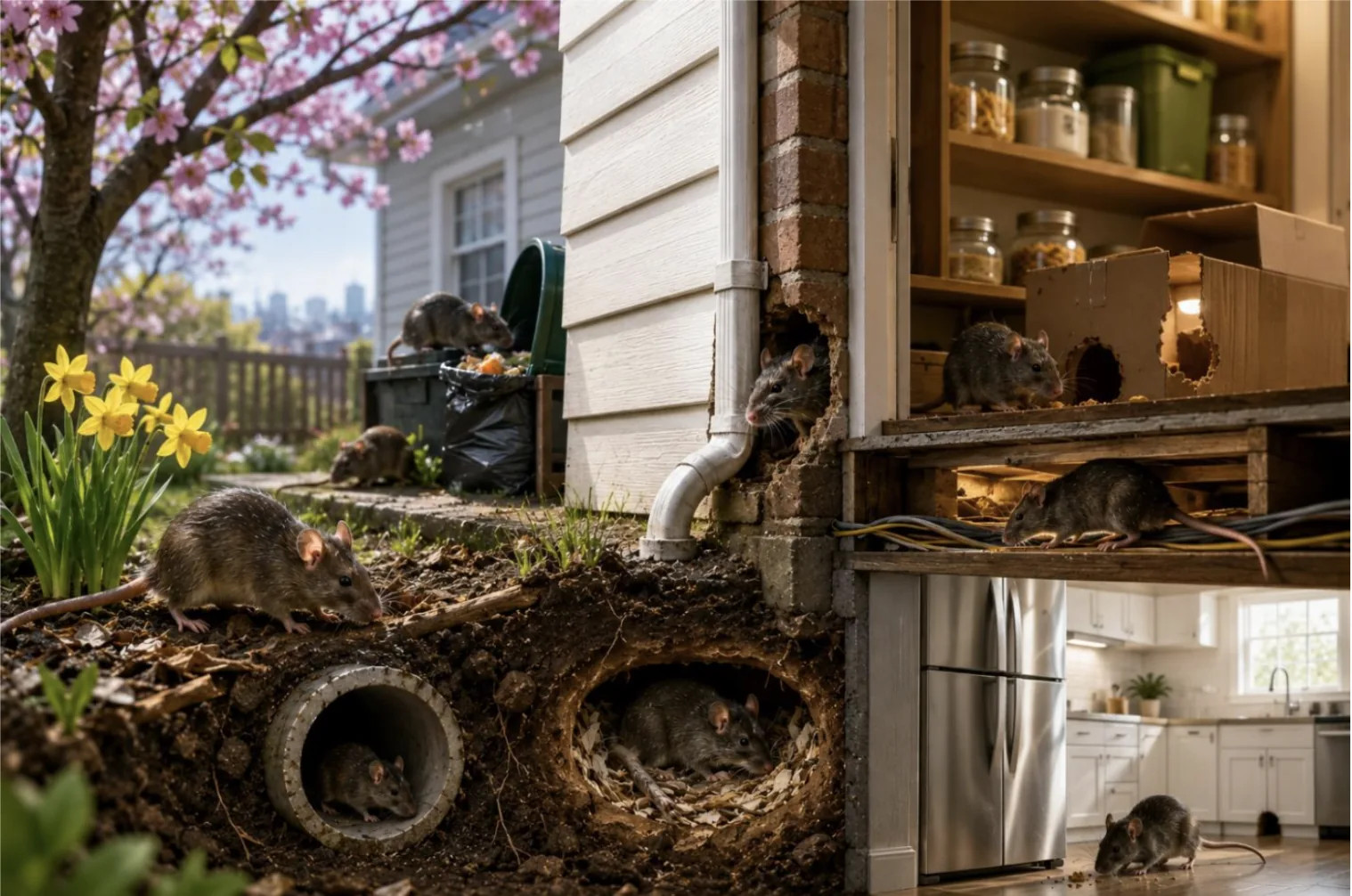
As winter gives way to warmer spring weather, nature becomes more active. Plants grow, insects become more noticeable, and animals begin changing their seasonal behaviour.
Rodents are no exception. Rats and mice do not simply disappear during winter. Many remain active in protected locations such as buildings, burrows, drainage systems, storage areas, false ceilings and other sheltered environments. As temperatures become warmer, their activity patterns can change — rodents may travel more frequently in search of food, water, nesting sites and new territory.
For homeowners and businesses, this can mean an increase in visible signs such as droppings, gnaw marks, scratching noises and actual rodent sightings. Spring is therefore an excellent time to inspect your property and correct the conditions that may have allowed rodents to survive unnoticed during cooler months.
Where Do Rodents Spend The Winter?
Unlike animals that undergo true seasonal hibernation, common pest rodents such as rats and house mice can remain active throughout winter. When outdoor conditions are less favourable, they may use protected locations such as wall voids, false ceilings, roof spaces, storage rooms, basements, garages, warehouses, drains, burrows, garbage areas and utility shafts.
Homes and commercial buildings can be particularly attractive because they provide shelter, food, water and stable temperatures together. Once rodents establish themselves indoors, they may remain there even after outdoor temperatures become warmer.
Do Rats And Mice Hibernate?
No. Common pest rodents such as rats and house mice do not normally hibernate through winter. They continue to search for food, maintain nests, move through harbourages, reproduce when conditions permit, and explore their environment.
Cold weather may influence their movement and shelter choices, but it does not automatically eliminate rodent populations. This is why a rodent problem discovered in spring may actually have begun months earlier.
Why Does Rodent Activity Change In Spring?
Spring can bring changes in temperature, vegetation, food availability, water availability, nesting opportunities and outdoor activity. These environmental changes may encourage rodents to explore wider areas: winter shelter gives way to warmer conditions, which leads to increased exploration, new food sources and new nesting sites.
As rodents move, homeowners may begin noticing signs that were previously hidden.
Spring Doesn't Necessarily Mean Rodents Leave Your Home
A common assumption is: "It is warmer outside now, so the rats will leave." Unfortunately, rodents have little reason to abandon a safe location if it continues to provide everything they need.
A kitchen, storage room or false ceiling may still offer food, water, shelter and protection. If rodents have established themselves inside a building, warmer outdoor temperatures alone are unlikely to solve the problem — professional control and structural proofing may still be necessary.
Spring Breeding Can Increase Rodent Pressure
Rodents are capable of reproducing rapidly under favourable conditions. Spring may provide increased access to food, vegetation and protected nesting opportunities in some environments. An unnoticed population can therefore become a larger problem if conditions remain suitable.
This makes early detection important. The best time to deal with a rodent infestation is before the population grows and spreads into additional areas.
Heard scratching in the ceiling over winter? Get a free inspection before spring breeding adds to the problem.
Book Free Inspection Call NowSigns Of Rodent Activity In Spring
Look for the following warning signs.
- Fresh droppings: check kitchens, storage rooms, utility areas, along walls, behind appliances and inside cabinets — fresh evidence may indicate current activity.
- Gnaw marks: rodents need to gnaw regularly, so look for damage to food packaging, cardboard, plastic, wood, insulation and electrical cables. Fresh gnaw marks deserve immediate attention.
- Scratching sounds: rodents moving through walls, false ceilings, roof spaces and cabinets may produce scratching or running sounds, often easiest to hear at night when the property is quiet.
- Grease or rub marks: repeated movement along the same pathway can sometimes leave dark marks along walls or structural surfaces.
- Nesting materials: look for shredded paper, cardboard, fabric or insulation — rodents may collect soft materials to create nests.
- Actual sightings: seeing a rat or mouse is the clearest sign. Repeated sightings suggest the property should be inspected.
See our full guide on signs of rodent infestation for detail on each of these.
Why Rodents Start Exploring New Areas
Rodent populations cannot remain concentrated indefinitely. Competition for food, shelter, nesting sites and territory can encourage animals to explore surrounding areas. This means a rodent population in one building, drain, garbage area or vacant property can potentially create pressure on nearby properties.
Rodent control should therefore consider the surrounding environment — not only the room where the animal was seen.
Spring Cleaning Can Reveal Hidden Rodent Activity
Spring cleaning can sometimes uncover evidence that remained hidden throughout winter. Moving storage boxes, furniture, appliances and old cardboard may reveal droppings, nesting material, damaged packaging or gnaw marks.
This is actually useful information. Instead of simply cleaning everything away, note where the evidence was found — the location can help a pest-control professional identify movement routes and harbourages.
Check Behind Kitchen Appliances
Kitchens remain one of the most important rodent inspection areas. Check accessible areas around refrigerators, dishwashers, cabinets, ovens and sinks — rodents may find food residue, warmth and protected spaces around appliances. If you notice droppings or gnawing around electrical equipment, arrange appropriate professional inspection.
Inspect The Pantry
Spring is a good time to inspect stored foods. Check packages containing rice, flour, cereals, pulses, nuts, biscuits and pet food, looking for holes, gnaw marks, spillage or droppings. Discard food that has been contaminated by rodents, and store susceptible foods in secure containers where practical.
Inspect Your False Ceiling
If you heard scratching noises during winter, don't assume the problem has disappeared simply because the noise stopped — rodents may still be using the ceiling space. Look for evidence around accessible ceiling openings, utility shafts, AC lines and cable routes. Do not enter unsafe ceiling spaces yourself; professional inspection may be required.
Check For Electrical Damage
Rodent gnawing can damage electrical wiring. During spring inspections, look for signs such as damaged insulation, gnawed cables, exposed wiring or unexplained electrical problems. If electrical damage is suspected, use a qualified electrical professional; pest management should then address the rodent activity responsible for the damage.
Found droppings or gnaw marks while spring cleaning? Let our technicians trace where they're coming from.
Book Free Inspection WhatsApp UsSpring Is An Excellent Time For Rodent Proofing
Once active rodent routes have been identified and existing animals are appropriately controlled, structural proofing becomes essential. Inspect door gaps, plumbing openings, utility penetrations, ventilation openings, roofline gaps and damaged walls. The goal is simple: stop new rodents from entering — see our detailed guide on rodent exclusion for material recommendations by location.
Inspect Doors
Check gaps underneath main doors, utility doors, garage doors, service entrances and commercial kitchen doors. Properly fitted rodent-resistant door sweeps can help reduce access.
Inspect Plumbing Openings
Look underneath kitchen and bathroom sinks. Pipes often pass through holes that are considerably larger than the pipe itself, and these openings can potentially become rodent pathways. Appropriate proofing can reduce access.
Inspect Utility Penetrations
Modern buildings contain many service lines. Check around electrical cables, internet cables, AC pipes, gas lines, drainage and water pipes. Even relatively small structural openings can matter.
How Small A Gap Can A Rodent Use?
House mice can exploit openings around approximately 6 mm (¼ inch) under suitable conditions — roughly the width of a pencil. Rodent inspection should therefore not focus only on large holes; small gaps can be important.
Rats need more space than mice but can still exploit surprisingly small openings — young rats may use gaps of approximately 12–13 mm (½ inch) in some circumstances, and can also climb, dig and gnaw. A complete rodent-proofing inspection should therefore consider multiple access routes. See our full guide on how small a hole a rodent can squeeze through for exact gap sizes to check.
Spring Vegetation Can Create New Rodent Routes
As vegetation grows, plants may begin touching walls, roofs, balconies and windows, and climbing rodents may use vegetation as a pathway. Trim excessive vegetation where appropriate, particularly branches providing direct access to structures — see our detailed guide on landscaping for rodent prevention for a plant-by-plant breakdown.
Inspect The Garden
Spring gardens can provide food, shelter, water and vegetation. Check for burrows, rodent pathways, fallen fruit, garbage, pet food, standing water and dense vegetation. Keeping outdoor areas maintained reduces conditions that support rodents.
Check Garbage Areas
Rodents are opportunistic feeders, and garbage areas can become reliable food sources. Make sure bins are appropriately covered, food waste isn't left exposed, spilled waste is cleaned, garbage rooms are maintained and outdoor waste does not accumulate.
For apartments and commercial properties, waste-management areas should be included in regular pest inspections — see our detailed guide on rodent control for apartment garbage areas for a room-by-room checklist.
Spring Rodent Activity By Property Type
Apartments
Apartment buildings can experience rodent movement through shared infrastructure — basements, garbage rooms, utility shafts, service ducts, plumbing and false ceilings. If several residents report rodent activity, individual flat treatments may not address the complete problem; a building-wide inspection can help identify the source.
Villas And Independent Houses
Independent properties may face increased rodent pressure from surrounding outdoor environments. Inspect the garden, compound wall, drain, garbage area, utility room, roof and kitchen in sequence. Rodent control works best when the exterior and interior are considered together.
Restaurants
Restaurants remain attractive to rodents throughout the year. Spring inspections should focus on food storage, garbage areas, delivery zones, drains, door gaps, kitchens, storage rooms and false ceilings. Rodent management in food businesses should be preventive rather than waiting for visible sightings.
Warehouses
Spring inspections are also important for warehouses — check around pallets, cardboard storage, loading bays, doors, stored food and utility areas. Large storage environments can allow rodent populations to remain unnoticed for extended periods, so regular monitoring is essential.
Don't Rely Only On Rodent Poison
Rodent management should not mean simply placing poison whenever a rat is seen. A complete program considers food, water, shelter, entry points and population together. Professional methods may include monitoring, trapping, secured bait stations where appropriate, sanitation, structural proofing and follow-up inspections.
Rodenticides require careful placement because they can present risks to children, pets and non-target animals if improperly used — see our guide on the dangers of secondary rodenticide poisoning.
Spring Rodent Control Should Follow An IPM Approach
Integrated Pest Management (IPM) combines multiple strategies for rodents:
- Inspect — locate activity.
- Identify — determine which rodent is present.
- Remove food — improve sanitation and storage.
- Reduce shelter — manage clutter.
- Control — use appropriate rodent-management methods.
- Exclude — seal suitable entry points.
- Monitor — check for continuing activity.
The goal is not simply to kill rodents — it is to make the property less suitable for rodents. See our guide on sanitation and rodent control for more on removing food and water sources.
Spring Rodent Inspection Checklist
Use this checklist around your property.
Kitchen
- ☐ Check behind appliances
- ☐ Inspect food packages
- ☐ Clean crumbs
- ☐ Secure pet food
- ☐ Inspect under the sink
Storage
- ☐ Reduce cardboard clutter
- ☐ Look for droppings
- ☐ Check for nesting material
- ☐ Inspect along walls
Building
- ☐ Check door gaps
- ☐ Inspect pipe openings
- ☐ Check utility penetrations
- ☐ Inspect roof areas
- ☐ Look for wall damage
Outdoors
- ☐ Trim vegetation
- ☐ Check for burrows
- ☐ Remove fallen food
- ☐ Manage garbage
- ☐ Inspect drains
Monitoring
- ☐ Listen for scratching
- ☐ Look for fresh droppings
- ☐ Check for new gnaw marks
- ☐ Record rodent sightings
Professional Rodent Control In Bangalore
Standard Pest Control provides professional rodent control services in Bangalore for residential and commercial properties, suitable for apartments, villas, independent houses, restaurants, hotels, hospitals, offices, warehouses, factories and commercial kitchens.
Our rodent-management approach focuses on inspection, identification, control, proofing and monitoring. The objective is not simply to remove the rat or mouse that has been seen — it is to understand where it came from, where it is hiding, what is supporting it, and how future entry can be reduced.
Frequently Asked Questions
Are rats and mice more active in spring?
Rodent behaviour can change as environmental conditions become warmer and food, water and vegetation patterns change. This may make rodent movement or signs of activity more noticeable in some properties.
Do rats hibernate during winter?
No. Common pest rats remain active throughout winter, although their shelter and movement patterns can change according to environmental conditions.
Do mice leave houses when spring arrives?
Not necessarily. If a home continues providing food, water and safe harbourage, mice may remain indoors even when outdoor conditions become warmer.
Why am I suddenly seeing mice in spring?
Increased movement, exploration, breeding conditions or disturbance of existing harbourages may make rodents more noticeable. The infestation itself may have been present earlier.
Can spring cleaning reveal a rodent infestation?
Yes. Moving boxes, furniture and stored materials can expose droppings, nests, gnaw marks and damaged food packages.
Should I seal rodent holes during spring?
Rodent proofing is strongly recommended, but active infestations should first be assessed so rodents are not accidentally trapped inside structural spaces.
What attracts rats to a garden?
Food waste, garbage, fallen fruit, pet food, dense vegetation, water and protected nesting areas can all contribute to rodent activity.
How can I prevent spring rodent problems?
Secure food, manage garbage, reduce clutter, trim vegetation, repair structural gaps, inspect plumbing and utility openings and monitor regularly for rodent evidence.
When should I call professional rodent control?
Professional inspection is appropriate when you repeatedly see rodents, discover fresh droppings, hear scratching in ceilings or walls, find gnaw damage or continue experiencing activity after basic preventive measures.
Final Takeaway: Spring Is The Time To Find What Winter Was Hiding
Spring does not create every rodent infestation. Sometimes it simply makes an existing one easier to notice. Rats and mice may have spent cooler months protected inside walls, false ceilings, storage areas, drains and burrows. As conditions change, increased movement can reveal their presence.
That makes spring an excellent time to inspect, clean, remove food sources, find entry points, control existing rodents, proof the building and monitor. Don't wait until one mouse becomes a larger household problem or a single rat sighting becomes repeated activity — use spring as an opportunity to discover what may have been hiding all winter, and prevent it from staying for the rest of the year. For persistent rodent activity, Standard Pest Control provides pest-management services for homes and businesses across Bangalore.
Related reading: Rodents in Summer: Outdoor Activity and Breeding | Winter Rodent Invasions: Why Rats and Mice Seek Shelter Indoors | Signs of Rodent Infestation You Should Never Ignore | How Small of a Hole Can a Rodent Squeeze Through? | Rodent Exclusion: Sealing Entry Points to Keep Pests Out | Landscaping for Rodent Prevention | Sanitation and Rodent Control: Eliminating Food and Water Sources | Fall Rodent Control: Preparing Your Home for Colder Weather