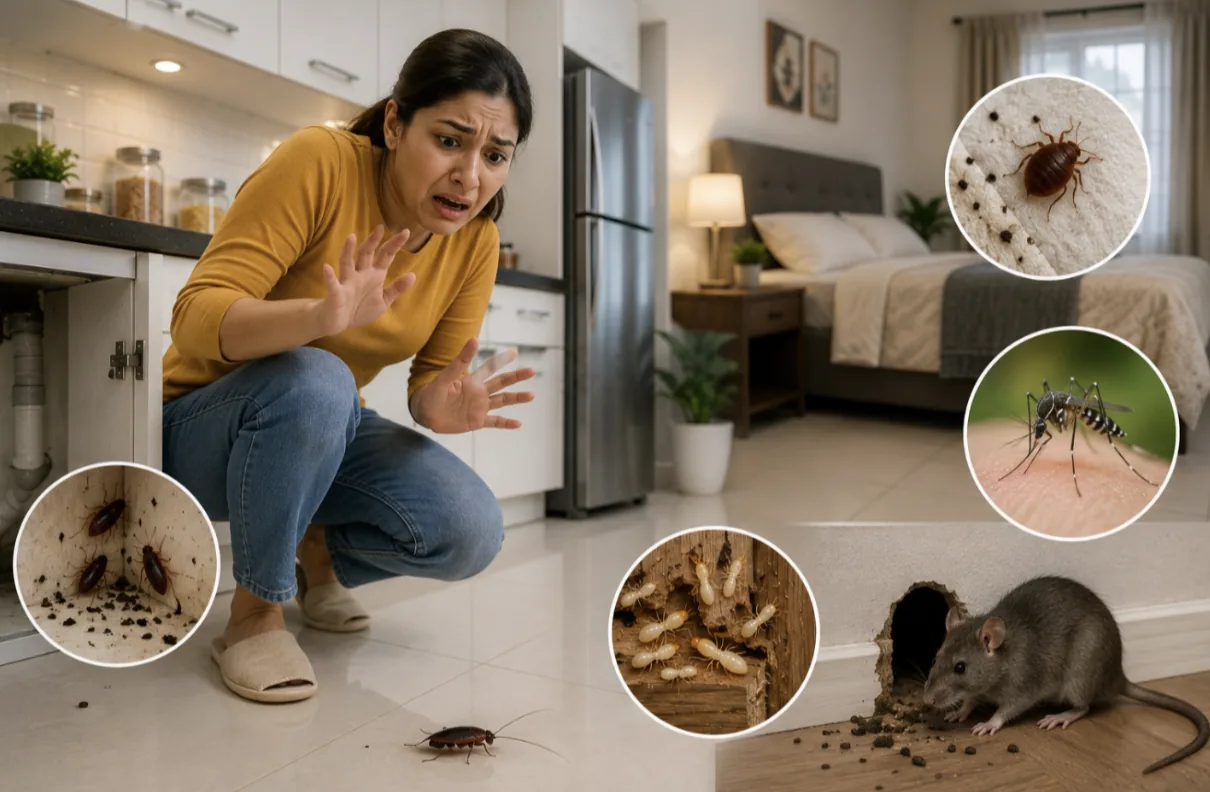
A cockroach suddenly runs across the kitchen floor. A spider appears on the bathroom wall. You hear a rat moving somewhere above the ceiling. Or you discover bed bugs near your mattress.
For many people, the reaction is immediate: fear, disgust, shock, anxiety.
Sometimes the pest is tiny and poses little immediate danger, yet our emotional reaction can be surprisingly strong. Why?
Our response to pests is influenced by a combination of biology, learned behaviour, cultural associations, previous experiences and our natural desire to keep our homes safe and clean. Understanding the psychology behind pest fear can help us respond more calmly and make better pest-management decisions.
Why Are Humans Afraid of Pests?
Fear is an important protective response. Throughout human history, quickly recognizing possible threats — from dangerous animals to contaminated food — could improve the chances of survival.
Our brains are therefore very good at noticing things that move suddenly, appear unexpectedly, have unfamiliar body shapes, may bite or sting, are associated with disease, or enter our personal space. Many common pests have several of these characteristics.
A cockroach running unexpectedly from underneath a refrigerator can therefore trigger an immediate reaction before we have time to think logically about what we are seeing.
Fear and Disgust Are Different
Fear and disgust often occur together, but they serve somewhat different purposes. Fear is generally connected with avoiding potential danger. Disgust is strongly associated with avoiding contamination.
This helps explain why people may react differently to different pests. A person may fear a wasp because it could sting. But they may feel intense disgust toward a cockroach because they associate it with:
Both reactions encourage avoidance.
Why Cockroaches Create Such Strong Disgust
Cockroaches are among the pests that frequently generate strong emotional reactions. They move quickly, hide in dark places, appear unexpectedly, can occur around drains and waste, may contaminate food-contact environments, can reproduce indoors, and often become active at night.
Imagine opening a kitchen cabinet and seeing a cockroach run across your plates. Even after removing the insect, you may still feel uncomfortable using those utensils. The emotional response is not only "There was a cockroach." It becomes:
"What else did that cockroach touch?"
That is the psychology of contamination — see our related look at the psychological impact of cockroaches for more.
Why Rats Trigger Fear
Rodents create a somewhat different psychological reaction. People may worry about bites, disease, food contamination, property damage, and unexpected movement.
But one particularly disturbing element is often sound. Hearing scratching above a false ceiling at night can create anxiety because you know something is there but cannot see it. The uncertainty makes the situation feel more threatening. Every small noise may suddenly become "Is that the rat?"
Hearing scratching or seeing unexplained activity? Get a free inspection and put the uncertainty to rest.
Book Free Inspection Call NowWhy Bed Bugs Can Cause Significant Stress
Bed bugs can have a particularly strong psychological impact because they invade one of our most personal environments: the bed. Your bed is supposed to represent rest, comfort and safety.
Finding insects that feed while people sleep can disrupt that sense of security. People dealing with bed bug infestations may become highly alert to small marks on bedding, itching, movement, spots on mattresses, and sensations on the skin.
Even after treatment, some people may continue checking their bed frequently until confidence gradually returns.
Why Termites Create a Different Kind of Anxiety
Termites usually don't trigger the same immediate disgust as cockroaches. Instead, they can create financial and property-related anxiety. The fear is: "How much damage is happening where I can't see it?"
Termites can remain concealed within soil-connected pathways, structural areas and timber. When homeowners discover mud tubes or damaged wood, uncertainty about the extent of hidden activity can create considerable concern.
Mosquitoes: Small Pest, Serious Perception
Mosquitoes produce another type of psychological response. The irritation of buzzing near your ear at night can be enough to disturb sleep.
But mosquitoes are also associated with diseases such as dengue and malaria in many parts of the world. This means even a few mosquitoes may create concern — particularly during periods of increased mosquito-borne disease activity. The emotional response combines:
Why Sudden Movement Frightens Us
One reason insects are so effective at startling people is their movement. Cockroaches can rapidly change direction. Spiders can suddenly run across surfaces. Rodents can disappear behind furniture in seconds.
Our visual system pays attention to sudden movement because movement can indicate a potential threat. This reaction happens very quickly. That is why someone who says "I'm not afraid of cockroaches" may still jump when one suddenly runs across their foot.
Why Pests Feel Worse Inside the Home
Seeing an insect outdoors often feels very different from seeing the same insect inside your bedroom. Why? Because homes represent controlled personal spaces. We expect our homes to be safe, clean, comfortable, predictable, and private.
A pest infestation violates that expectation. Suddenly, something unwanted is sharing the space. This creates a feeling of loss of control.
The Bedroom Effect
Pests in bedrooms often create stronger reactions than pests elsewhere. A cockroach in the garden may be unpleasant. A cockroach beside the bed can feel alarming. An ant outside is normal. Ants crawling across the pillow are not.
Location changes our perception of the pest. The closer pests come to:
the stronger the emotional reaction may become.
Pests spreading closer to bedrooms or food-storage areas? Ask about our species-specific treatment plans.
Book Free Inspection WhatsApp UsThe Fear of What You Cannot See
Hidden pests can sometimes create more anxiety than visible ones. Examples include rats inside walls, termites inside timber, cockroaches behind cabinets, and bed bugs inside furniture.
People begin wondering: "How many are there?" "Where are they hiding?" "Are they spreading?" "Will they come out tonight?" Uncertainty can magnify fear.
This is one reason a professional inspection can be reassuring: it replaces uncertainty with information.
Why One Pest Can Feel Like Hundreds
After seeing one cockroach, some people begin scanning the entire room. Every dark object becomes suspicious. Every movement catches their attention. This is a form of increased vigilance — your brain has identified a possible threat and begins searching for additional evidence.
This can be useful during a genuine infestation. But it can also make a minor pest problem feel much larger than it actually is. Monitoring and inspection help replace assumptions with evidence.
Why Pest Infestations Can Cause Embarrassment
Many people associate pests with poor hygiene. As a result, discovering an infestation may create embarrassment. Homeowners may think "What will visitors think?" Restaurants may worry "What if a customer sees one?" Hotels may worry about reviews. Businesses may worry about reputation.
However, pest infestations do not automatically mean a property is dirty. Pests can enter through deliveries, luggage, plumbing, structural gaps, neighbouring properties, utility systems, and outdoor environments. Sanitation is important, but it is only one part of pest management.
Why People Delay Calling Pest Control
Interestingly, fear and embarrassment can sometimes make infestations worse. People may delay professional treatment because they hope the pest disappears, feel embarrassed, don't want to spend money, try repeated DIY treatments, or underestimate the infestation. The pattern becomes:
By the time professional help is requested, the infestation may be more established — see our guide on pest control horror stories for real examples of this pattern.
Fear Can Lead to Excessive Pesticide Use
When people panic, they sometimes assume more chemical means better pest control. That is not necessarily true. Excessive or inappropriate pesticide use can increase unnecessary exposure while failing to reach hidden harbourages.
Avoid: mixing pesticides, spraying every surface, using products beyond label directions, applying pesticides to inappropriate areas, and repeatedly treating without identifying the pest.
Good pest control is targeted, not panic-driven.
Why Professional Inspection Can Reduce Anxiety
One of the most useful parts of professional pest management is information. Instead of wondering "Where are these pests coming from?", inspection can identify pest species, harbourage locations, entry points, breeding areas, food sources, moisture sources, and infestation level.
The situation changes from an unknown threat to an identified problem with a treatment plan. That can make the infestation feel much more manageable.
Monitoring Replaces Fear With Evidence
Monitoring is another important tool. Imagine a homeowner saying "I think there are cockroaches everywhere." Monitoring may reveal that activity is actually concentrated around one kitchen appliance. That changes the treatment strategy.
Similarly, rodent monitoring can help determine movement routes. Evidence-based pest management reduces unnecessary treatment and uncertainty.
Children and Fear of Pests
Children often learn how to respond to pests partly by observing adults. If adults react with extreme panic every time an insect appears, children may begin developing similar reactions.
A calmer response can help:
Children should still be taught appropriate safety — for example, not touching unknown insects or pest-control products. The goal is awareness rather than unnecessary fear.
Pest Phobias Are Real
For some people, fear of particular animals or insects can become much more intense than ordinary discomfort. A severe phobia may lead someone to avoid particular rooms, constantly inspect their surroundings, experience panic, have difficulty sleeping, or avoid certain places entirely.
Pest-control professionals can eliminate an infestation, but they do not treat phobias. If severe fear continues after the pest problem has been resolved and significantly affects daily life, support from an appropriate healthcare or mental-health professional may be helpful.
Why Pest Control Is Also About Peace of Mind
People often think pest control is simply: technician arrives, chemical applied, pest dies. Professional pest management should be broader. It can help restore confidence in the kitchen, comfort in the bedroom, trust in the property, confidence when inviting visitors, and peace of mind for business owners.
Removing pests is important. Understanding why they appeared and preventing recurrence is equally important.
Integrated Pest Management Reduces Uncertainty
Integrated Pest Management (IPM) provides a structured approach: inspection to determine what pest is present, identification to understand its biology and behaviour, sanitation to reduce food and waste, moisture management to correct conditions that support pests, exclusion to reduce entry opportunities, targeted treatment using appropriate control methods, and monitoring to confirm whether activity is decreasing.
The process becomes:
rather than:
See our guide on the benefits of Integrated Pest Management for more.
Pest Psychology in Commercial Properties
The emotional impact of pests can be even greater for businesses. Imagine a cockroach appearing while a customer is eating. Or a rat running through a hotel corridor. Even if the actual infestation is limited, customer perception can change instantly. For businesses:
Hotels, restaurants, hospitals, schools, offices and commercial kitchens therefore benefit from preventive pest-management programs. The objective is to identify pest activity before customers see it.
Pest Fear and Social Media
Today, a single pest sighting can quickly become photo, video, social media, review. This makes preventive pest management increasingly important for commercial businesses.
One pest does not necessarily mean an entire business is unhygienic. But customers may not make that distinction. Regular inspection, monitoring and documentation help reduce this risk.
Common Pest Concerns in Bangalore
Homes and businesses in Bangalore may encounter pests including cockroaches, bed bugs, rodents, termites, mosquitoes, ants, wood borers, and flies. Dense apartment living, construction activity, food businesses, drainage systems, seasonal rainfall and urban development can all influence pest activity.
The solution should always begin with correct pest identification and inspection.
Professional Pest Control in Bangalore
Standard Pest Control provides professional pest control services in Bangalore for residential and commercial properties. Services include management of cockroaches, bed bugs, rodents, termites, mosquitoes, ants, wood borers, and general pest problems.
Services are available for apartments, independent houses, villas, restaurants, hotels, hospitals, offices, schools, factories, and commercial kitchens. Our approach focuses on:
The objective isn't simply to kill the pest you can see. It is to understand why the pest is present, where it is hiding and how to reduce the chance of recurrence.
Frequently Asked Questions
Why are humans naturally afraid of pests?
Humans are sensitive to sudden movement, possible danger and potential contamination. These responses can help us avoid threats, although the intensity varies greatly between individuals.
Why do cockroaches cause so much disgust?
Cockroaches are associated with drains, garbage, waste and food contamination. Their fast and unpredictable movement can also intensify the reaction.
Why am I scared of cockroaches even though I know they probably won't hurt me?
Emotional responses can occur faster than conscious reasoning. Sudden movement and contamination associations can trigger fear or disgust before you have time to evaluate the actual risk.
Why do bed bugs cause so much anxiety?
Bed bugs affect sleeping environments and feed on people. This can interfere with the sense that a bed is a safe and comfortable place.
Can a pest infestation cause stress?
Yes. Persistent infestations can cause frustration, embarrassment, increased vigilance, sleep disruption and stress for some people.
Does having pests mean my house is dirty?
No. Sanitation can influence many pest populations, but pests can also enter clean properties through luggage, deliveries, drains, neighbouring buildings and structural openings.
Why do I still worry about pests after treatment?
After a significant infestation, people may remain alert to signs of pests for some time. Professional monitoring can provide objective evidence that activity is decreasing.
Can pest control treat my fear of insects?
Pest control can remove or manage the environmental pest problem. It does not treat a severe phobia. Persistent fear that significantly interferes with daily life may require appropriate healthcare support.
How can I react more calmly when I see a pest?
Avoid immediately using excessive pesticides. Identify the pest where possible, note where it was seen, inspect for other signs and address the source systematically.
Final Takeaway: Understand the Pest Before You Fear It
Fear and disgust toward pests are understandable human reactions. Cockroaches can trigger contamination concerns. Rodents can create fear through unexpected movement and hidden activity. Bed bugs invade our sleeping space. Termites create anxiety about hidden property damage. Mosquitoes remind us of disease risk.
But panic rarely improves pest control. A better response is:
The more we understand pest behaviour, the less we need to rely on fear. Professional pest management replaces uncertainty with evidence and random treatment with a structured plan.
Because effective pest control isn't simply about creating a property with fewer pests. It's about helping people feel safe, comfortable and confident in their environment again.
Related reading: Pests in Pop Culture: From Movies to Literature | How Pests Inspire Science and Technology | Pest Control Horror Stories: Real-Life Infestations Gone Wrong | The Psychological Impact of Cockroaches: Fear, Disgust and Stress