Movie theaters, multiplexes, auditoriums, concert halls, convention venues and entertainment centres welcome hundreds or thousands of visitors every day. With large crowds come food, beverages, waste, spills and constant movement, creating conditions that can attract cockroaches, rodents, flies, ants and other pests.
Unlike an ordinary office, entertainment venues also contain dark auditoriums, upholstered seating, false ceilings, concession counters, kitchens, storerooms and waste-handling areas. Pest activity can therefore remain hidden until a customer sees it. One cockroach near a popcorn counter or a rodent running through an auditorium can quickly turn into a customer complaint, poor online review or social-media post.
For entertainment venues, pest management should therefore be preventive, discreet and continuous. A strong Integrated Pest Management (IPM) programme combines sanitation, monitoring, pest proofing, staff awareness and targeted treatment to manage pests without unnecessarily disrupting customers or operations. For professional commercial pest-management services in Bangalore, visit Standard Pest Control.
Why Theaters Need Specialized Pest Control
Entertainment venues have several characteristics that make pest management challenging. Hundreds of people may enter and leave within a short period. Popcorn, snacks, soft drinks, sweets and restaurant food create attractive food sources. Pests can remain hidden underneath seats and along walls in dark auditoriums. Seats contain numerous seams, joints and protected spaces. Multiplexes may operate from morning until late at night, leaving limited time for pest-control work. Large entertainment complexes may also contain several independent food outlets.
Pest management must therefore be coordinated across the entire facility.
Common Pests in Theaters and Entertainment Venues
1. Cockroaches
Cockroaches are one of the most important pest risks around concession and food-preparation areas. Common hotspots include:
- Popcorn machines
- Beverage dispensers
- Food counters
- Kitchens
- Drains
- Sinks
- Storage cabinets
- Waste areas
Warm equipment, food residues and moisture can create ideal harbourage conditions. For professional cockroach management, see Cockroach Pest Control Bangalore.
2. Rodents
Rats and mice can enter through service doors, loading areas, utility openings, drainage, false ceilings and wall gaps. Once inside, they may feed on discarded popcorn, food waste and stored products. They may also damage electrical cables, packaging, equipment and insulation. A rodent sighting inside an auditorium can create a major reputation problem. See Rodent Pest Control Bangalore.
3. Flies
Flies are commonly associated with garbage, beverage residues, food waste, dirty drains and organic material. Fly activity around food counters can negatively affect customers' perception of hygiene.
4. Ants
Sugary beverages, sweets and food crumbs can attract ants. Common locations include concession counters, auditoriums, VIP lounges, staff kitchens and restaurants. See our complete guide to ant control.
5. Bed Bugs
Although less common than cockroaches or rodents, bed bugs can potentially be transported into venues on people's clothing or belongings. The presence of upholstered seating makes early detection important. A suspected bed bug should be professionally identified rather than assumed based on a bite or customer complaint alone. See Bed Bug Control Bangalore.
Why Crowd Management Matters in Pest Control
Large visitor numbers create a constantly changing environment. Customers may drop food, spill beverages, leave waste underneath seats, carry bags and personal belongings, and move between auditoriums and food areas. Cleaning teams need to respond quickly between shows. Pest management therefore becomes closely connected to crowd turnover and housekeeping schedules.
Divide the Venue Into Pest-Risk Zones
A large entertainment venue should be divided into manageable areas.
Zone 1 – Food Concessions
Includes popcorn counters, beverage stations, kitchens and snack counters. Main risks: cockroaches, ants, flies and rodents.
Zone 2 – Auditoriums
Includes seating, floors, walls and stage areas. Main risks: rodents, ants, occasional cockroaches and potential hitchhiking pests.
Zone 3 – VIP Lounges
Food service and upholstered furniture increase pest risks.
Zone 4 – Staff Areas
Pantries and lockers can attract cockroaches and ants if food is not properly managed.
Zone 5 – Waste Areas
Main risks: rodents, flies and cockroaches.
Zone 6 – Loading & Utility Areas
These can become major rodent entry routes.
Zone 7 – External Areas
Parking, drainage and landscaping should be included in the programme.
Pest Control Should Begin Before Opening
The best time to discover a pest problem is before customers enter the building. Daily opening checks can include food counters, auditoriums, toilets, waste rooms, staff kitchens and entrances. Look for droppings, cockroach activity, dead insects, gnawing, food debris and unusual odours. Problems can then be corrected before operations begin.
Cleaning Between Shows
A small amount of popcorn under one seat may not appear serious. Multiply that by hundreds of seats and several shows every day, and the food available to pests becomes significant. Between screenings, remove food waste, collect cups, clean spills, check underneath seats, and empty bins when necessary. Cleaning should focus particularly on hidden spaces beneath and between seats.
End-of-Day Deep Cleaning
The final cleaning shift is especially important. Food should not remain overnight. At the end of operations, vacuum or sweep auditoriums, clean sticky beverage residues, empty waste bins, clean concession counters, clean food-preparation areas, inspect floor drains and remove food waste. Leaving food overnight can provide hours of uninterrupted feeding for nocturnal pests.
Cockroach Management Behind Food Equipment
Visible surfaces may look clean while cockroaches remain hidden behind equipment. Inspect motors, hinges, electrical equipment, refrigerators, popcorn machines, beverage systems and sinks. Professional treatment should focus on harbourage areas while protecting food and food-contact surfaces.
Not sure what's causing the problem? Get a professional inspection before you decide on treatment.
Book Free Inspection Call NowRodent Proofing
Rodent management should begin outside. Inspect service doors, loading bays, drainage, wall penetrations, utility lines and roof areas. Physical exclusion can reduce long-term rodent pressure.
Create a Rodent Monitoring Programme
Number and map monitoring stations, for example:
- R01 – Loading Bay
- R02 – Garbage Room
- R03 – Concession Storage
- R04 – External Boundary
- R05 – Utility Room
Record findings after each inspection. This helps identify rodent movement patterns.
Fly Management
When flies appear, find the source. Check waste bins, drainage, beverage residues, food waste and mop-cleaning areas. Simply treating adult flies without removing breeding sources is unlikely to provide long-term control.
Bed Bug Monitoring in Theater Seating
A customer reporting bites does not automatically prove bed bugs are present. Inspect the affected seating area, looking at seat seams, joints, under seats and adjacent seating. If a suspicious insect is found, collect it for professional identification where possible. Avoid indiscriminately spraying an entire auditorium based only on an unconfirmed complaint.
Waste Management
Theaters generate large amounts of popcorn containers, beverage cups, food packaging and leftover food. Use suitable covered bins and remove waste regularly. Garbage rooms should be cleaned, inspected and properly drained. Waste should not remain unnecessarily close to food-storage or preparation areas.
Staff Training
Cleaning staff, security, concession workers and maintenance teams can all contribute to early detection. Train them to recognize:
- Cockroach activity
- Rodent droppings
- Gnaw marks
- Fly breeding
- Structural gaps
- Suspicious insects around seating
This is the same principle behind our Employee Training for Pest Awareness in the Workplace programme.
Create a Pest-Sighting Register
Use a simple format of date, time, screen or area, pest, number seen and action taken. Patterns become easier to identify when sightings are documented.
Discreet Pest Control Is Important
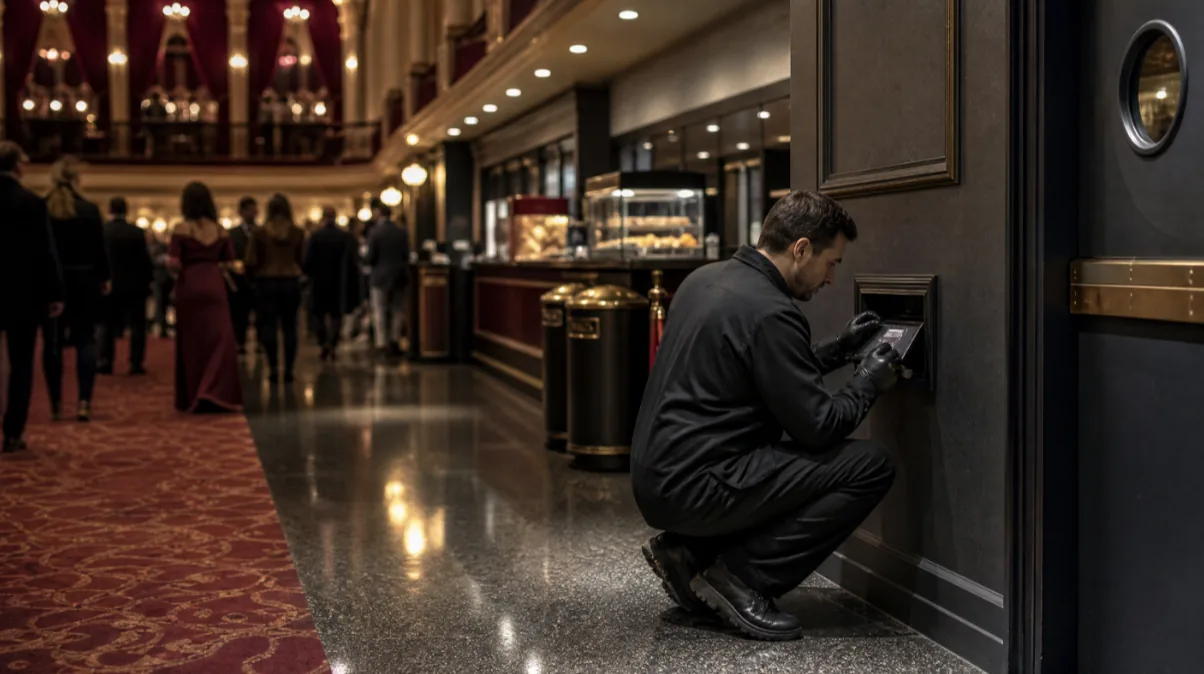
Customers should not have to watch technicians spray pesticides while waiting for a movie. Where possible, planned treatments should take place before opening, after closing, or during maintenance windows. Emergency corrective action may occasionally be required during operations, but customer safety and food protection must come first.
Avoid Routine Blanket Spraying
A theater should not automatically be sprayed from one end to the other. Use monitoring data to determine where treatment is needed. For example:
- Cockroach activity behind popcorn equipment → treat harbourage area
- Rodent activity near loading bay → inspect and proof entry point
- Flies around waste room → correct sanitation or breeding source
Targeted treatment is usually more compatible with IPM.
Food Vendor Responsibility
Every food concession should follow the venue's pest-management standards, including proper food storage, daily cleaning, waste removal, pest reporting, stock inspection and drain cleaning. One poorly managed outlet can affect the rest of the facility.
Ready to get this sorted? Ask us about a structured, documented treatment plan.
Book Free Inspection WhatsApp UsPest Control for Concert Halls and Auditoriums
Not all entertainment venues are cinemas. Concert halls and auditoriums may also experience pest activity around seating, backstage areas, dressing rooms, food service, storage and loading bays. Backstage areas should be included in regular inspections.
Pest Control for Convention and Event Centres
Large event venues may experience sudden changes in pest risk depending on the type of event. A food exhibition, for example, creates different pest pressures from a business conference. Event-specific inspections can therefore be useful.
Protecting Reputation
A pest problem in a theater can become public almost immediately. Customers can take photographs, record videos, post reviews and share complaints on social media. Preventive pest management is therefore not only about hygiene — it is also about protecting the venue's reputation and customer confidence.
Handling a Customer Pest Complaint
If a visitor reports a pest, a clear response process matters.
Step 1 – Take the Complaint Seriously
Do not dismiss it.
Step 2 – Record the Exact Location
Screen number, row and seat can be important.
Step 3 – Inspect Promptly
Check the immediate area.
Step 4 – Identify the Pest
Avoid assumptions.
Step 5 – Correct the Cause
Sanitation, proofing or treatment may be required.
Step 6 – Document the Action
Maintain a record for follow-up.
Emergency Pest Response During a Show
If a rodent or other significant pest is reported, the sequence is: Report → Verify → Protect Customers → Inspect → Correct → Document → Follow Up. Facility management should have a predefined response plan.
Pest-Control Documentation
Maintain service reports, monitoring records, pest-sighting logs, corrective-action reports, treatment records and trend reports. Documentation helps management evaluate whether the programme is improving.
Monthly Pest Trend Analysis
Review which screens have repeated activity, whether cockroaches are concentrated around one concession, whether rodent activity is increasing near the loading dock, whether fly complaints are linked to one waste area, and whether pest complaints increase after weekend crowds. This information helps convert pest control from reactive spraying into preventive management.
Integrated Pest Management for Entertainment Venues
A strong IPM programme can be summarized as: Proof → Clean → Monitor → Identify → Correct → Treat → Document → Review. This approach focuses on the reasons pests are present, the same discipline covered for other high-traffic public venues in our guide to pest control for gyms and fitness centres.
Professional Pest Control for Theaters in Bangalore
Standard Pest Control provides professional pest-management services for commercial properties in Bangalore. A customized theater or entertainment-venue programme can include:
- Pest-risk inspection
- Cockroach management
- Rodent monitoring and control
- Ant control
- Fly management
- Bed bug inspection
- Structural proofing recommendations
- Staff-awareness recommendations
- Pest monitoring
- Service documentation
- Follow-up inspections
Related Services
Frequently Asked Questions
Why do theaters attract pests?
Food crumbs, sugary drinks, waste, dark spaces, kitchens and long operating hours can provide pests with food, water and shelter.
What pests are common in movie theaters?
Cockroaches, rodents, ants and flies are common concerns. Upholstered seating may also require investigation when bed bugs are suspected.
Can bed bugs live in theater seats?
Bed bugs can potentially be transported into public spaces and may hide in upholstered furniture. However, suspected activity should be professionally confirmed before treatment.
How can theaters prevent cockroaches?
Maintain strict concession-area sanitation, clean under equipment, manage drains, remove waste and use professional monitoring and targeted treatment.
How can rats be prevented in a multiplex?
Inspect service doors, loading bays, drainage and utility openings. Combine structural proofing with sanitation and rodent monitoring.
Should pest control be performed while customers are present?
Planned pesticide treatments are generally better scheduled during suitable maintenance periods when customers are not in the treatment area. Always follow product-label and site-safety requirements.
Why is cleaning under theater seats important?
Food debris can accumulate underneath seating and provide food for cockroaches, ants and rodents.
How often should a theater receive pest control?
Frequency should be based on pest pressure, food operations, facility size and monitoring results. High-risk food areas may require more frequent inspection than low-risk locations.
Should theater staff report individual pest sightings?
Yes. Even a single sighting can provide valuable early-warning information.
What is the best pest-control approach for entertainment venues?
A customized Integrated Pest Management programme combining sanitation, proofing, monitoring, staff awareness, targeted treatments and documentation provides the strongest long-term approach.
Final Thoughts
Theaters and entertainment venues sell more than tickets. They sell an experience. Customers expect comfortable seating, clean surroundings, hygienic food and a pleasant environment. A single visible pest can damage that experience.
The most effective approach is therefore: clean continuously, inspect regularly, monitor high-risk areas, proof the building, treat targeted areas, train staff, and track trends.
When pest management works properly, customers should never need to think about it. The best theater pest-control programme happens behind the scenes, so pests never become part of the show. For professional commercial pest-management services in Bangalore, visit Standard Pest Control.
Related reading: Pest Control for Gyms and Fitness Centres: Hygiene and Health | Pest Control for Sports Facilities: Stadiums and Arenas | Employee Training for Pest Awareness in the Workplace: Building a Pest-Smart Team | Bed Bug Treatment Bangalore: Spot & Stop Infestations Fast | Choosing a Commercial Pest Control Provider: What to Look For