If you’re planning a new home or commercial project, understanding the pre construction termite treatment process can save you from huge repair costs later. This isn’t just another box to tick for approval; it’s the backbone of long-term termite prevention around your foundation.
Most issues we see in India don’t come from using the wrong termite chemicals, but from skipping small steps on site: poor soil compaction, uneven spraying, or rushing the work before a concrete pour. Once the structure is up, those mistakes are buried forever.
Why Pre-Construction Anti-Termite Treatment Matters
Termites in Indian conditions love warm, moist soil and hidden entry points, especially around the plinth and footing beams. Once they find a tiny gap under your flooring, they can move through your house for years without being noticed.
A proper anti termite process during construction creates a continuous treated zone under and around the building. Done once, in this stage, it’s far easier and more effective than drilling and injecting after the tiles and interiors are finished — which is what post-construction termite control in Bangalore usually has to do.
Stage 1: Site Preparation And Planning
The first stage starts before any chemical is sprayed. The area under the future building must be cleared of roots, old timber pieces, stumps, and construction debris, because these create hidden bridges through the treated soil. Most missed infestations start from wood left in backfill or near foundation trenches.
Good planning means the pest control team walks the site with the builder and supervisor, studies the foundation drawings, and agrees on where the treated zones will be. For larger projects, this planning should be documented as a soil treatment process checklist that the site engineer and applicators both follow.
Stage 2: Foundation Trench And Footing Treatment
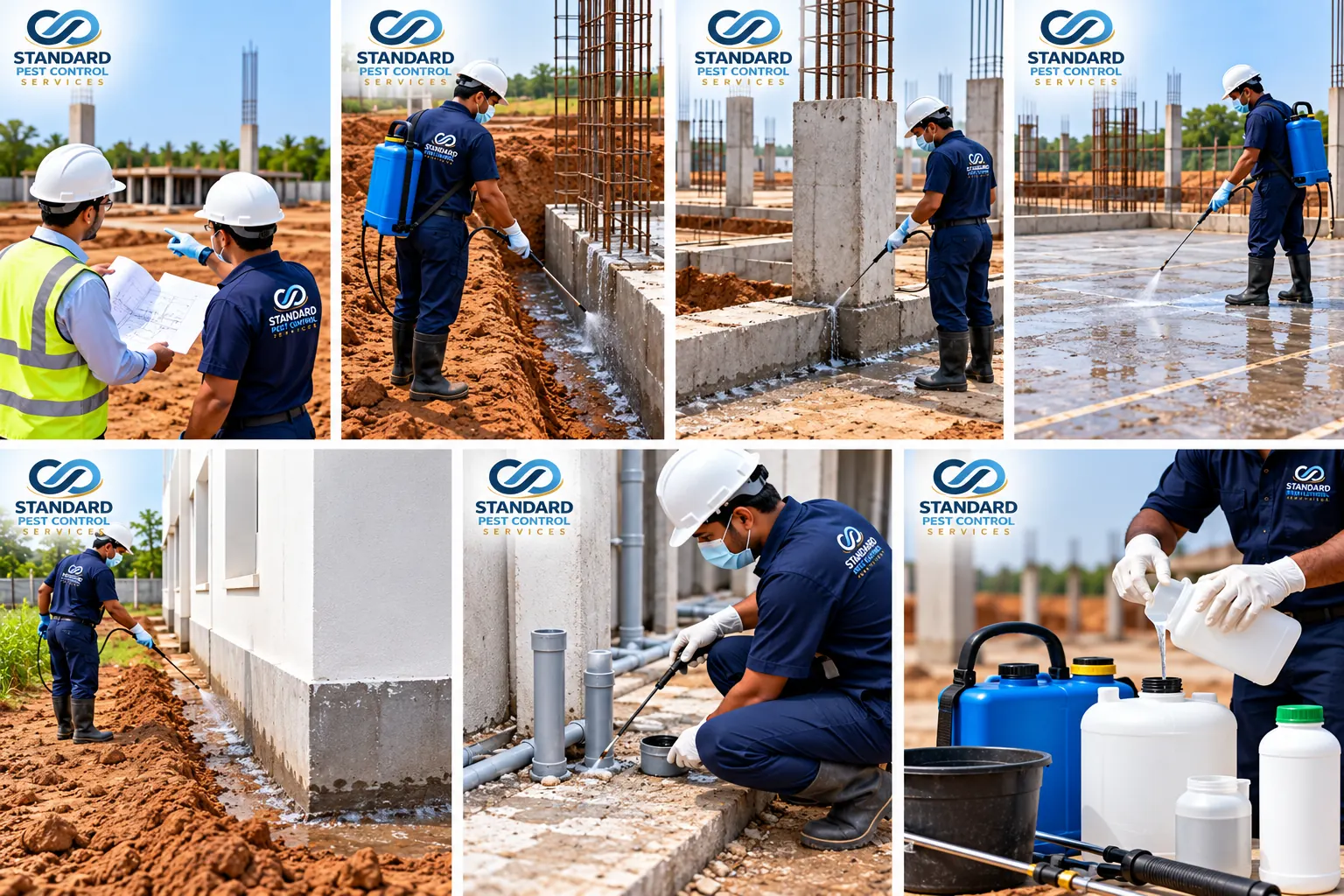
Once excavation is completed, but before steel and footing concrete are fully in place, the exposed soil in the trenches is treated. This is the heart of builder termite treatment, because it blocks termite entry right where they usually try to reach the structure.
The applicators spray the sides and bottom of trenches with the recommended dilution, keeping the nozzle close to the soil so the chemical soaks in evenly instead of drifting away in the air. In loose or sandy soil, they may need to spray slowly in two passes to avoid runoff.
Starting excavation soon? Book pre-construction anti-termite treatment that's scheduled around your foundation work.
Book Free Inspection Call NowStage 3: Treatment Around Columns, Plinth Beams And Joints
Vertical members like columns and plinth beams often become hidden highways for termites if not treated carefully before shuttering and concreting. This is where the foundation termite treatment gets more detailed than just “spray everything once and move on.”
The soil around column pits and under plinth beams is saturated up to the required depth, paying extra attention to corners and junctions. On stepped footings and complex foundations, the applicator must follow every level, not just spray the top surface.
Stage 4: Pre-Floor And Plinth Level Treatment
After plinth filling is completed and the soil is compacted, the entire area inside the future building lines is treated. This stage ties all the earlier work together into one continuous construction pest control barrier under your floors.
The applicators spray the compacted soil at the specified rate, moving methodically in lanes so no strip is missed. If there are service trenches or sunken portions for bathrooms and kitchens, these sections are treated separately and usually require extra attention, because leaks and dampness in these spots attract termites later.
Stage 5: Perimeter And External Soil Treatment
The protection isn’t complete until the outer perimeter is treated. A lot of contractors ignore this step or treat only close to the walls, but termites often travel from garden beds and boundary areas. Proper external treatment also supports long-term termite barrier performance around the plinth.
The applicators treat a band of soil all along the external foundation line, following the recommended width and depth. Care is taken near open drains, wells, or water bodies to avoid contamination, so the treatment stays effective but safe for people and the environment.
Stage 6: Special Attention To Pipes, Joints And Expansion Gaps
Termites love shortcuts. Pipes, conduits, and expansion joints often give them just that, especially if they pass through foundations without extra protection. A well-planned layout of pre construction pest control always includes these vulnerable points.
Before concreting, the soil around pipe entries and service ducts is treated more heavily, and in some projects, sleeves or collars are installed for extra defence. For expansion joints in larger buildings, the treatment usually continues as a treated band below the joint, with care taken during concreting so the barrier is not broken.
Want the treatment documented stage by stage? Our team records dilution, coverage and treated zones for every pour.
Book Free Inspection WhatsApp UsStage 7: Choosing And Applying Termiticides Correctly
The best design fails if the wrong product or dilution is used. In India, approved liquid termiticides are usually based on chemicals like chlorpyrifos, imidacloprid, fipronil, or newer low-odour formulations. These termite chemicals must be mixed exactly as per label directions, not “approximately” by the applicator. For a closer look at the products themselves, see methods and chemicals in pre-construction anti-termite treatment.
On a well-run site, the supervisor checks the mixing drums, measures water and concentrate, and confirms coverage rates in square metres per litre. Under-dosing creates weak spots; over-dosing wastes money and can raise safety concerns, especially in cramped residential plots.
On-Site Quality Control And Documentation
Good treatment is as much about discipline as it is about product choice. Many failures we investigate trace back to hurried work just before a slab pour or last-minute changes in layout. Consistent termite prevention depends on someone responsible being present on site from start to finish.
A basic record should note date, area covered, dilution used, and weather conditions. Photos before and after treatment can help later if there are disputes. For bigger projects, the pest control company often provides a diagram marking treated zones and any sections where work couldn't be completed as planned.
Common Mistakes In Pre-Construction Termite Proofing
Some mistakes repeat across projects, even with experienced builders. One of the biggest is treating only visible open areas and ignoring concealed corners under steps, ramps, or service shafts, which weakens overall termite proofing in exactly the places termites prefer.
Another problem is reworking treated soil after spraying, such as digging new pits for extra plumbing without re-treating the disturbed area. Allowing water to stagnate on freshly treated soil also dilutes the chemical and should be avoided wherever possible.
What To Expect From A Professional Service
A good vendor will walk you through their pre construction termite treatment process before starting. They should explain which termiticide they plan to use, coverage rates, safety precautions, and how long each stage will take so the work ties in smoothly with civil construction.
Clear communication between the pest control team, site engineer, and contractor reduces friction. It also avoids common conflicts, such as applicators arriving to treat when steel fixing is incomplete, or concrete trucks waiting while spraying is rushed. Both trades need a realistic schedule and someone willing to hold the line when shortcuts are suggested.
Frequently Asked Questions
What are the stages of the pre-construction termite treatment process?
There are seven key stages: site preparation and planning, foundation trench and footing treatment, treatment around columns, plinth beams and joints, pre-floor and plinth level treatment, perimeter and external soil treatment, special attention to pipes, joints and expansion gaps, and choosing and applying termiticides correctly.
Why is pre-construction treatment better than treating after the building is finished?
A proper anti-termite process during construction creates a continuous treated zone under and around the building. Done once at this stage, it is far easier and more effective than drilling and injecting after the tiles and interiors are finished.
Which chemicals are used for pre-construction anti-termite treatment in India?
Approved liquid termiticides are usually based on chemicals like chlorpyrifos, imidacloprid, fipronil, or newer low-odour formulations. They must be mixed exactly as per label directions, since under-dosing creates weak spots and over-dosing wastes money and can raise safety concerns.
What are the most common mistakes builders make?
Treating only visible open areas while ignoring concealed corners under steps, ramps or service shafts, reworking treated soil (such as digging new plumbing pits) without re-treating it, and allowing water to stagnate on freshly treated soil, which dilutes the chemical.
Why do pipes and expansion joints need extra attention?
Pipes, conduits and expansion joints give termites shortcuts through the foundation. Before concreting, the soil around pipe entries and service ducts is treated more heavily, sometimes with sleeves or collars, and expansion joints get a treated band below the joint.
What records should the pest control company keep?
A basic record should note the date, area covered, dilution used and weather conditions, ideally with before-and-after photos. On bigger projects, a diagram marking treated zones and any sections that couldn't be completed as planned is useful.
Conclusion
Handled properly, pre-construction anti-termite work is a one-time investment that protects your building when it’s hardest to reach later. Choosing a team that follows a clear pre construction termite treatment process, supervises mixing and application, and documents each stage gives you real peace of mind.
If you’re planning a project in India and don’t want to gamble with hidden termite damage, speak with a specialist such as Standard Pest Control early in your planning so treatment can be integrated with your foundation schedule from day one. Our termite control service in Bangalore covers both pre-construction soil treatment and post-construction protection.
Related reading: What Is Pre-Construction Anti-Termite Treatment and Why Is It Essential? | The Unseen Shield: Pre Construction Anti Termite Treatment | Fortifying Your Foundation: Methods and Chemicals in Pre Construction Anti Termite Treatment | Building a Termite-Proof Future: Pre Construction Treatment Stages | Why Do Termites Love Bangalore's Red Soil So Much? | Pest Control for Construction Sites: Managing Temporary Infestations | IS 6313 Guidelines for Pre-Construction Anti-Termite Treatment Explained | Best Time to Carry Out Pre-Construction Anti-Termite Treatment | 10 Common Mistakes Builders Make During Anti-Termite Treatment