Mosquito control is often treated as an individual household problem. A family may use screens, repellents, remove standing water, or arrange mosquito treatment around their property.
But mosquitoes do not respect property boundaries.
A breeding source in an empty plot, clogged drain, construction site, common garden, rooftop, or neighbouring property can affect an entire street, apartment complex, school, workplace, or residential community. That is why effective mosquito management often requires a community-wide approach.
Community-wide mosquito control combines surveillance, breeding-source reduction, larval control, targeted adult mosquito management, public education, environmental management, and ongoing monitoring. The objective is not simply to kill the mosquitoes people can see — it is to identify where mosquitoes are breeding, why populations are increasing, and what can be done collectively to reduce them.
What Is a Community-Wide Mosquito Control Program?
A community mosquito-control program is a coordinated effort to reduce mosquito breeding and mosquito populations across a larger area rather than treating one individual property. Programs may involve:
- Residential communities
- Apartment complexes
- Gated communities
- Schools
- Hospitals
- Factories
- Commercial campuses
- Hotels
- Construction sites
- Public spaces
- Local authorities
The exact approach depends on mosquito species, local conditions, disease risk, rainfall, drainage, population density, and available resources. A good program follows an Integrated Mosquito Management (IMM) approach.
Why Individual Mosquito Control Is Sometimes Not Enough
Imagine that you eliminate every container of standing water in your home. But nearby there is an uncovered water tank, a blocked drain, discarded containers, construction material holding rainwater, or water collecting in a neighbouring property. Mosquitoes emerging from these sources may still enter your property.
Community participation is therefore critical.
Building a Community Mosquito Control Program: Step by Step
Step 1: Mosquito Surveillance
Professional mosquito management should begin with understanding the problem. Surveillance may involve identifying mosquito species, locating breeding areas, monitoring larvae and adult mosquitoes, recording high-activity locations, and reviewing seasonal patterns.
Different mosquito species behave differently. Knowing which mosquitoes are present helps determine where to look for breeding sites and which control methods may be appropriate.
Step 2: Mapping Mosquito Hotspots
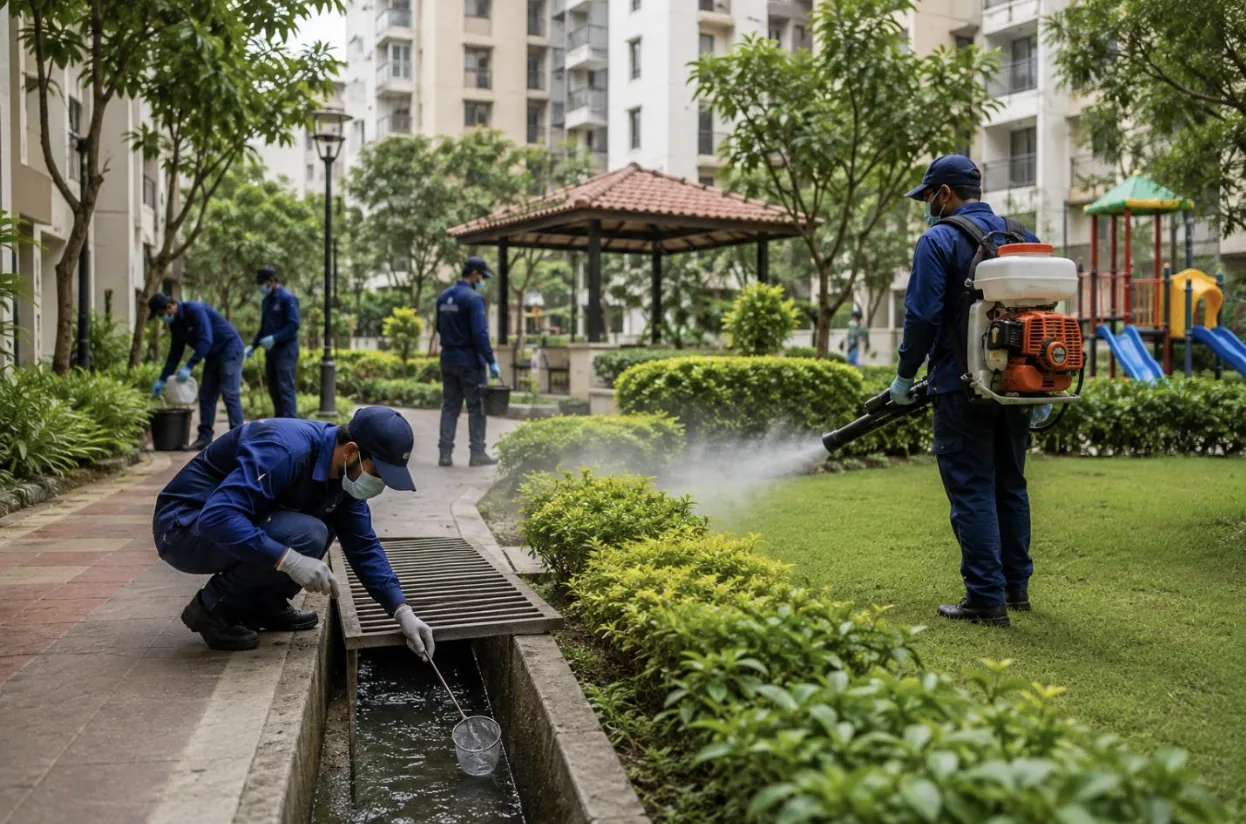
Community programs can identify locations where mosquito activity is consistently high — storm-water drains, construction areas, common gardens, rooftops, basements, utility areas, water-storage locations, garbage areas, empty plots, and parking areas.
Mapping these locations makes mosquito management more systematic. Instead of randomly spraying an entire property, control efforts can focus on the areas creating the problem.
Step 3: Breeding-Source Inspection
One of the most important components of mosquito control is finding standing water. Depending on the mosquito species, surprisingly small collections of water may support breeding. Inspection should cover buckets, flowerpot trays, discarded containers, tyres, tarpaulins, construction materials, water tanks, roof gutters, coolers, drainage channels, and decorative water features.
A mosquito-control program that ignores breeding sources may provide only temporary relief.
Step 4: Source Reduction
Source reduction means removing or modifying places where mosquitoes can breed. This is one of the most sustainable mosquito-control strategies and may include:
- Emptying water — removing unnecessary standing water
- Covering water containers — keeping tanks and stored-water containers properly covered
- Improving drainage — preventing water from remaining stagnant unnecessarily
- Removing waste — disposing of containers capable of collecting rainwater
- Maintaining gutters — clearing blocked drainage channels
- Managing landscaping — preventing irrigation and landscape features from creating persistent standing water
Step 5: Larval Mosquito Control
Some water sources cannot simply be emptied — drains, water-management structures, ponds, utility areas, and permanent water bodies, for example. Where appropriate, mosquito-control programs may use approved larval-control methods to control mosquitoes before they become flying adults.
This can be highly valuable because larvae are concentrated within water sources and cannot yet disperse through the community.
Step 6: Adult Mosquito Control
When adult mosquito populations are high or disease risk requires additional intervention, targeted adult mosquito control may be considered, depending on the program and local regulations.
Adult mosquito control should not be viewed as a replacement for breeding-source management. A program that repeatedly kills adult mosquitoes while allowing breeding to continue can become an endless cycle.
Mosquito activity across your community not going down? Get a structured inspection and treatment plan.
Book Free Inspection Call NowIs Mosquito Fogging Enough?
Fogging is one of the most visible mosquito-control activities. Because residents can see the fog, it is often assumed that fogging alone solves mosquito problems.
But fogging primarily targets adult mosquitoes present and exposed during application. It does not automatically eliminate eggs, larvae, pupae, hidden adults, or future breeding sites — which means mosquito populations may return if breeding sources remain.
Fogging can have a role within an appropriate mosquito-management program, but it should not be the entire program.
Timing of Mosquito Treatment Matters
Different mosquito species are active at different times. For example, some mosquitoes associated with dengue transmission are often active during daylight periods, while other mosquito species may be more active around evening or night.
Control activities should therefore be based on the target mosquito species, activity patterns, local conditions, weather, and treatment method. Randomly fogging at the same time every day without understanding the target mosquito may not provide the best results.
Managing Shared Spaces and Infrastructure
Step 7: Vegetation and Landscape Management
Adult mosquitoes often rest in dense vegetation, shaded areas, bushes, shrubs, and damp landscape zones. Communities should maintain landscaping appropriately — trimming excessive vegetation, removing unnecessary organic debris, preventing over-irrigation, improving airflow, and preventing persistent water accumulation.
The goal isn't to remove all greenery. It is to prevent landscaping from creating unnecessary mosquito harbourage and breeding conditions.
Step 8: Drain Management
Drains can become important mosquito-control concerns when water remains stagnant. Community management teams should inspect storm drains, basement drains, open drains, blocked channels, and utility drainage.
Drain management should focus on improving water flow and eliminating unnecessary stagnation. Simply spraying drains repeatedly without correcting blockage or standing-water problems may not provide lasting results.
Step 9: Construction-Site Mosquito Management
Construction sites can create numerous temporary water-holding environments — buckets, drums, tarpaulins, lift pits, open tanks, building materials, excavations, and discarded containers.
During rainy periods, these sites should be inspected frequently. Construction companies and property managers should include mosquito prevention in routine site-management procedures.
Mosquito Control Across Different Community Settings
Step 10: Apartment Community Mosquito Control
Large apartment complexes require coordinated mosquito management. The program should inspect both individual and common areas, with high-priority locations including basements, gardens, drains, rooftops, water tanks, utility areas, and the garbage area.
Residents also have a role. A common area may be professionally managed while a small container holding water on a private balcony continues producing mosquitoes.
Step 11: Resident Education
Community awareness is one of the most powerful mosquito-control tools. Residents should understand that mosquito breeding can occur close to where people live. A simple weekly routine can help:
Residents can check balconies, flowerpots, buckets, containers, rooftops, garden areas, and pet-water containers. Community notices and awareness campaigns can remind residents to participate.
Step 12: Protecting Schools and Childcare Facilities
Schools should regularly inspect playgrounds, gardens, roof areas, drains, water-storage areas, and discarded containers. Because children spend considerable time outdoors, mosquito prevention around schools deserves particular attention.
Any pesticide applications should be professionally planned and carried out according to product labels and applicable safety requirements.
Step 13: Mosquito Management in Hospitals
Hospitals and healthcare campuses require structured mosquito management, including regular inspection, breeding-source elimination, drain monitoring, landscaping management, larval control where appropriate, targeted adult mosquito management, and documentation.
Treatment decisions should consider patients, visitors, healthcare workers, sensitive clinical areas, and pesticide safety.
Step 14: Commercial and Industrial Mosquito Control
Factories, warehouses, offices, hotels, and large commercial campuses may contain extensive mosquito-breeding opportunities — loading zones, roofs, drains, cooling-related areas, landscaping, utility spaces, waste areas, and construction zones.
For large properties, mosquito management should be included in the overall pest-management program rather than treated as an occasional emergency.
Managing mosquitoes across an apartment, school, hospital or commercial campus? Talk to us about a coordinated program.
Book Free Inspection WhatsApp UsThe Role of Monitoring
How do you know whether a mosquito-control program is working? Monitoring. The program should evaluate breeding sites, larval activity, adult mosquito activity, resident complaints, and recurring hotspots.
If mosquito activity remains high, the program should investigate why rather than simply repeating the same treatment.
Weather Matters
Mosquito activity is strongly influenced by environmental conditions, including rainfall, temperature, humidity, and water availability. After rain, new breeding sites can appear quickly.
Communities should therefore increase inspections during periods when environmental conditions favour mosquito breeding.
Why Community Participation Matters
One untreated property can affect surrounding properties. For example:
House A: No standing water
House B: No standing water
House C: Open containers filled with rainwater
Mosquitoes emerging from House C can move into surrounding homes. Community mosquito control works best when everyone participates.
Community Mosquito-Control Checklist
Standing Water
- Buckets emptied
- Containers removed
- Flowerpot trays checked
- Water tanks covered
- Tyres inspected
Drainage
- Drains flowing
- Gutters cleared
- Blockages corrected
- Basement water checked
Landscaping
- Vegetation maintained
- Over-irrigation avoided
- Water accumulation eliminated
Buildings & Monitoring
- Rooftops inspected
- Utility areas checked
- Construction zones monitored
- Mosquito complaints recorded
- Breeding hotspots mapped
- Follow-up inspections completed
Integrated Mosquito Management: The Better Strategy
The strongest community mosquito-control programs combine several methods:
No single intervention is suitable for every mosquito problem. An integrated approach addresses mosquitoes at different stages of their life cycle.
Community Mosquito Control in Bangalore
Bangalore's climate, monsoon rainfall, construction activity, urban drainage, gardens, apartment developments, and water-storage practices can create mosquito-breeding opportunities.
Residential communities should pay particular attention to rooftops, balconies, basements, storm-water drains, gardens, construction areas, utility spaces, and water-storage areas. Mosquito management should become especially proactive before and during periods of increased rainfall, and where dengue risk is a concern, dengue mosquito prevention steps should be part of the community's routine.
Professional Mosquito Control in Bangalore
Standard Pest Control provides professional mosquito control Bangalore services for residential communities and commercial properties. Services can support apartment complexes, gated communities, residential layouts, hotels, hospitals, schools, offices, factories, commercial campuses, and construction sites.
A professional program may include site inspection, breeding-source identification, larval management where appropriate, targeted adult mosquito treatment, monitoring, and preventive recommendations.
The objective is not simply "spray mosquitoes." It is to understand why mosquitoes are present and systematically reduce the conditions supporting them.
Frequently Asked Questions
What is community-wide mosquito control?
It is a coordinated mosquito-management program covering multiple properties or shared areas, and may include surveillance, source reduction, larval control, targeted adult control, education, and monitoring.
Is mosquito fogging enough?
Fogging may reduce exposed adult mosquitoes under appropriate conditions, but it does not replace breeding-source elimination and larval management.
How often should an apartment complex be checked for mosquito breeding?
Inspection frequency should depend on weather, mosquito activity, site conditions, and local public-health guidance. During rainy periods, standing-water sources should be checked frequently.
Where do mosquitoes commonly breed around apartment complexes?
Potential locations include containers, flowerpot trays, drains, rooftops, construction areas, utility spaces, poorly maintained water features, and other locations where water remains standing.
Can mosquitoes breed in small amounts of water?
Yes. Some mosquito species can use relatively small water-holding containers, which is why small containers around homes and balconies should not be ignored.
What is larval mosquito control?
Larval control targets immature mosquitoes living in water before they develop into flying adults. Methods depend on the water source and applicable regulations.
Why do mosquitoes return after fogging?
Adult mosquitoes can re-enter the area, hidden adults may survive, and new adults can emerge from untreated breeding sites. Source reduction and larval management are therefore essential.
Who should participate in community mosquito control?
Property managers, facility teams, residents, pest-management professionals, and — where appropriate — public-health or municipal authorities all have roles.
When should professional mosquito control be considered?
Professional support is useful when mosquito activity remains high despite source reduction, breeding locations are difficult to manage, large properties require coordinated treatment, or a structured monitoring program is needed.
Final Takeaway: Mosquito Control Is a Community Responsibility
Mosquitoes do not recognize apartment walls, compound boundaries, streets, or property ownership. That means sustainable mosquito management cannot always be achieved one home at a time.
A successful community program combines finding breeding sites, removing standing water, controlling larvae, managing adult mosquitoes, educating residents, and monitoring results. Fogging may sometimes be part of the solution, but fogging alone is not a complete mosquito-management program.
When residents, property managers, pest-control professionals, and public authorities work together, mosquito breeding can be addressed at its source — helping create a safer and more comfortable environment for the entire community.
Get a free, no-obligation mosquito control assessment for your community today.
Book Free Inspection Call NowRelated reading: Best Mosquito Control Tips for Apartments | Mosquito Control Through Spraying and Fogging | Mosquito Control Bangalore: Safe Spraying & Fogging Tips | Dengue Mosquito Prevention Methods | The Benefits of Seasonal Mosquito Control Programs